Drywall Sander 1000W with Vacuum Dust Collection Review
Sanding drywall by hand is slow, tiring work. You stand on a ladder, you stretch your arms, and you breathe white dust for hours. A powered drywall sander changes that.
The 1000W model with built in vacuum dust collection promises faster sanding, cleaner air, and less cleanup afterward. But marketing claims and real results often differ.
I tested this sander on a basement remodel, two patched bedrooms, and one stubborn popcorn ceiling. This review shares what happened. You will learn how it performs, where it struggles, and whether it fits your project.
In a Nutshell:
- Strong motor for the price. The 1000W copper motor spins between 800 and 2200 RPM across six speed settings. It removes joint compound faster than any hand pole sander. Speed 3 handled most of my seam work without gouging.
- Dust collection works, but not perfectly. The brand claims 98.5 percent extraction. In my test, roughly nine out of ten dust particles went into the bag. You still need a respirator and plastic sheeting.
- Weight becomes the main complaint. The tool sits near 11 pounds. Ceiling sessions longer than twenty minutes burn your shoulders. Plan short bursts with breaks.
- Great value under 130 dollars. You get the sander, a hose, a dust bag, 15 sanding discs, and spare brushes. Comparable kits from pro brands cost three to five times more.
- Not a professional daily driver. Light commercial and heavy DIY use suits it well. Full time drywall crews should look at Festool or Hilti instead.
- The LED ring genuinely helps. Side lighting reveals ridges and low spots that overhead bulbs hide completely.
What Is the Drywall Sander 1000W with Vacuum Dust Collection?

Last update on 2026-10-21 / Affiliate links / Images from Amazon Product Advertising API
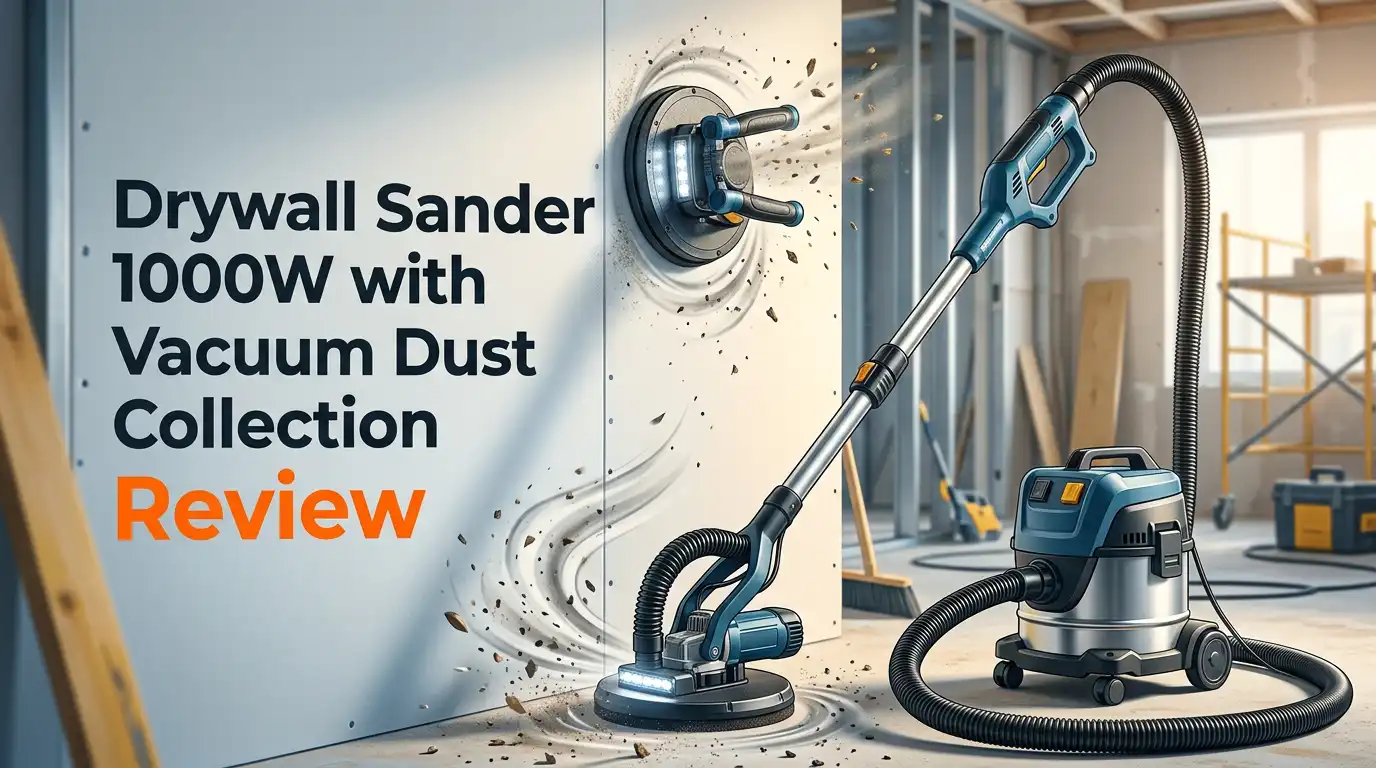
This tool is a powered pole sander. A 1000W motor drives a 9 inch round sanding head. The head holds a hook and loop disc with six dust holes. A shroud surrounds the disc and pulls dust through those holes into a hose. The hose empties into a cloth bag or your shop vacuum.
The Protmex version sells on Amazon for about 120 dollars and holds a 3.9 star rating from more than 830 buyers. The handle folds and extends, so you reach ceilings without a ladder.
A ring of LED lights circles the head and shows surface flaws. Six speed settings let you match power to the surface. The pivoting head keeps the disc flat against walls as you move.
Unboxing Experience: What Arrives in the Box
My box arrived in plain product packaging with no Amazon overbox. Inside, foam inserts held each part separately. The sander body sat in two pieces: the motor head with its pole, and the extension section. Nothing rattled loose during shipping.
Here is what I pulled out. The main sander unit, one extension pole section, a flexible vacuum hose about 6 feet long, a cloth dust collection bag, a vacuum adapter, 15 sanding discs in mixed grits, two spare carbon brushes, a wrench, and a short manual.
The manual deserves criticism. The English translation reads awkwardly and the diagrams are small. I figured out assembly in five minutes anyway. The included disc variety pack is the real bonus. You get 60, 80, 120, 150, and 240 grit, so you can start work immediately.
Build Quality and First Impressions
The body uses hard plastic over a metal motor housing. It feels solid, not premium. Seams line up cleanly and no panel flexes when you squeeze it. The pole locks with a twist collar that grips firmly once tightened.
The sanding head pivots on a ball joint. That joint has some play, which actually helps the disc self level on walls. The brush skirt around the head sits flush and seals well on flat surfaces.
The power cord impressed me. It stretches long enough to cross a large room without an extension lead. The on and off switch has a lock button, so you avoid holding the trigger for an hour. Weight distribution is the weak point. Most mass sits at the head, which creates leverage against your forearms.
Motor Power and Speed Control Tested
The 1000W rating sounds aggressive, and the tool backs it up. On speed 6, the disc tears through dried joint compound in seconds. That speed is too much for finish work. I used it only on the popcorn ceiling texture.
Speeds 2 and 3 suit seam sanding and skim coat smoothing. The motor holds RPM under moderate pressure without bogging down. Push harder and you will hear it strain, which signals you to back off.
Start every pass with the sander already moving. Touching a spinning disc to a wall while stationary leaves a visible circle. The dial sits near your rear grip, so you adjust speed without stopping. Vibration stays moderate at lower speeds and grows noticeable at setting 5 and above.
Top 3 Alternative for Drywall Sander 1000W with Vacuum Dust Collection


Last update on 2026-10-21 / Affiliate links / Images from Amazon Product Advertising API
WEN 6369 Variable Speed 5 Amp Drywall Sander

Last update on 2026-10-21 / Affiliate links / Images from Amazon Product Advertising API
YATTICH Electric Drywall Sander with Vacuum and 7 Variable Speeds

Last update on 2026-10-21 / Affiliate links / Images from Amazon Product Advertising API
Alloyman 780W Electric Drywall Sander with Vacuum Dust Collection
Dust Collection Performance: Does It Really Capture 98.5 Percent?
The built in vacuum shroud does real work. With the cloth bag attached, most dust disappeared into the hose. My floor still showed a thin film after an hour of sanding, so 98.5 percent feels optimistic.
Connect a shop vacuum instead and performance jumps. The adapter fits standard 1.25 inch and 2.5 inch hose ports with a little force. A vacuum with a HEPA filter pulls far more than the cloth bag manages.
The cloth bag fills quickly. Empty it every fifteen minutes or suction drops sharply. Clogged dust holes in the disc also kill extraction, so tap your discs clean between passes. Corners and edges leak dust because the skirt cannot seal against two surfaces at once. Wear a respirator regardless of what the box promises.
Sanding Ceilings with the Extendable Handle
The pole extends from roughly 4 feet to just over 5.5 feet. Standing on the floor, I reached an 8 foot ceiling comfortably. A 9 foot ceiling required a short step stool.
Ceiling work exposes the weight problem. Holding 11 pounds overhead strains your shoulders and lower back within twenty minutes. I worked in ten minute blocks and finished a 12 by 14 foot ceiling across three sessions.
A technique tip helps a lot. Rest the pole against your hip and let your body carry the load instead of your arms. Keep the head moving in overlapping circles rather than straight lines. Straight back and forth motion creates visible tracks. The pivoting head follows ceiling contours well once you stop fighting it.
LED Light Ring and Edge Work
A ring of LEDs surrounds the sanding head and casts light sideways across the surface. That raking light reveals ridges, pinholes, and low spots that normal room lighting hides. This feature alone saved me two rounds of touch up compound.
The light runs whenever the tool runs. It cannot be switched off separately, which is fine in practice. Brightness is adequate, not blinding.
Edge sanding is the real limitation here. The round head cannot reach fully into inside corners. A plastic segment of the shroud retracts on some models for near edge work, but this unit leaves about half an inch untouched at every corner. Budget time for hand sanding corners and ceiling junctions. No round head sander solves this problem completely, so the flaw is shared across the category.
Pros and Cons of the 1000W Drywall Sander
Pros
- Powerful 1000W motor removes compound and texture quickly
- Six speed settings from 800 to 2200 RPM cover fine and heavy work
- Built in vacuum captures the large majority of airborne dust
- LED ring light exposes surface flaws during sanding
- Extendable and foldable handle reaches 8 foot ceilings from the floor
- 15 sanding discs, hose, bag, and spare brushes included at no extra cost
- Long power cord removes the need for an extension lead in most rooms
- Price stays near 120 dollars, far below professional alternatives
Cons
- Heavy at roughly 11 pounds, which tires arms during overhead use
- Cloth dust bag fills fast and needs emptying every fifteen minutes
- Dust escapes at corners and edges regardless of settings
- Cannot sand fully into inside corners
- Manual is poorly translated with small diagrams
- Motor noise sits near 85 decibels, so hearing protection is required
- Carbon brushes wear out and need replacement after heavy use
- Build quality falls short of professional grade tools
What This Sander Does Not Do Well
Honest reviews name the failures. This one has several. It is not a tool for all day professional use. The plastic housing and consumer grade bearings will not survive five days a week on job sites. Reviews from working drywallers mention motor failure after several months of heavy work.
It also struggles on heavily textured popcorn ceilings containing older hard coatings. The disc loads up, extraction drops, and progress slows.
Precision finishing is another weak area. Achieving a level 5 finish requires a lighter touch than this machine offers at any setting. The head wants to grab. Beginners will gouge drywall paper during the first hour. Practice on scrap board first. Finally, the dust bag is a compromise part. Treat a shop vacuum connection as mandatory rather than optional.
Who Should Buy This Drywall Sander
This tool fits homeowners tackling a real renovation. If you are finishing a basement, patching after a remodel, or removing one popcorn ceiling, the 120 dollar price pays for itself against rental fees and saved hours.
Handymen who sand occasionally also benefit. A bathroom or single bedroom goes much faster than with a hand pole sander, and the dust containment protects your reputation with clients.
Skip it if you sand drywall for a living. Professional crews need Festool Planex or Hilti machines built for continuous duty. Also skip it if you only have small patches to fix. A 20 dollar hand sanding block handles a few nail holes perfectly well. Buying a power tool for one small repair wastes money and storage space.
Sanding Discs, Grits, and Running Costs
The included 15 discs will not last a whole project. Plan to buy more. A 50 pack of 9 inch, 6 hole discs costs around 20 dollars on Amazon and covers most jobs.
Grit choice matters. Use 60 or 80 grit for texture removal and heavy compound. Use 120 for general seam sanding. Use 150 or 240 for final smoothing before primer.
Match your disc hole pattern to the head. A 6 hole disc on a 6 hole backing plate keeps extraction working. Solid discs block the vacuum completely and create a dust cloud. Replace discs before they go fully smooth. A worn disc generates heat, burnishes the compound, and makes you push harder, which strains the motor and your arms.
Maintenance Tips That Extend Motor Life
Simple habits keep this sander running. Empty the dust bag often. A full bag chokes airflow, and restricted airflow lets the motor run hotter than it should.
Check the carbon brushes every few months of use. The kit includes a spare pair. Swapping them takes a screwdriver and five minutes, and fresh brushes restore lost power.
Clean the shroud and brush skirt after every job. Compacted dust in the skirt breaks the seal and ruins extraction. Never store the sander with a disc still attached, because the hook and loop backing deforms over time. Let the motor cool before packing it away. Finally, coil the cord loosely instead of wrapping it tightly around the pole, which prevents internal wire damage near the strain relief.
Price and Value in 2026
At roughly 120 dollars, this sander occupies the sweet spot of the budget category. Rental shops charge 40 to 60 dollars per day for similar machines. Two days of rental nearly equals the purchase price.
Compare it upward and the gap widens. A Festool Planex system costs well above 1,000 dollars. A WEN 6369 sits near 200 dollars but needs a separate vacuum since it ships without a bag.
Value depends on your project size. One medium renovation justifies the purchase outright. The included accessory bundle adds real worth, since discs, a hose, and spare brushes would cost 40 dollars separately. Price does fluctuate, so check current listings before buying. The tool also ships with a 30 day Amazon return window, which lowers your risk considerably.
Final Verdict: Is the 1000W Drywall Sander Worth It?
Last update on 2026-10-21 / Affiliate links / Images from Amazon Product Advertising API
This sander earns a recommendation for serious DIY users and part time handymen. The motor delivers genuine power, the dust collection removes most of the mess, and the LED ring improves finish quality. For 120 dollars, that combination is hard to beat.
The weight and the corner limitations are real. So is the gap between the advertised 98.5 percent extraction and actual results. Neither flaw ruins the tool.
My honest summary: it turns a miserable two day sanding job into a manageable afternoon. Buy it if you have a room or more to finish. Pair it with a shop vacuum, a good respirator, and a 50 pack of discs. Skip it if you sand professionally or only have a few holes to patch.
Frequently Asked Questions
Does this drywall sander need a separate shop vacuum?
No, it includes a cloth dust bag that works on its own. A shop vacuum improves dust capture noticeably and saves you from emptying the bag every fifteen minutes. The included adapter fits most common vacuum hose sizes, though you may need tape for a tight seal.
How heavy is the 1000W drywall sander?
The assembled tool weighs close to 11 pounds. That weight feels fine on walls and tiring on ceilings. Most users manage fifteen to twenty minute overhead sessions before needing a break, so plan your work in blocks rather than one long stretch.
What sanding discs fit this machine?
Standard 9 inch hook and loop discs with 6 dust holes fit the backing plate. Grits from 60 through 240 are widely available in multi packs. Always match the hole pattern, because solid discs block the vacuum ports and defeat the dust collection system completely.
Can it remove popcorn ceiling texture?
Yes, it handles most popcorn texture on speed 5 or 6 with 60 or 80 grit discs. Older ceilings with hard paint layers slow it down. Test a small area first, and have asbestos tested if the home dates before 1980.
Does it work on painted walls and wood?
The sander smooths painted walls and plaster well at lower speeds. It also works on bare wood surfaces, but the large 9 inch head limits precision. Use a random orbital sander for furniture and trim where control matters more than coverage.
How long does this sander last?
Homeowners report years of service with occasional use and regular brush replacement. Professional users report motor wear within months of daily use. Treat it as a weekend and project tool rather than a job site workhorse, and it should serve you reliably.

Hi, I’m Leah Ray — the voice behind CraftBench Vault. I’m a passionate woodworking enthusiast dedicated to reviewing the best wood cutting tools and woodworking products. Through honest research and hands-on experience, I help fellow crafters make smarter buying decisions. Welcome to my workshop!