POWERTEC 70136 Hose Cone Reducer Review 2026: Worth Buying?
Dust collection fails at the connections. Not at the collector. Not at the hose. At the spots where two different sizes meet and air leaks out.
If you own a 4 inch dust hose and a 2.5 inch shop vac hose, you already know this pain. You have probably wrapped duct tape around a joint at some point and hoped it would hold.
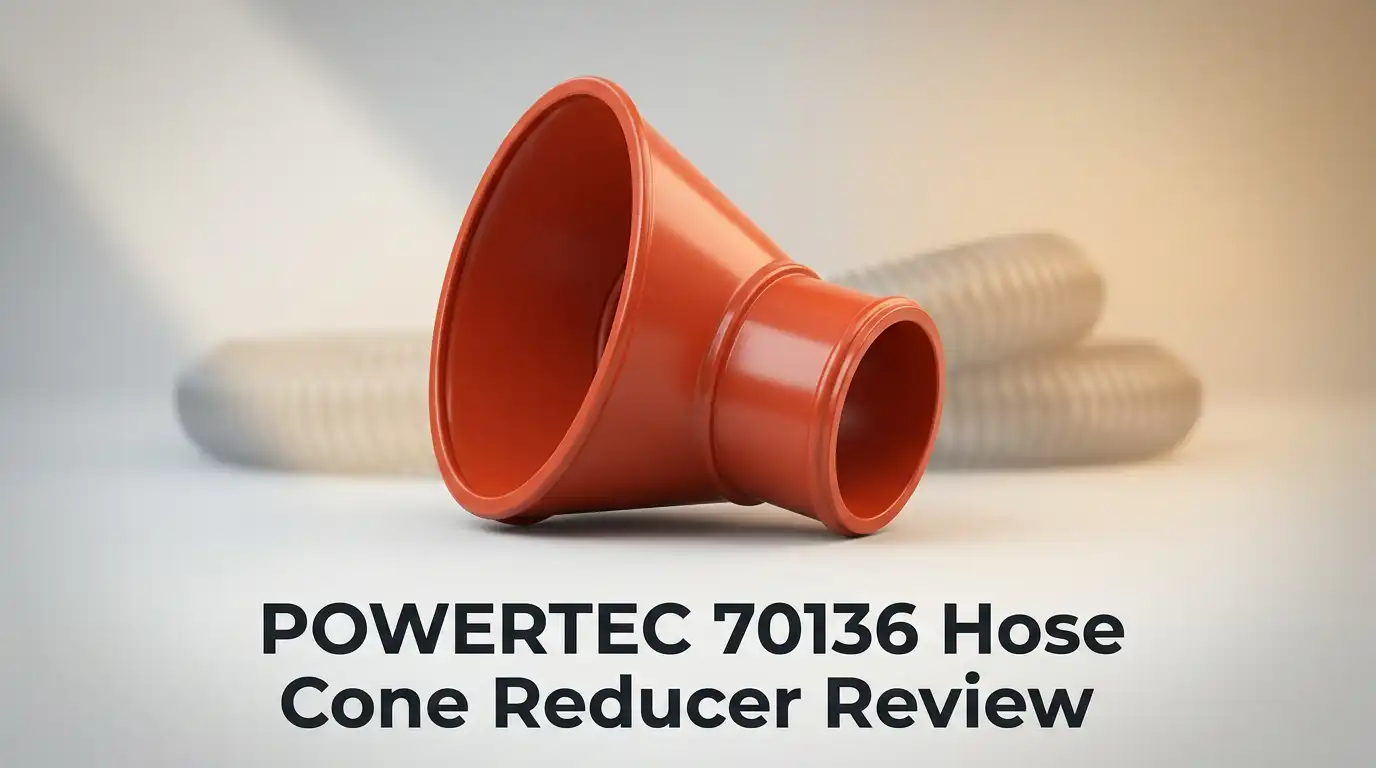
The POWERTEC 70136 Hose Cone Reducer promises to fix that gap for the price of a sandwich. It is a simple black ABS cone with a wide end and a narrow end. No clamps. No tape. No tools. Just push and go.
In a Nutshell:
- This reducer connects hose to hose, not hose to machine port. The 4 inch end slides inside a 4 inch ID dust hose. The 2.5 inch end slides inside a 2.5 inch ID hose. That is the whole job, and it does that job well.
- It will not fit over a 4 inch machine outlet. This is the single biggest source of one star and three star reviews. The large end is male, so it matches the outside diameter of most 4 inch ports instead of sliding over them.
- The ABS plastic feels genuinely solid. Heavy walled, rigid, and smooth inside. It does not flex or crack when you twist a stiff hose onto it.
- Ratings sit around 4 stars with roughly 83 percent of buyers recommending it based on nearly 150 reviews at major retailers, which is strong for a part this cheap.
- Stepping down from 4 inch to 2.5 inch costs you airflow volume. Physics, not product defect. You gain velocity at the tool and lose CFM overall.
- Buy the multi pack. One reducer always ends up glued into a setup you never want to take apart.
What Is the POWERTEC 70136 Hose Cone Reducer?


Last update on 2026-10-18 / Affiliate links / Images from Amazon Product Advertising API
The 70136 is a double sided adapter made for woodworking dust collection systems. POWERTEC designs it to step a large main line down to a smaller branch line. The wide end handles 4 inch internal diameter flexible dust hose. The narrow end handles 2.5 inch internal diameter shop vacuum hose.
The shape matters here. It is a cone, not a straight coupler. That gradual taper keeps air moving smoothly instead of slamming it into a sharp shoulder. Sharp transitions create turbulence, and turbulence drops suction at the tool.
POWERTEC builds it from ABS plastic with thick walls. The company sells it as a permanent shop fixture rather than a temporary patch. It arrives in black, measures just a few inches long, and weighs almost nothing. No clamps, screws, or gaskets come in the box. It relies entirely on friction fit against the ribbed inside of your hose.
The Unboxing Experience
Do not expect ceremony. The 70136 usually arrives in a thin plastic bag or a plain cardboard sleeve, sometimes tucked inside a larger box with other hardware. There is no retail blister pack, no instruction sheet, and no printed diagram.
You pull it out and immediately notice the weight. For a part this small, it feels dense. The plastic has a slight satin finish rather than a cheap glossy shine. The inside surface is smooth to the touch, with no flash or molding burrs around either rim.
Run your thumb around the large opening. You will feel a clean, even edge. That detail predicts how easily a hose will slide on. My first move was grabbing a tape measure, which I recommend you do too. Measure your hose before you measure your hope. Thirty seconds with a tape saves a return trip.
Build Quality and Material Honesty
ABS plastic gets a bad reputation because thin ABS cracks. This part is not thin. Squeeze the cone between your fingers and it barely deflects. Drop it on a concrete shop floor and it bounces rather than shatters.
Wood dust is abrasive. Fine maple and MDF dust moving at high velocity slowly sands the inside of any fitting. ABS resists that scouring far better than soft vinyl or thin PVC. After months of planer duty, the inside still looks clean rather than frosted.
Temperature is worth a note. ABS stiffens in cold weather. If your garage shop sits near freezing, warm the fitting in your hands before forcing a stiff hose onto it. Cold plastic plus brute force equals a split rim.
The molding tolerances deserve credit. Both ends measure consistently unit to unit, which is why the multi packs fit the same way.
Exact Dimensions That Matter Most
Numbers prevent disappointment, so here they are plainly. The 4 inch nominal end measures roughly 3.95 inches outside diameter and 3.64 inches inside diameter. The 2.5 inch nominal end measures about 2.47 inches outside diameter and 2.28 inches inside diameter.
Read those figures twice. The large end outside diameter nearly equals the outside diameter of a standard 4 inch machine port. Two pieces of identical outside diameter cannot slide into each other. That is the physical reason so many buyers report “same size, would not fit.”
POWERTEC states this clearly on the product page. Shoppers rarely read product pages. The fitting is for hoses only.
Flexible 4 inch dust hose has an inside diameter larger than its nominal size, which is exactly what allows the male cone end to seat inside it. Same logic applies at the 2.5 inch end with standard shop vac hose. Match hose to cone, never port to cone.
Top 3 Alternative for POWERTEC 70136 Hose Cone Reducer

Last update on 2026-10-18 / Affiliate links / Images from Amazon Product Advertising API
POWERTEC 70291 4 Inch Dust Port to 2.5 Inch Hose Tapered Reducer Adapter

Last update on 2026-10-18 / Affiliate links / Images from Amazon Product Advertising API
POWERTEC 70140 2.5 Inch to 1.25 Inch Hose Reducer

Last update on 2026-10-18 / Affiliate links / Images from Amazon Product Advertising API
POWERTEC 70149 4 Inch Dust Control Flex Cuff with Steel Hose Clamps
Installation and Setup Steps
Installation takes under a minute. Push the large cone end into your 4 inch hose until the ribs grip. Twist slightly as you push. The spiral wire inside flexible hose threads over the cone and locks it surprisingly tight.
Then push the 2.5 inch end into your shop vac hose the same way. Twist, seat, done.
A dab of dish soap on the cone makes stubborn hoses slide on without a fight. It evaporates and leaves no residue in the airstream.
For a permanent run, add a worm gear hose clamp over each hose end. The clamp squeezes the hose into the cone and kills small leaks you cannot see. A leak you cannot see is still a leak you can feel at the tool.
Skip silicone unless you are certain. Removing a siliconed fitting usually destroys the hose end.
Airflow Performance in Real Shop Use
Be honest about what happens when you reduce 4 inch down to 2.5 inch. You lose volume. A 4 inch line moves roughly twice the air of a 2.5 inch line at the same static pressure. Nothing can change that.
What you gain is velocity. Air speeds up as the passage narrows, which helps grab heavy chips right at the cutter. That tradeoff works well for sanders, routers, biscuit joiners, and small bandsaw ports.
It works poorly for planers and jointers. Those machines throw thick shavings that need volume, not speed. Shavings pile up at the step down and clog.
Attached to a true shop vac, this reducer performs great because the vac was never moving 4 inch volume anyway. Match the reducer to the machine, and performance complaints mostly disappear. The cone shape itself adds very little restriction compared to a blunt coupler.
Which Tools Pair Well With It
Buyers report consistent success with benchtop and hobby grade equipment. Table saws with 2.5 inch cabinet ports pair nicely when a 4 inch main line runs overhead. Random orbit sanders, trim routers, and miter saws all work with the small end.
Several woodworkers use it to connect a 4 inch collector hose to a WEN or Ridgid tool outlet, though that usually requires a hose on both sides rather than a direct port connection.
Shop vacs are the natural partner. Most Craftsman, Ridgid, and Shop Vac hoses accept the 2.5 inch end with a firm friction fit.
Outside woodworking, people use it for dryer vent transitions and pellet stove cleanup rigs. It is not certified for heating appliance use, so treat those as temporary cleanup setups rather than permanent installations.
The Biggest Complaint Buyers Report
Scan the critical reviews and one theme dominates. People expect the large end to be female. They want to slip it over a 4 inch machine outlet, and it will not go.
One buyer described matching it against a bandsaw outlet and finding identical diameters. Another spent half an hour in a hardware store hunting for a second adapter to bridge the gap. A third simply returned it.
None of these are quality failures. They are expectation failures caused by listings that do not shout the male orientation loudly enough.
The fix costs a few dollars. A 4 inch flex cuff with clamps creates the female connection, and the cone reducer plugs into it. Buy both at the same time if you are connecting to a machine port. That combination solves the problem completely and still costs less than most single fittings sold at specialty woodworking shops.
What This Reducer Does Not Do Well
Authentic reviews name weaknesses, so here are the real ones.
It does not seal airtight on its own. Friction fit leaves tiny gaps, and fine dust escapes at both joints over time. You will see a gray halo on the floor under the connection.
It does not clamp. No grooves, no threads, no retaining lip. Pull the hose sideways and the fitting can pop loose.
It does not handle planer and jointer shavings reliably. Long curls bridge across the narrowing and build a plug.
It does not swivel, so hoses twist and kink instead of rotating freely. It does not include any mounting flange for wall attachment either.
It also does not grip smooth wall PVC pipe, only ribbed flexible hose. Rigid pipe users need a different fitting entirely.
Pros and Cons
Pros
- Thick ABS construction survives shop abuse and abrasive dust better than thin plastic fittings
- Smooth internal taper reduces turbulence and keeps suction strong at the tool
- Installs in seconds with no tools, tape, or hardware required
- Consistent molding tolerances mean a tight friction fit on standard flexible hose
- Very low price, with multi packs dropping the per unit cost further
- Works in both directions, so you can step up or step down depending on your layout
Cons
- Large end is male, so it will not slide over a 4 inch machine port
- No clamps or grooves included, so connections can pull apart under tension
- Minor dust leakage at both joints without added hose clamps
- Clogs with long planer and jointer shavings
- Reduces total airflow volume, which matters for high demand machines
- Listings describe sizes vaguely, which causes frequent wrong fit returns
Price and Value in 2026
Expect to pay somewhere around ten to thirteen dollars for a single unit, with prices drifting based on seller and pack size. Three packs and four packs lower the per piece cost noticeably.
Compare that against specialty woodworking retailers charging similar money for thinner fittings, and the value looks fair. You are paying for plastic thickness and dimensional consistency, not for features.
The smarter purchase is the multi pack. Shop layouts change. You add a tool, move a bench, reroute a line. Each change eats another fitting, and ordering one at a time wastes shipping.
Pair it with a flex cuff and two hose clamps for under twenty five dollars total. That small kit solves most 4 inch to 2.5 inch connection problems in a hobby shop permanently.
Tips to Get a Better Seal
Small habits turn a loose fitting into a solid one. Add a worm gear clamp over each hose end and snug it until the hose dimples slightly. Do not crank it hard enough to crush the cone.
Warm stiff hose with a hair dryer for twenty seconds before assembly. Warm hose stretches over the cone and shrinks back tight as it cools.
Wrap a single turn of self fusing silicone tape around the joint if you want a cleaner seal without permanent glue. It peels off later with no residue.
Check connections monthly. Vibration loosens friction fits slowly. A quick push and twist restores the seal.
Finally, run a grounding wire along the hose if you move large volumes of fine dust. Plastic fittings build static charge during long sanding sessions.
Who Should Buy It
Buy the 70136 if you own both 4 inch and 2.5 inch flexible hose and need them joined. That is the use case, and it performs cleanly.
Hobby woodworkers with a small collector and a shop vac get the most value. Garage shops with benchtop tools benefit too.
Skip it if you are connecting directly to a machine outlet, unless you add a flex cuff.
Skip it for planers and jointers running heavy stock removal. Those need full 4 inch lines.
Professional shops with ducted systems should use metal fittings instead. Plastic friction fittings are not built for daily commercial cycles or long rigid duct runs.
Final Verdict
Last update on 2026-10-18 / Affiliate links / Images from Amazon Product Advertising API
The POWERTEC 70136 earns its place in a hobby shop. The plastic is thick, the taper is smart, the fit on flexible hose is tight, and the price is honest. Roughly 83 percent of buyers recommend it, and that figure holds up once you understand what the part actually does.
The negatives are real but predictable. It leaks slightly without clamps. It clogs with shavings. It will not hug a machine port. None of those surprise anyone who reads the dimensions first.
Treat it as a hose to hose connector and you will be satisfied. Treat it as a universal adapter and you will be disappointed.
Buy the multi pack, add two hose clamps, and move on to building something. Dust fittings should be boring, and this one is boring in the best way.
Frequently Asked Questions
Does the POWERTEC 70136 fit a 4 inch machine dust port?
No. The large end is male and measures close to the outside diameter of a standard 4 inch port. Both pieces are the same size, so they cannot nest. You need a 4 inch flex cuff or a tapered port adapter such as the 70291 to connect directly to a machine outlet.
Will it fit my shop vacuum hose?
Most standard 2.5 inch shop vac hoses accept the small end with a firm friction fit. Craftsman, Ridgid, and Shop Vac hoses typically work. Measure the inside diameter of your hose first and compare it against 2.47 inches.
Does reducing to 2.5 inch hurt dust collection?
It reduces total airflow volume while increasing air speed. That tradeoff helps sanders, routers, and saws. It hurts planers and jointers, which need volume to clear heavy shavings.
Do I need hose clamps with it?
Not strictly, but they help. Clamps stop the fitting from pulling loose and cut down dust leakage at both joints. Two worm gear clamps cost very little.
Can I use it in reverse to step up?
Yes. The fitting works in both directions. You can run a 2.5 inch hose into the small end and connect a 4 inch hose on the large end.
Is the plastic strong enough for daily use?
For hobby and weekend shop use, yes. The ABS is heavy walled and resists dust abrasion well. Commercial shops running ducted systems should choose metal fittings instead.
How long does it last?
Users report years of service with no cracking. The main wear points are the hose ends rather than the fitting itself.

Hi, I’m Leah Ray — the voice behind CraftBench Vault. I’m a passionate woodworking enthusiast dedicated to reviewing the best wood cutting tools and woodworking products. Through honest research and hands-on experience, I help fellow crafters make smarter buying decisions. Welcome to my workshop!