Drywall Pole Sander with Telescoping Pole Review 2026
Sanding drywall is the part of the job nobody brags about. You tape, you mud, you wait, and then you face a wall full of ridges and lap marks.
A good pole sander turns that chore into something you can finish in one afternoon. A bad one flips, gouges, and leaves you on a ladder anyway.
The HOOMESUN Drywall Pole Sander with Telescoping Pole promises a simple fix. One pole, three flip locks, a metal joint, and twenty five sheets of sandpaper in the box. No pole sections to screw together.
In a Nutshell:
- The telescoping pole is the main selling point. It adjusts from 20 to 43 inches with three quick flip locks, so you can switch from close patch work to overhead ceiling sanding in about four seconds. No tool needed, no separate pole sections to hunt for in the garage.
- The reinforced metal joint with a limit screw genuinely reduces wobble. Cheap pole sanders flip and dig a crescent into fresh mud. This one stays flatter against the surface, though it is not completely flip proof when you push too hard.
- Twenty five hook and loop sheets come included in five grits (60, 80, 180, 240, 320). That is real value. Most sanders ship with two sheets and a sales pitch for refills.
- It is light. Aluminum pole, plastic sanding plate, foam grip, and about two pounds total. Your shoulders will thank you after the second hour.
- It has no dust control at all. No vacuum port, no shroud, no bag. You will wear a respirator and you will clean for an hour afterward. This is the single biggest weakness.
- Best for homeowners and weekend finishers. Professional tapers sanding whole houses every week should look at a radial head or a powered sander instead.
Drywall Pole Sander with Telescoping Pole: What You Actually Get

Last update on 2026-10-21 / Affiliate links / Images from Amazon Product Advertising API
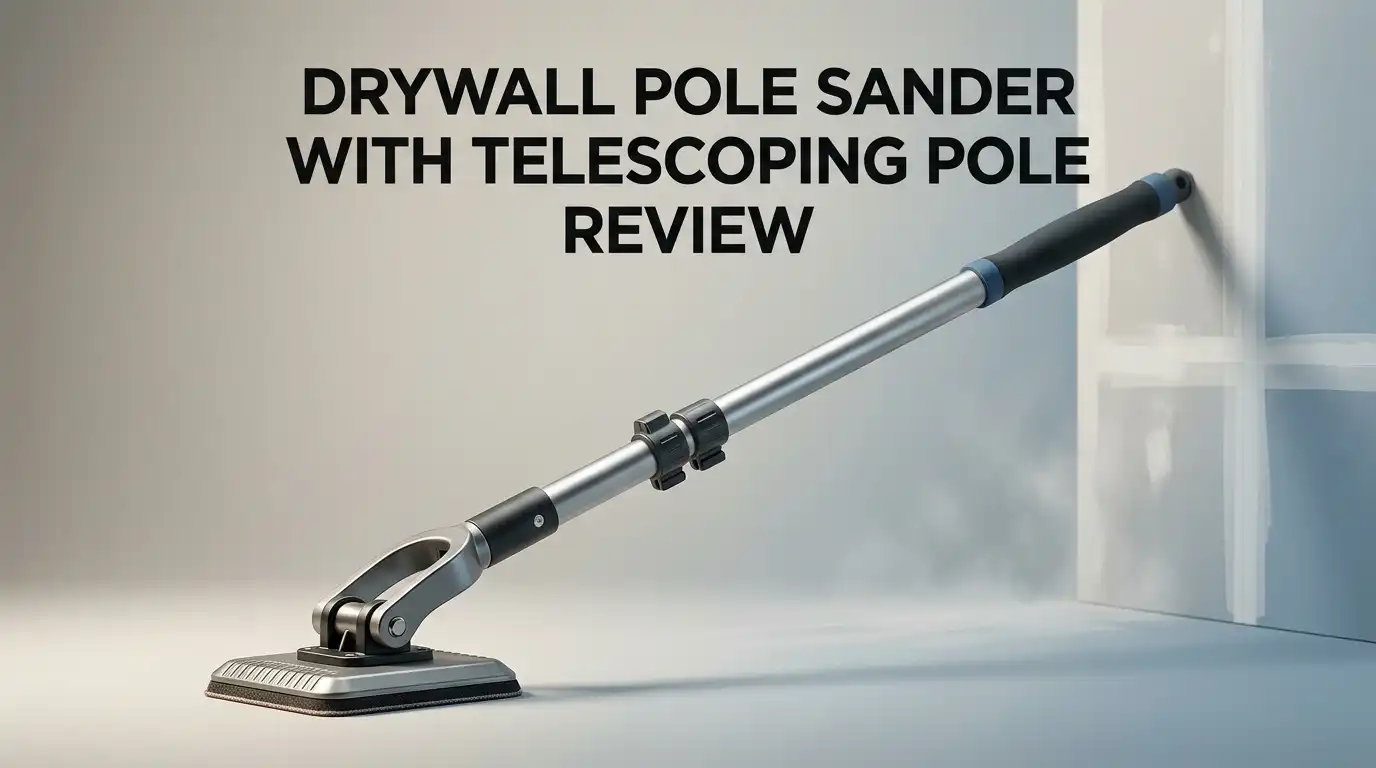
This is a manual hand sander on an extendable aluminum pole. The head measures 8.66 by 3.34 inches, which is a standard rectangular drywall sanding plate. The sheets that fit it run 11 by 3.34 inches, with the extra length folding over the end clamps.
The pole collapses to 20 inches and extends to 43 inches overall. Three flip locks along the shaft handle the adjustment. The whole package weighs roughly two pounds, which matters more than any spec sheet number once your arms are over your head.
One detail I like: the threaded end hides under a removable black sleeve. Take the sleeve off and you get a standard US thread for the included head or any broom thread accessory. Leave it on and the pole works with non threaded tools. That small touch makes the pole useful long after the sanding job ends.
Unboxing Experience: First Five Minutes
The box arrives flat and surprisingly small, about 17 inches long. Open it and you find the pole collapsed, the sanding head loose in a plastic sleeve, and the sandpaper stacked in a paper band. There is no instruction manual worth reading, just a printed card with three diagrams.
Assembly took me under two minutes. Slide the sleeve off, thread the head onto the pole, tighten the limit screw with a flathead or a coin, then press a sheet onto the hook and loop backing. That is it.
First impression was mixed. The pole feels solid and the foam grip is comfortable. The plastic sanding plate, however, feels like the cheapest part of the kit. It flexes if you squeeze it. That flex actually helps conform to walls, but it does not scream durability.
Build Quality: Where the Metal Helps and Plastic Hurts
The reinforced metal joint is the real upgrade here. Most budget pole sanders use a plastic swivel bracket that loosens after a few hours and starts rocking. The limit screw on this one lets you dial in how freely the head pivots, so you can tighten it slightly and stop the head from flopping over mid stroke.
The aluminum pole does not bend under normal pressure. I leaned on it hard against a ceiling seam and it held straight. The flip locks grip well, though the middle lock on my unit needed a half turn of tightening after the first week to stop slipping under load.
The weak link stays the plastic sanding plate. It will crack if you drop the tool onto a concrete floor or wedge the head into a corner and twist. Treat it gently and it lasts a full renovation.
Top 3 Alternative for Drywall Pole Sander with Telescoping Pole

Last update on 2026-10-21 / Affiliate links / Images from Amazon Product Advertising API
MARSHALLTOWN Radial Pole Sander, 9 Inch


Last update on 2026-10-21 / Affiliate links / Images from Amazon Product Advertising API
Hyde Tools 09165 Dustless Drywall Vacuum Hand Sander with 6 Foot Hose

Last update on 2026-10-21 / Affiliate links / Images from Amazon Product Advertising API
Pole Sander for Drywall, 86 Inch Manual Hand Drywall Sander with Extension Pole
Telescoping Pole Performance: Does 43 Inches Reach Enough?
Here is the honest math. Forty three inches of pole plus your arm reach gets most adults to a standard eight foot ceiling while standing flat on the floor. Nine foot ceilings are a stretch. Ten foot ceilings and stairwells still need a ladder or a longer pole.
The flip locks are the best part of daily use. I collapsed the pole to 20 inches for sanding around outlets and door casings, then flipped all three locks open and extended it for the ceiling line in one motion. Traditional screw together poles cannot do that without a trip to the toolbox.
What it does not do: it will not replace a true 86 inch extension pole for tall rooms. If your project is a vaulted living room, buy a longer pole sander instead and save yourself the frustration.
Sanding Sheets: Twenty Five Pieces in Five Grits
The included sheets cover 60, 80, 180, 240, and 320 grit with five of each. For drywall work, the useful grits are 180 and 220 to 240. The 60 and 80 grit sheets are aggressive enough to tear paper facing if you lean in, so save those for popcorn texture knockdown or paint stripping.
The hook and loop backing is the convenience win. Press a sheet on, sand, peel it off, slap on the next one. No wing nut clamps, no torn edges, no fiddling.
The clamps at each end still hold the overhanging sheet ends, which keeps the paper from curling. My gripe is grit distribution. Five sheets of 180 grit will not finish a full room. I burned through them in one bedroom and had to buy refills, so budget for a pack of 220 grit sheets on day one.
Real World Sanding Test: Walls, Ceilings, and Seams
I ran this sander over roughly 400 square feet of fresh joint compound. On flat walls it performed exactly as expected. The rectangular head feathered seam edges cleanly with 180 grit, and the swivel followed the surface without me fighting it.
Ceilings went slower. Gravity works against a manual sander, and you feel every pass in your shoulders. Twenty minutes of overhead work was my limit before a break.
Inside corners are the trouble spot. The rectangular head cannot reach tight into a corner without the edge digging into the adjacent wall. I switched to a sanding sponge for every corner and three way joint, which is standard practice anyway but worth knowing before you buy.
Comfort and Fatigue: The Foam Grip Matters
Two pounds sounds trivial until it is extended over your head for an hour. The soft foam grip sits at the base of the pole and gives your lower hand a comfortable anchor. It does not slide or spin, which cheap rubber sleeves often do.
My upper hand had no grip at all, just bare aluminum. After a sweaty afternoon the pole got slippery. A wrap of grip tape fixed that for two dollars, but it should have come that way.
The light weight is the real comfort feature. Compared with a cast aluminum radial sander on a wooden handle, this setup is noticeably easier to hold at full extension. For anyone with wrist or shoulder issues, lightweight beats heavy duty every time on a manual tool.
Dust Control: The Honest Problem
There is none. Zero. This sander has no vacuum port, no hose fitting, and no dust shroud. Every speck of joint compound you remove goes into the air and then onto your floors, your trim, and your lungs.
Plan accordingly. Wear an N95 or better, seal the doorway with plastic, cover the floor, and run a box fan in a window. Expect to spend nearly as long cleaning as sanding.
If dust is your main concern, a vacuum hand sander that attaches to a wet dry vac removes most airborne dust and costs about the same. That is the single biggest reason to choose a different tool. I would not buy a manual sander with no dust management for a furnished, occupied house.
What This Pole Sander Does Not Do Well
Authentic reviews name the flaws, so here they are plainly.
It does not reach high ceilings. Forty three inches tops out at standard eight foot rooms for most people. It does not control dust in any way. It does not sand inside corners without a separate sponge. The plastic sanding plate is the weakest component and will crack under abuse.
The flip locks can loosen and slip under heavy downward pressure until you snug them. The 60 and 80 grit sheets are too coarse for finish work on drywall paper and will scuff the surface if you misread the label.
Finally, it will never match a powered sander for speed. On a whole house, a manual pole sander costs you hours. This is a homeowner tool, not a production tool.
Pros and Cons
Pros
- Telescoping pole adjusts from 20 to 43 inches with three fast flip locks, no assembly required
- Reinforced metal joint with a limit screw cuts head wobble and reduces flipping
- Twenty five hook and loop sheets in five grits included, which is strong value in the box
- Light at about two pounds, with a comfortable foam lower grip
- Removable sleeve exposes a standard US thread, so the pole fits other accessories
- Hook and loop sheet changes take about three seconds
Cons
- No dust collection of any kind, so expect heavy airborne dust
- Maximum 43 inch reach falls short for nine foot and taller ceilings
- Plastic sanding plate flexes and can crack
- Rectangular head cannot sand inside corners cleanly
- Only five sheets of each grit, so refills are needed quickly
- Bare aluminum upper grip gets slippery
Who Should Buy This Pole Sander
This tool fits homeowners and weekend remodelers perfectly. If you patched a few holes, skimmed a wall, or retaped a bathroom ceiling, the telescoping pole saves you ladder trips and the included sandpaper saves you a second shopping trip.
It also suits renters and small apartment projects where storage space is tight. The pole collapses to 20 inches and slides into a closet.
Skip it if you are a professional taper. Pros sanding multiple rooms per week need a nine inch radial head for coverage, a longer pole, or a powered sander with vacuum extraction. Skip it too if you are sanding in a finished, furnished room where dust cannot be contained. The savings disappear the moment you spend a weekend cleaning drywall powder off furniture.
Price and Value in 2026
Manual pole sanders in this class sit in the forty to sixty dollar range. At that price, the twenty five sheets of sandpaper carry a lot of the value, since a pack of quality drywall sheets alone runs ten to fifteen dollars.
Compare it against a bare Marshalltown head plus a separate pole, and the math favors this kit on cost. Compare it against a vacuum sander with a hose for the same money, and the comparison gets harder. You are trading dust control for convenient reach adjustment.
My take on value: if you already own a shop vac and hate dust, spend the money elsewhere. If you want one simple tool that works out of the box with no setup and no cords, this is a fair deal.
Tips to Get a Smooth Finish
Small habits make a bigger difference than the tool itself.
Use 180 grit for the first pass and 220 to 240 grit for the finish pass. Anything coarser scuffs the paper facing and raises fuzz that shows through paint.
Let the weight of the head do the work. Pressing hard is what causes gouges and flipped heads. Long, light, overlapping strokes beat short aggressive ones.
Hold a bright work light at a low angle against the wall. Raking light reveals every ridge and hollow that straight on light hides. Mark problem spots with a pencil, not a marker.
Finally, prime before you judge your work. Primer exposes missed spots, and a quick touch up sand after priming takes five minutes.
Final Verdict: A Good Tool With One Big Gap
Last update on 2026-10-21 / Affiliate links / Images from Amazon Product Advertising API
The HOOMESUN Drywall Pole Sander with Telescoping Pole does the main job well. The flip lock pole is genuinely convenient, the metal joint reduces the flipping that ruins fresh mud, and the included sandpaper means you can start the moment the box opens.
It is not a professional tool and it does not pretend to be. The plastic plate, the 43 inch limit, and the total absence of dust control keep it in the homeowner category.
Score: 4 out of 5 for homeowners, 2.5 out of 5 for professionals. Buy it for patch work, a single room, or a paint prep weekend. Buy something with a vacuum port if dust is the dealbreaker.
FAQs
Does this pole sander work on popcorn ceilings?
Yes, with the 60 or 80 grit sheets. It knocks down texture reasonably fast. Wet the ceiling lightly first to cut dust and soften the texture. Expect an enormous mess either way, and test for asbestos in any home built before 1980 before you touch a popcorn ceiling.
Can I attach the head to my own extension pole?
In most cases yes. The sanding head uses a standard US broom thread, so it fits common painter extension poles. Thread it on and tighten the limit screw. That is a good workaround for high ceilings where 43 inches is not enough.
What grit should I use on fresh joint compound?
Start with 180 grit and finish with 220 to 240. Coarser grits tear the paper facing and leave scratches that show through paint. Save the 60 and 80 grit sheets for texture removal or old paint.
Can I connect a vacuum to this sander?
No. There is no port or hose fitting of any kind. If you want dust extraction, you need a vacuum sander designed for it, such as the Hyde dustless hand sander with a hose connection.
How long does the included sandpaper last?
Roughly one medium bedroom for the 180 grit sheets. Five sheets per grit sounds generous but disappears fast on fresh compound. Order a refill pack of 220 grit at the same time you buy the sander.
Is it better than a sanding sponge?
For large flat areas, yes, by a wide margin. The pole covers more surface per stroke and keeps your strokes flat. For inside corners and tight spots, a sponge wins every time. Most finishers use both tools on the same job.

Hi, I’m Leah Ray — the voice behind CraftBench Vault. I’m a passionate woodworking enthusiast dedicated to reviewing the best wood cutting tools and woodworking products. Through honest research and hands-on experience, I help fellow crafters make smarter buying decisions. Welcome to my workshop!