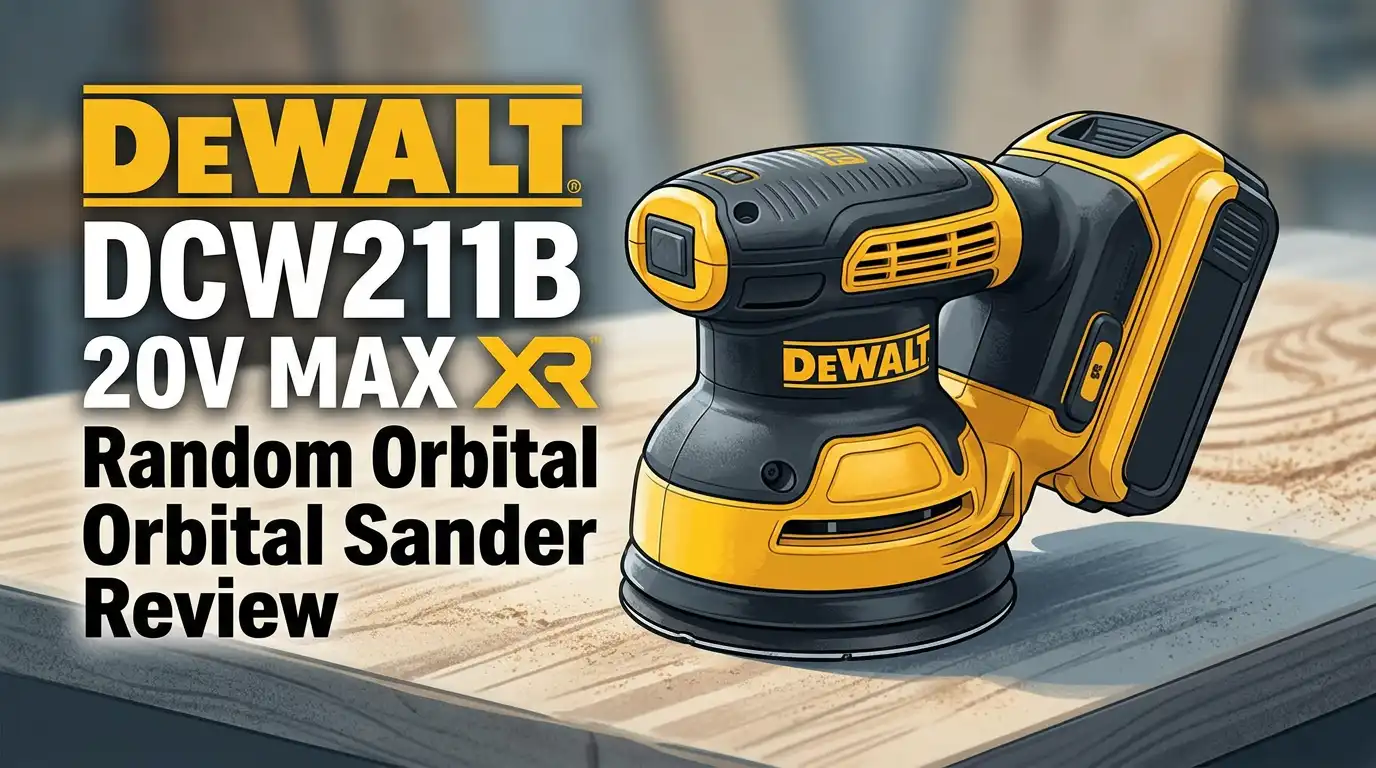
DEWALT DCW211B 20V MAX XR Random Orbital Sander Review 2026
Sanding is the job nobody brags about, yet it decides how your finish looks. A bad sander leaves swirl marks, numb hands, and dust on every surface in the room. DEWALT released the DCW211B as its newest cordless 5 inch random orbital sander, and the claims are bold.
The company says it offers the best control with the fastest material removal against leading competitors, plus up to 40% less vibration. That sounds great on a spec sheet.
The real question is how it behaves on a cabinet door at 4 PM when your arm is tired. This review covers the unboxing, the speed dial, the dust system, the runtime, and the parts DEWALT would rather you overlook. Read on before you spend $199 on a bare tool.
In a Nutshell:
- Performance: The DCW211B uses a brushless motor with a 2.6 mm random orbit action and five speed settings from 8,000 to 12,000 OPM. That orbit size sits in the sweet spot between fast cutting and a swirl free finish.
- Comfort: DEWALT advertises up to 40% less vibration than its older DCW210. The low profile body also sits closer to the work surface, so your hand stays near the panel instead of hovering above it.
- Dust control: The AirLock port pairs with DEWALT dust extractors and captures up to 95% of dust. Wireless Tool Control starts your vacuum when you squeeze the trigger.
- Runtime: DEWALT rates the tool at up to 50 square feet per charge using a 5.0Ah DCB205 battery on high speed. That covers a few cabinet doors, not a whole floor.
- Value: It sells near $199 as a bare tool, weighs 3.86 lbs, and ships with a dust bag, one 80 grit disc, and a Tool Connect chip adapter. No battery, no charger, no case.
- Verdict: A strong buy for people already invested in DEWALT 20V MAX batteries. A poor buy for anyone who wants a complete kit out of the box.
What Is the DEWALT DCW211B 20V MAX XR Random Orbital Sander?


Last update on 2026-10-19 / Affiliate links / Images from Amazon Product Advertising API
The DCW211B is a cordless 5 inch random orbit sander in DEWALT’s XR line. XR means extended runtime, and in practice it signals a brushless motor and premium internals.
The tool replaces nothing outright, but it sits above the older DCW210 in the catalog. DEWALT built it for woodworkers, remodelers, trim carpenters, and cabinet installers who sand every week rather than once a year.
The sander spins an 8 hole hook and loop pad. The 2.6 mm orbit throws the disc in a wide pattern, which removes stock quickly while hiding the scratch pattern.
You get a variable speed dial, a dust bag, an AirLock dust port, and Tool Connect chip readiness. It runs on any DEWALT 20V MAX battery you already own. That compatibility is the single biggest reason most buyers pick this model over a Makita or Milwaukee equivalent.
Unboxing the DCW211B: What Actually Arrives
The box is plain cardboard, not a molded kit case. Open the flap and you see the sander sitting in a simple tray with the yellow shroud facing up. There is no soft bag, no hard case, and no battery. DEWALT sells this as a bare tool, and the packaging matches that promise with nothing extra.
Inside you get the sander body, one dust bag, one 8 hole 80 grit sanding disc, and a DCE042 Tool Connect chip adapter. The manual sits underneath. The whole unpack takes about thirty seconds.
First impressions are good. The tool feels dense for 3.86 lbs, and the rubber overmold covers the top and the front edge. The pad brake makes a soft scrape when you spin the disc by hand, which is normal. The dust bag clips on with a quarter twist and holds firm.
Design, Size, and Build Quality
DEWALT calls this its lowest profile 5 inch random orbital sander. Height matters more than weight on a sander, because a tall tool forces your wrist up and reduces your feel for the surface. The DCW211B keeps your palm low, and that difference shows up on vertical panels and face frames.
The body measures roughly 9.5 inches long and 8 inches wide. The rubber grip wraps the top dome, so you can run it one handed or brace it with two. Battery mounting sits at the rear, which balances a 2.0Ah pack well but tips the tool slightly with a 5.0Ah pack.
Build quality feels serious. The pad is replaceable, which matters because hook and loop pads wear out long before motors do. The variable speed dial clicks into five detents instead of sliding freely, so it will not drift mid pass.
Top 3 Alternatives for DEWALT DCW211B 20V MAX XR Random Orbital Sander

Last update on 2026-10-19 / Affiliate links / Images from Amazon Product Advertising API
DEWALT 20V MAX Cordless Random Orbital Sander DCW210B

Last update on 2026-10-19 / Affiliate links / Images from Amazon Product Advertising API
Makita XOB01Z 18V LXT Lithium Ion Cordless 5 Inch Random Orbit Sander

Last update on 2026-10-19 / Affiliate links / Images from Amazon Product Advertising API
Milwaukee M18 5 Inch Random Orbit Sander 2648 20
Motor Power and Material Removal Speed
The brushless motor is the heart of this tool. Brushless designs hold speed under load better than brushed motors, and that is exactly what a sander needs. When you press down, a weak sander bogs and the pad slows. The DCW211B resists that bogging well on medium pressure.
DEWALT tested removal on pine with 80 grit at 3 kg of bias force and claims the fastest material removal against leading cordless competitors.
Those lab numbers always flatter the manufacturer, but the field results track the claim. The sander strips old polyurethane from stair treads at a pace close to a corded palm sander.
Push harder and you will lose, not win. The pad brake fights excess pressure, and the finish suffers. Let the grit cut and keep your hand light. That habit gives you both a flatter surface and longer battery life.
Variable Speed Control: Five Settings Explained
The dial sits on the rear housing near the battery. It offers five positions covering 8,000 to 12,000 OPM. That range is identical on paper to the older DCW210, but the motor control feels smoother here.
Setting one and two work for finish sanding with 180 grit and above. Slow speeds reduce heat, which keeps paint and old finish from gumming the disc. Setting three suits general smoothing on hardwood. Settings four and five handle rough stock, glue squeeze out, and coating removal.
Veneer is where the low settings earn their keep. A 5 inch sander at full speed will cut through thin veneer in seconds. Dialing down to setting two gives you time to see what is happening. The dial is reachable with your thumb mid job, so you can adjust without setting the tool down.
Vibration, Comfort, and All Day Use
Vibration is the reason people abandon sanding projects halfway. DEWALT measured vibration on a steel plate with 180 grit and 50 N of bias force, and reports up to 40% less than the DCW210. That is a meaningful jump rather than marketing noise.
In use, your fingertips stay comfortable far longer than with budget sanders. A full battery of continuous sanding leaves a mild buzz in the hand, not the numb tingling that cheaper tools cause. The counterweight is well matched to the 2.6 mm orbit, and the tool does not try to walk across the board at startup.
The low profile height helps as much as the vibration damping. Keeping your wrist flat reduces strain during long sessions. Pair it with a compact 2.0Ah battery and the whole package stays light and nimble.
Dust Collection and the AirLock System
Dust handling is a genuine strength. The sander includes an AirLock port, which twists onto compatible DEWALT dust extractor hoses without tape or adapters. With a matched extractor, DEWALT states the tool collects up to 95% of dust.
The included dust bag works far better than nothing, but it is the weak link. Expect roughly 60% to 70% capture with the bag alone, and plan to empty it often. Fine drywall dust clogs the bag fabric quickly and reduces airflow.
Wireless Tool Control is the standout feature. Pair the sander with a compatible DEWALT vacuum, pull the trigger, and the vacuum starts automatically. You stop walking back and forth to flip a switch. For anyone finishing interiors or built ins, that one feature changes the workflow more than any speed spec.
Battery Life and Real Runtime
DEWALT rates the DCW211B at up to 50 square feet per charge. That figure comes from a specific test: high speed, 80 grit, 3 kg of force on pine, using a 5.0Ah DCB205 battery. Read that carefully, because your results will differ.
A 2.0Ah compact pack gives you roughly 12 to 15 minutes of continuous sanding. A 5.0Ah pack roughly doubles that. A 9.0Ah pack runs longest but makes the tool rear heavy and awkward on vertical work.
Sanders drain batteries faster than drills. Plan on two packs minimum for any real project. The honest comparison is this: the 6 inch DCW230B covers up to 200 square feet and 41 minutes, so the 5 inch model is built for control, not coverage. If you sand large tabletops weekly, size up.
Real World Sanding: How It Performs
On a maple cabinet door, the sander moved from 120 grit to 220 grit without leaving visible swirls. The 2.6 mm orbit cuts fast enough that you can skip a grit step on mild surfaces. Keep the pad flat and move at about one inch per second.
On stair treads with old finish, setting five and 80 grit stripped the coating cleanly. The tool reached the tread nose without the body hitting the riser, which taller sanders struggle with.
On painted trim, results were mixed. Soft latex paint loads discs fast regardless of which sander you use. Dropping to setting two reduced gumming but slowed progress considerably. This is a wood sander first. It handles paint, filler, and light metal prep, but wood is where it shines brightest.
What the DCW211B Does Not Do Well
Honest reviews name the flaws, so here they are. The dust bag is mediocre. Without an extractor, you still breathe dust and still sweep afterward. Budget for a vacuum hose and AirLock connector if dust matters to you.
It is not a corner sander. A round 5 inch pad cannot reach inside a square corner, and no orbital sander can. Keep a detail sander or a sanding block nearby.
Price is the real sticking point. At around $199 bare, it costs more than many complete corded kits and more than several competing cordless bare tools. You also get no case, which feels stingy at that price. Finally, the 8 hole pad limits your disc choices slightly, and mismatched hole patterns hurt dust capture badly.
Pros and Cons of the DEWALT DCW211B
Pros
- Very low vibration compared to the older DCW210, which reduces hand fatigue during long sanding sessions.
- The lowest profile 5 inch body in DEWALT’s range gives better control on vertical panels, face frames, and tight assemblies.
- Five speed settings from 8,000 to 12,000 OPM cover rough removal and delicate finish work with one tool.
- Wireless Tool Control starts a compatible vacuum automatically, which saves real time on interior jobs.
- AirLock dust port and up to 95% dust capture with a matched extractor keep the work area cleaner.
- Replaceable pad and a 3 year limited warranty support long term ownership.
- Runs on any DEWALT 20V MAX battery you already own.
Cons
- Sold as a bare tool with no battery, no charger, and no case.
- The included dust bag captures far less than the advertised 95% figure.
- Around $199 is expensive next to corded 5 inch sanders that perform similarly.
- Only 50 square feet per charge, so heavy users need multiple packs.
- Large 9.0Ah batteries unbalance the tool on vertical surfaces.
- Cannot reach square inside corners, so you still need a detail sander.
Who Should Buy the DCW211B?
Buy this sander if you already own DEWALT 20V MAX batteries and sand regularly. Cabinet installers, trim carpenters, furniture builders, and remodelers get the most value. The cordless freedom saves setup time on punch list work, and the low vibration pays off across a full day.
Buy it if dust control matters in finished spaces. The AirLock plus Wireless Tool Control combination is genuinely better than what most competitors offer.
Skip it if you sand one project a year. A $70 corded random orbit sander will serve you fine and never need charging. Skip it also if you refinish large surfaces like floors or dining tables, because the 6 inch DCW230B covers four times the area per charge. Match the tool to the size of your typical workpiece, not to the brand loyalty.
Price and Value in 2026
The DCW211B lists near $199 as a bare tool at most retailers. Add a 5.0Ah battery and charger and you are close to $320 total. That is premium territory for a palm sander.
Value depends entirely on your existing battery collection. If you own three DEWALT packs already, the effective cost is $199 and the math looks reasonable. If you own none, a corded sander plus a shop vacuum costs less and never stops working.
Watch for kit bundles. DEWALT frequently pairs this sander with free battery promotions, and those deals change the value picture completely. Retailers also discount during spring and holiday tool sales. Patience saves real money here, since the tool rarely sells at a deep standalone discount.
Final Verdict: Is the DCW211B Worth It?
Last update on 2026-10-19 / Affiliate links / Images from Amazon Product Advertising API
The DEWALT DCW211B earns a recommendation with clear conditions. It sands fast, vibrates little, reaches tight spaces, and connects to dust extraction better than most rivals. The five speed dial adds real versatility, and the brushless motor holds speed under sensible pressure.
The flaws are real too. You pay a premium, you supply your own battery, you get no case, and the stock dust bag underdelivers. Runtime limits you to medium projects unless you carry spare packs.
Rating: 4.3 out of 5. For DEWALT battery owners doing cabinet work, trim, and furniture, this is one of the best cordless 5 inch sanders available right now. For everyone else, a corded sander still wins on price and endurance. Choose based on your batteries and your project size.
Frequently Asked Questions
Does the DCW211B come with a battery and charger?
No. The B suffix means bare tool. You get the sander, a dust bag, one 80 grit disc, and a Tool Connect chip adapter. Battery and charger cost extra.
What size sanding discs fit the DCW211B?
It uses 5 inch hook and loop discs with an 8 hole pattern. Match the hole pattern exactly or dust collection drops sharply.
How long does one battery last while sanding?
A 2.0Ah pack gives roughly 12 to 15 minutes of continuous use. A 5.0Ah pack gives around 25 to 30 minutes and covers up to 50 square feet per DEWALT’s rating.
Is the DCW211B better than the DCW210?
Yes, on comfort and access. It produces up to 40% less vibration and sits lower, though both share the same 8,000 to 12,000 OPM range.
Can it connect to a shop vacuum?
Yes. The AirLock port fits compatible DEWALT extractors directly. Other vacuums need a standard adapter, and capture rates drop without a proper seal.
What warranty does DEWALT provide?
The tool carries a 3 year limited warranty, 1 year of free service, and a 90 day money back guarantee through DEWALT.
Does it work on metal and paint?
It handles light metal prep and paint removal, but wood is its strength. Soft paint loads discs quickly at any speed setting.

Hi, I’m Leah Ray — the voice behind CraftBench Vault. I’m a passionate woodworking enthusiast dedicated to reviewing the best wood cutting tools and woodworking products. Through honest research and hands-on experience, I help fellow crafters make smarter buying decisions. Welcome to my workshop!