Azzuno 200A MIG Welder Review 2026: Worth Buying?
Buying your first serious welder feels risky. You see a machine that promises four processes, dual voltage, and 200 amps for under two hundred dollars, and your brain immediately asks what the catch is.
That is a fair question. Cheap multiprocess welders flooded Amazon over the last few years, and plenty of them arrive with wobbly wire feeders and arcs that stutter like a cold engine.
This review covers the unboxing, the real arc quality, the duty cycle limits, and the things Azzuno does not advertise. You will get the good and the annoying.
In A Nutshell:
- The value is genuinely strong. For roughly $170, you get a 200 amp inverter machine with four welding processes. Comparable branded units cost two to four times more, and several reviewers who own expensive welders said the arc quality surprised them.
- The 110V mode is the real limit. On a standard household outlet, output drops to about 160 amps for MIG and 146 amps for stick. You need 220V to reach the advertised 200 amps. Plan your outlet before you plan your projects.
- Steel work is where it shines. Mild steel from 24 gauge sheet up to about 1/4 inch runs clean and predictable. Thicker plate needs multiple passes and 220V power.
- Accessories are thin. No TIG torch, no spool gun, no welding helmet, and no gas regulator in the box. Budget another $50 to $120 for the parts you actually need.
- Aluminum is possible but fussy. The standard 4 in 1 model pushes soft aluminum wire through a steel liner. Results depend heavily on your technique and patience.
- Build quality is fair, not premium. Thin sheet metal case, plastic knobs, and a basic wire drive. It works, but treat it gently.
Azzuno 200A MIG Welder Overview


Last update on 2026-10-17 / Affiliate links / Images from Amazon Product Advertising API
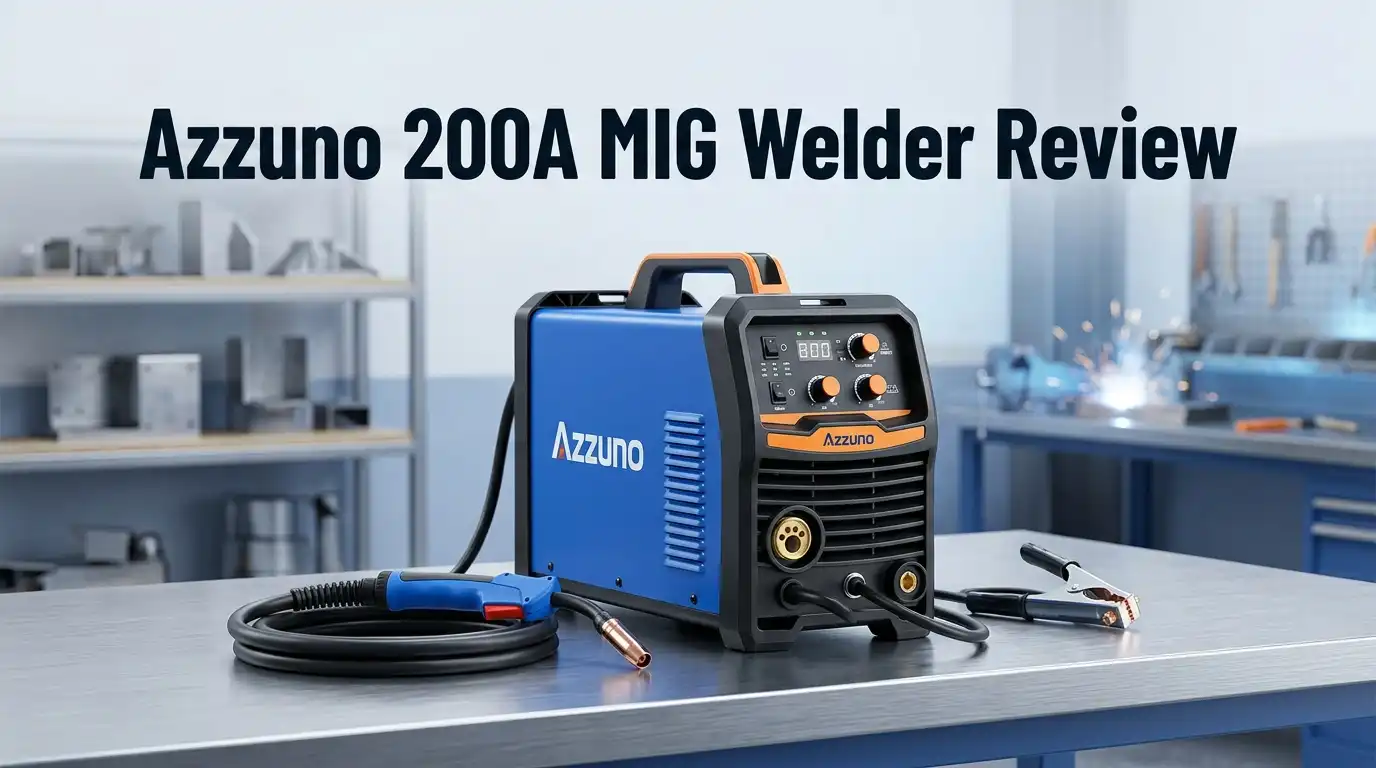
The Azzuno 200A is an inverter based multiprocess welder built for home shops, farms, and small repair work. Azzuno sells it as a 4 in 1 machine, and the four processes are flux core MIG, gas shielded MIG, lift TIG, and stick arc welding. One machine covers most of what a hobby fabricator touches in a year.
The unit accepts 110V or 220V input through an included adapter cord. That flexibility matters. You can run it in a rented garage on a wall outlet, then move it to a dryer circuit or a generator for heavier jobs.
Weight sits at 32.5 pounds, and the case measures 18.5 by 13.2 by 9.9 inches. It is portable without being flimsy in your hand. You can carry it one handed up a short flight of stairs.
Azzuno is a newer brand that sells mostly through Amazon and its own store. Support runs through email with a stated 24 hour response window, and the Amazon unit carries a one year quality guarantee.
Unboxing Experience: What Actually Arrives
The box arrives plain and heavier than expected. Mine came double boxed with molded foam on both ends, and nothing rattled. That packaging detail matters more than it sounds, because inverter boards crack when a machine tumbles in transit.
Lift the lid and the welder sits face up under a plastic sleeve. Underneath, a cardboard tray holds the accessories. You get the 15AK MIG torch with a decent nine foot lead, a ground clamp, an electrode holder, the 110V to 220V adapter cord, a gas hose with two hose clamps, spare contact tips, an extra drive roller, and a chipping hammer with a wire brush.
The manual is small and printed in readable English, though the parameter charts are dense. Read the wire feed chart before your first bead. It saves ten minutes of guessing.
What is missing stings a little. No welding helmet. No gas regulator. No welding wire. No TIG torch. You are ordering more parts the same day the welder lands.
Build Quality And First Impressions
Pick the machine up and you feel the tradeoff immediately. The case is thin painted sheet steel, and it flexes slightly under thumb pressure near the side vents. The carry strap is nylon webbing with plastic hardware. It holds fine, but it is not the padded strap you get on a Miller.
The front panel looks better than the price suggests. Two large digital displays show amperage and voltage, and the selector knobs click into place with real detents. No mushy potentiometers here. Lettering is silk screened and stayed legible after weeks of shop dust.
Inside, the wire drive uses a single roller system with a plastic tensioner arm. This is the weakest part of the machine. It feeds .030 and .035 wire reliably, but it lacks the grip of a dual drive feeder.
The spool hub accepts both 2 pound and 10 pound rolls, which is generous at this price. Cooling comes from a rear fan that runs loud under load. You will hear it over your helmet.
Top 3 Alternative for Azzuno 200A MIG Welder

Last update on 2026-10-17 / Affiliate links / Images from Amazon Product Advertising API
ARCCAPTAIN 200A MIG Welder 6 in 1 Multiprocess Welding Machine

Last update on 2026-10-17 / Affiliate links / Images from Amazon Product Advertising API
YESWELDER 205A MIG Welder MIG 205DS PRO 5 in 1
Last update on 2026-10-17 / Affiliate links / Images from Amazon Product Advertising API
AZZUNO 200A MIG Welder 8 in 1 Aluminum Multiprocess Welder
Key Specifications Explained In Plain Words
Spec sheets confuse people, so here is the translation. Input voltage covers AC 110V and 220V with a 15 percent tolerance, which means the machine tolerates weak shop wiring better than most cheap units.
On 110V input, MIG output runs 30 to 160 amps and stick output runs 20 to 146 amps. On 220V input, you reach the full 200 amps. The 200A number on the label is a 220V number, not a household number. Read that twice before buying.
Wire compatibility covers .030 inch and .035 inch solid and flux core wire. Stick mode handles 1/16, 3/32, and 1/8 inch electrodes, including 6011, 6013, and 7018 rods.
Safety features include overcurrent protection, thermal overload shutdown, and VRD, which lowers open circuit voltage to reduce shock risk in stick mode.
Practical thickness range lands at 24 gauge sheet metal up to roughly 1/4 inch plate in a single pass on 220V. Thicker material works with beveled joints and multiple passes.
Setup And First Weld: How Fast Can You Start
Fast, actually. I had an arc going in about twenty minutes, and most of that was loading wire. The polarity change for flux core is clearly labeled inside the side door, so you are not guessing which lug goes where.
Loading a spool is straightforward. Release the tensioner, thread wire through the guide, snug the roller, and jog the trigger. Set your roller tension just tight enough to stop slipping. Overtightening flattens the wire and causes feed problems in this machine specifically.
The parameter chart on the inside door gives you a starting point for voltage and wire speed by thickness. Those numbers are close enough for practical work. I adjusted down slightly on thin sheet.
First bead on 1/8 inch mild steel with .030 flux core came out surprisingly stable. The arc lit instantly, sounded consistent, and left a manageable slag layer that chipped off cleanly. No stuttering, no birdnesting, no burn back to the tip.
MIG Welding Performance On Steel
Gas shielded MIG is where this welder earns its reputation. Running .030 solid wire with 75/25 argon CO2 mix at about 20 CFH, the arc runs smooth and quiet. Spatter stays low and the bead profile looks tidy without much cleanup.
At 220V, I welded 3/16 inch plate in a single pass with full penetration on a beveled joint. Fillet welds on 1/4 inch angle iron needed a slight weave but held up under a hammer test. The puddle behaves predictably, which is what a beginner needs most.
Thin sheet metal work is also solid. On 20 gauge body panel steel, short stitch welds at low amperage kept warping under control without blowing through.
The arc start is the standout feature. Cold starts are clean, with none of the harsh crackle cheap machines produce. Azzuno appears to have tuned the inductance well for the price bracket.
Vertical and overhead welds are harder, though that is technique, not the machine.
Flux Core Performance Without Gas
Flux core is the mode most buyers use first, because gas bottles cost money. Good news: this welder runs gasless wire well. I tested .030 and .035 E71T GS wire on material from 1/8 inch to 1/4 inch.
The arc runs hotter and dirtier than gas MIG, which is normal for flux core. Slag comes off with moderate chipping, and spatter lands in the usual places. Penetration on 1/4 inch plate was better than expected on 220V power.
Outdoor performance is a real advantage. Wind wrecks gas MIG welds, and flux core simply ignores it. I welded a fence repair on a breezy day with no porosity problems.
Anti stick and burn back control work properly here, so the wire does not fuse to the tip when you pause mid bead.
The one complaint: the fume output is heavy at higher settings. Ventilate your space or wear proper respiratory protection. This applies to all flux core welding, not just this machine.
Lift TIG And Stick Welding Modes
Stick welding works well and honestly surprised me. With 7018 rods at 110 amps on 220V input, the arc stayed stable and the hot start feature helped ignition considerably. Arc force adjustment kept the rod from sticking during tight fit ups. Root passes on pipe were manageable.
On 110V input, stick output drops to 146 amps, which still covers 1/8 inch rods comfortably. That is enough for gate repairs, trailer work, and general farm fixes.
Lift TIG is the weaker mode, and the reason is simple: the TIG torch is not included. You buy a WP 17V style torch separately, plus argon, plus a regulator. Once connected, the lift start works fine on stainless and thin steel.
Do not expect pedal control or AC output. This is DC lift TIG only, so aluminum TIG welding is off the table entirely. Treat TIG here as a bonus feature, not a primary reason to buy.
Duty Cycle, Heat, And Real Limits
Here is where budget welders get exposed. Azzuno rates the machine at a 60 percent duty cycle at maximum output on 220V. In plain terms, that means six minutes of welding out of every ten minutes, then four minutes of cooling.
In my testing, that rating held up reasonably at moderate settings. Running long beads at 150 amps on 220V, the machine kept going without a thermal trip for several minutes at a time. The fan ramped up and stayed loud.
Push it near 200 amps continuously and the thermal light will interrupt you. That is the machine protecting itself, not failing. Let it idle and it resets in a few minutes.
On 110V, heat builds faster because the inverter works harder for the same output. Household circuit breakers also protest. A 20 amp circuit handles moderate settings, but a 15 amp circuit will trip during heavy work.
Plan your projects around short bursts rather than production runs.
What This Azzuno Welder Does Not Do Well
Honest reviews list the failures, so here they are. Aluminum welding on the standard 4 in 1 model is frustrating. The steel liner grabs soft aluminum wire and causes feed jams. Azzuno sells an 8 in 1 version with a Teflon liner for this reason, and even that works best with an optional spool gun.
The wire feeder is the second weak spot. Single roller drives lose grip when the liner gets dirty, and you will need to clean or replace the liner sooner than on a premium machine.
Third, documentation gaps exist. The manual explains settings but skips troubleshooting depth. Fixing a feed issue means searching YouTube.
Fourth, the included MIG torch is basic. The trigger feels cheap and the nozzle threads wear over time.
Fifth, long term reliability data is thin. Azzuno is a young brand, and parts availability three years from now is unknown. Some buyers report units failing within the first year.
Finally, this is not a production machine. Daily commercial use will kill it.
Pros And Cons Of The Azzuno 200A MIG Welder
Here is the balanced breakdown after weeks of use.
Pros
- Excellent price to performance ratio at roughly $170, undercutting comparable multiprocess machines by a wide margin
- Genuinely smooth arc start and stable MIG puddle that flatters beginner technique
- True dual voltage operation with the adapter cord included in the box
- Four usable processes covering flux core, gas MIG, lift TIG, and stick welding
- Clear digital displays and clicking knobs that make setting parameters simple
- Accepts both 2 pound and 10 pound wire spools, which saves money on consumables
- Light enough at 32.5 pounds for one handed carrying and truck transport
- Good packaging with foam protection reduces shipping damage risk
- VRD, anti stick, hot start, and thermal protection all function as described
Cons
- Advertised 200 amps requires 220V power, dropping to 160 amps on household outlets
- No welding helmet, gas regulator, wire, TIG torch, or spool gun included
- Single roller wire drive struggles with soft or dirty wire
- Aluminum welding needs extra parts and still feeds inconsistently
- Thin sheet metal case and plastic knobs feel budget grade
- Cooling fan is loud enough to notice through a helmet
- Limited long term reliability track record from a newer brand
- Manual lacks real troubleshooting guidance
Who Should Buy This Welder And Who Should Skip It
Buy this machine if you are a home hobbyist, DIY fabricator, farm owner, or automotive tinkerer. If your projects involve trailer repairs, gate building, exhaust work, shop carts, or general steel fabrication, the Azzuno 200A covers all of it comfortably.
It also suits students and career changers learning to weld. Low cost entry matters when you are still deciding whether welding is for you. The forgiving arc helps beginners build muscle memory without fighting the equipment.
Skip it if you weld professionally. Duty cycle limits, the basic feeder, and uncertain parts support make it wrong for daily income work. Buy a Miller, Lincoln, or ESAB instead and accept the higher cost.
Also skip it if aluminum is your main material. Choose a pulse MIG machine or a proper AC TIG welder for that job.
Renters with only 110V access should still consider it, but set expectations at 160 amps and thinner material.
Price And Value In 2026
Pricing hovers around $169.99 with a typical list price near $179.99, and Prime discounts appear regularly. That figure puts it among the least expensive 200 amp multiprocess welders on Amazon.
Compare that to competing machines. ARCCAPTAIN and YESWELDER units with similar feature lists usually land between $230 and $330. Entry level offerings from legacy brands with fewer processes often cost more than $400.
Your real total cost is higher than the sticker, though. Add roughly $40 for a decent auto darkening helmet, $50 to $90 for a gas regulator and argon mix bottle rental, and $20 to $35 for wire. Budget $280 to $320 for a complete ready to weld setup.
Even at that total, the value holds. You are paying roughly half what a comparable branded kit costs. The tradeoff is build refinement and long term support, not arc quality. For occasional use, that trade makes sense.
Final Verdict On The Azzuno 200A MIG Welder

Last update on 2026-10-19 / Affiliate links / Images from Amazon Product Advertising API
The Azzuno 200A MIG welder delivers more than its price suggests, and that is the fair conclusion. The arc quality is the standout achievement here. Smooth starts, stable puddles, and predictable behavior make it easy to learn on and pleasant to use.
The machine is honest about most things and quiet about a few. Dual voltage works. Four processes work. The 200 amp claim needs a 220V asterisk, and the accessory list needs your wallet.
Would I recommend it? Yes, for the right buyer. Home shop welders, weekend fabricators, and beginners get remarkable capability for under two hundred dollars. Treat it as a hobby grade tool, keep the liner clean, respect the duty cycle, and it will serve you for years.
Professionals and aluminum specialists should look elsewhere. Everyone else gets a genuinely capable welder that leaves budget for consumables and safety gear.
Overall rating: 4.2 out of 5.
Frequently Asked Questions
Can the Azzuno 200A weld aluminum?
The standard 4 in 1 model can attempt aluminum with the right wire, but feeding is unreliable through the steel liner. Azzuno’s 8 in 1 version includes a Teflon liner and supports an optional LBT150 spool gun, which produces much better results. For serious aluminum work, choose a spool gun setup or a dedicated AC TIG welder.
Does it work on a regular household outlet?
Yes. The included adapter cord lets you plug into a standard 110V outlet. Output drops to about 160 amps for MIG and 146 amps for stick in that mode. Use a 20 amp circuit if possible, because 15 amp breakers trip under heavier settings.
What thickness of metal can it weld?
Expect 24 gauge sheet metal up to roughly 1/4 inch plate in a single pass on 220V power. Thicker material welds with beveled joints and multiple passes. On 110V, plan for material up to about 3/16 inch.
Is a welding helmet included?
No. The box contains the welder, MIG torch, ground clamp, electrode holder, adapter cord, gas hose, clamps, contact tips, a drive roller, and a hammer brush. You must buy a helmet, gloves, wire, and a gas regulator separately.
How long is the warranty?
The Amazon listing includes a one year quality guarantee, and purchases through Azzuno’s own store advertise a two year warranty. Support runs by email Monday through Friday with a stated 24 hour average response time.
Is it good for beginners?
Yes, this is one of its strengths. The parameter chart, digital displays, and forgiving arc all reduce the learning curve. Practice on scrap steel with flux core wire before moving to gas MIG, and read the manual’s settings tables first.

Hi, I’m Leah Ray — the voice behind CraftBench Vault. I’m a passionate woodworking enthusiast dedicated to reviewing the best wood cutting tools and woodworking products. Through honest research and hands-on experience, I help fellow crafters make smarter buying decisions. Welcome to my workshop!