Kreg Pocket Hole Jig 520PRO Review 2026: Worth Buying?
Pocket hole joinery turned me into a faster woodworker. It also turned a lot of nervous beginners into confident builders. The Kreg Pocket Hole Jig 520PRO sits right in the middle of that story.
It is small, it clamps onto your wood instead of holding your wood inside a frame, and it travels anywhere you need it. But is it the right jig for your shop in 2026, or should you spend a little more and get the bigger bench model?
This review covers the good parts, the annoying parts, and the things Kreg quietly leaves out of the marketing copy. Keep reading, because the weak spots matter more than the specs.
In a Nutshell:
- The clamp is the headline feature. The VersaGrip squeeze clamp grabs the workpiece instead of trapping it. You carry the jig to the board, which is perfect for long or awkward pieces that would never fit on a benchtop jig.
- Setup takes about two minutes. You measure thickness with the included gauge, slide the drill guide to the matching setting, set the stop collar on the bit, then squeeze and drill. Three preset thickness positions cover 1/2 inch, 3/4 inch, and 1 1/2 inch material.
- Build quality feels solid for the price. Hardened steel drill guides, glass filled nylon body, and a GripMaxx anti slip coating that genuinely stops the jig from sliding around.
- It is not the fastest option for repeat holes. Squeezing that handle a hundred times in a row gets tiring. A benchtop jig wins for production work.
- No dust collection at all. There is no shop vacuum port, so chips pile up on your bench and your floor.
- Owner ratings sit near 4.7 out of 5 across hundreds of reviews, with ease of use and joint strength as the most repeated praise.
Kreg Pocket Hole Jig 520PRO

Last update on 2026-10-15 / Affiliate links / Images from Amazon Product Advertising API
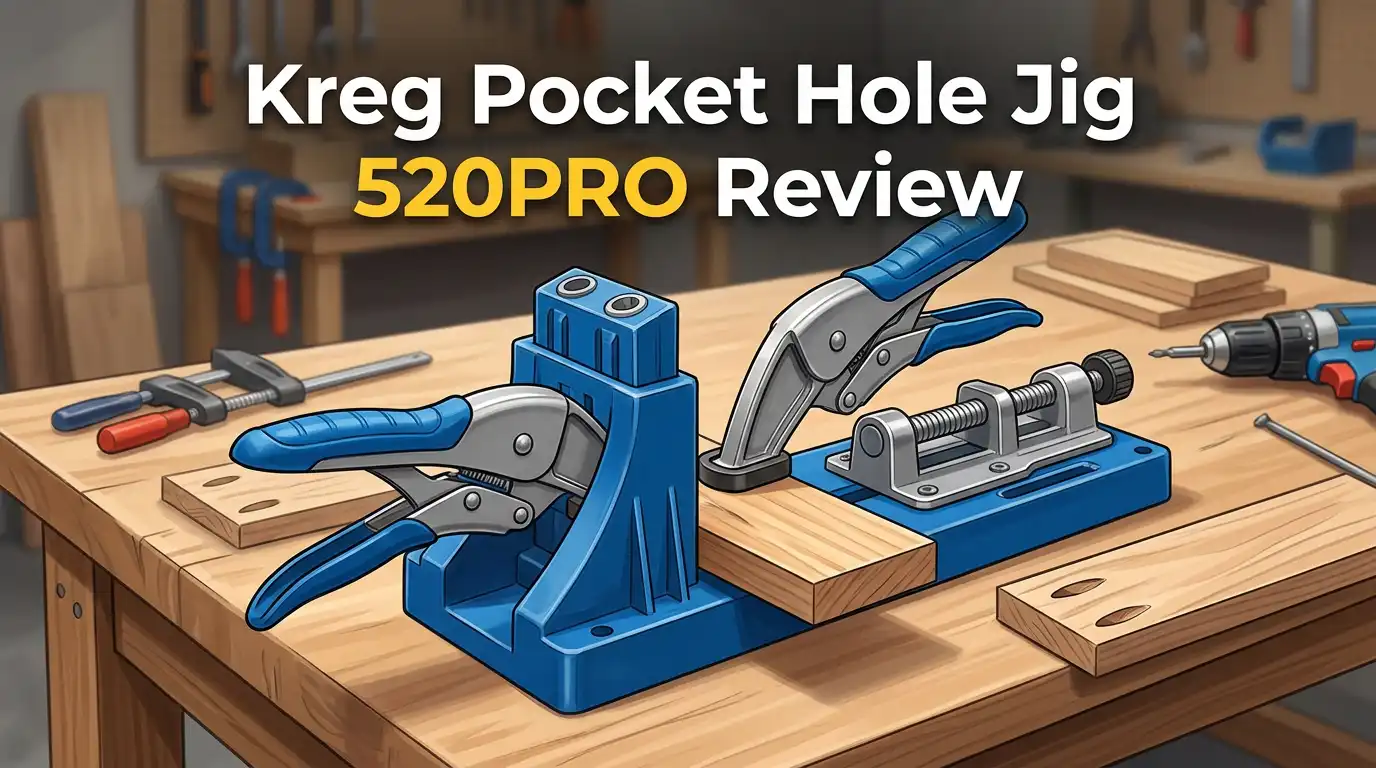
The 520PRO replaced the long running Kreg K4, and the change is bigger than the name suggests. The K4 was a box that your board sat inside. The 520PRO is a handheld clamp that bites onto your board wherever you point it. That single design choice changes how you work.
The jig handles material from 1/2 inch to 1 1/2 inch thick, which covers plywood, nominal 1 inch boards, and standard 2x framing lumber. It drills three holes per clamping position using reinforced steel guides.
The kit includes the jig, a stepped drill bit with easy set markings, a stop collar, a material thickness gauge that doubles as a hex key, a 6 inch square driver bit, and a face clamp. Some retail bundles also toss in a starter box of 60 screws.
Unboxing Experience and What Comes in the Box
The box is small. Smaller than you expect for a tool that costs around a hundred dollars. Inside, the jig sits in a molded cardboard tray with the accessories tucked into side pockets. There is no case, no blow molded storage, and no bag. That is the first small letdown.
Lifting the jig out, the weight surprised me in a good way. It feels dense, around two pounds, with no rattle in the clamp mechanism. The black drill guide block has crisp laser etched markings. The blue body has that familiar Kreg texture.
Setup out of the box took me under three minutes. The printed instructions are clear, with pictures rather than paragraphs. My only gripe is that the drill bit and driver bit have nowhere to live, so they end up loose in a drawer within a week.
Build Quality and Materials
Kreg builds the 520PRO from glass filled nylon with hardened steel drill guides pressed into the block. After drilling several hundred holes, my guides showed no visible wear and no slop. The bit still enters clean and straight every time.
The clamp jaw uses a GripMaxx anti slip coating, a gritty rubber surface that digs into wood without marking it badly. This is the part that makes the whole design work. Without it, the jig would skate across smooth plywood.
The handle rotates a full 360 degrees, which sounds like a gimmick until you clamp onto a vertical board and realize the handle would otherwise point straight into your bench.
Honest note on durability: a handful of owners report the clamping block flexing slightly under heavy squeeze pressure. Kreg says this does not affect hole placement, and my testing agrees, though it does feel slightly cheap in the moment.
Top 3 Alternative for Kreg Pocket Hole Jig 520PRO

Last update on 2026-10-15 / Affiliate links / Images from Amazon Product Advertising API
Kreg Pocket Hole Jig 720PRO

Last update on 2026-10-15 / Affiliate links / Images from Amazon Product Advertising API
Kreg Pocket Hole Jig 320

Last update on 2026-10-15 / Affiliate links / Images from Amazon Product Advertising API
Massca Pro M2 Aluminum Pocket Hole Jig System
How the VersaGrip Clamping System Performs
This is the feature that sells the jig, so it deserves real scrutiny. You squeeze the handle, the jaw closes, and the jig locks onto the board. One hand holds the jig, the other holds the drill. No separate clamp, no bench, no setup.
In practice it works very well on boards between 1/2 inch and 1 1/2 inch thick. The grip holds firm through all three holes. On a long 8 foot 2×4 lying on sawhorses, I drilled holes at both ends without moving the lumber once. That alone saves real time.
There is a quick reset knob on top for batch work. Clamp the first board, tighten the knob, and the clamp now releases only far enough to swap boards. It cuts your squeeze count roughly in half on repeat cuts, which your forearm will appreciate.
Setting Up the Jig Step by Step
Setup follows the same routine every Kreg jig uses. First, slide the material thickness gauge onto the edge of your board and read the number. Do not skip this. Plywood is almost never the thickness printed on the label, and guessing wrong is the single biggest cause of weak pocket hole joints.
Second, use the hex key built into that gauge to set the stop collar on the drill bit. The bit has easy set marks etched right on it, so you just line up the window with the matching label.
Third, press the gray tab on the drill guide and slide it to the matching thickness position. Fourth, squeeze the jig onto your board. Fifth, drill until the collar meets the guide. Pull the bit out while the drill is still spinning to clear chips. That is the whole process.
Real World Drilling Performance
Hole quality is excellent. The stepped bit cuts a clean pocket with a crisp shoulder, and the pilot section exits the board centered every time. I tested in birch plywood, poplar, pine, and oak. Hardwood required slower feed pressure but produced no tearout at the exit point.
Joint strength is where pocket holes earn their reputation. My 3/4 inch plywood cabinet joints held firm under weight with zero racking. For framing lumber, the 1 1/2 inch setting paired with 2 1/2 inch coarse thread screws gave rock solid results.
One real complaint from owners deserves mention here. A small number report pockets drilled too deep, leaving nothing for the screw head to seat against. This usually traces back to a stop collar set at the wrong mark, but a few appear to be genuine manufacturing misses.
Portability and Working Away From the Bench
This is the 520PRO’s strongest argument. I took it outside to install deck boards and used it while kneeling, holding the jig against a joist with one hand. No benchtop jig can do that. You can drill pocket holes in a piece already installed on a wall, which has saved me more than once.
The jig works vertically, horizontally, upside down, and at any angle between. The rotating handle means your wrist never ends up in a painful position. For anyone who builds in a driveway, a garage corner, or a client’s living room, this portability is worth the price alone.
It also fits in a tool bag. At roughly the size of a large stapler, it drops into a bucket organizer without hogging space. If your shop is a folding table that disappears at night, this jig fits your life.
What the Kreg 520PRO Does Not Do Well
Honest reviews list the misses, so here they are. The 520PRO has no dust collection port. None. Kreg confirms there is no vacuum option for this jig. You will sweep chips after every session, and they get everywhere.
Repeat drilling gets tiring. Squeezing that handle for one hundred pocket holes is genuine hand work. One owner described drilling 108 holes for a room divider, and that is a forearm workout.
Thickness settings are fixed, not automatic. You get three presets only. Material at 1 inch or 1 1/8 inch forces you to use the 3/4 inch setting and accept a compromise.
The drill guide block does not detach for ultra tight spaces. There is also no fine adjustment for bore depth, and no micro hole capability unless you buy the separate micro drill guide kit.
Pros of the Kreg Pocket Hole Jig 520PRO
- Clamps directly to the workpiece, so long boards, installed pieces, and awkward angles are no problem at all.
- The VersaGrip squeeze clamp works one handed, leaving your other hand free for the drill. No separate clamp needed for most jobs.
- GripMaxx anti slip coating holds firm on smooth plywood and melamine without leaving ugly marks on the surface.
- The handle rotates 360 degrees, which keeps your grip comfortable in vertical, horizontal, and angled positions.
- Setup is genuinely fast thanks to easy set marks on the drill bit and the combined thickness gauge and hex key.
- Hardened steel drill guides resist wear and keep producing accurate, clean holes after hundreds of uses.
- The quick reset knob speeds up batch work by shortening the clamp travel between identical boards.
- Compact and light enough to carry anywhere, including up a ladder or into a customer’s home.
- Strong owner satisfaction, with ratings averaging close to 4.7 out of 5 across hundreds of verified reviews.
Cons of the Kreg Pocket Hole Jig 520PRO
- No shop vacuum port, so sawdust and chips fall onto your bench and floor with every single hole.
- Only three thickness presets, which leaves odd dimensions like 1 inch and 1 1/8 inch without a dedicated setting.
- Manual thickness adjustment required, unlike the automatic clamping on Kreg’s larger 720PRO jig.
- Hand fatigue during long sessions, because every clamping cycle depends on squeezing the handle.
- No onboard storage for bits, so the drill bit and driver wander off within a week of ownership.
- The clamping block can flex slightly under heavy pressure, which feels less rigid than a benchtop frame.
- Micro pocket holes cost extra, since the micro drill guide kit is a separate purchase.
- A few owners report pockets drilled with no seat for the screw head, pointing to occasional quality control slips.
Kreg 520PRO vs Kreg 720PRO
This is the comparison most buyers agonize over. The 720PRO is the benchtop machine. It uses Automaxx clamping that adjusts to any material thickness automatically, so you skip the gauge step entirely. It also includes a dust port, onboard bit storage, and a wide stable base.
The 520PRO is the portable one. It goes to the wood. The 720PRO makes the wood come to it.
My honest take: if you have a dedicated bench and you build cabinets or furniture in batches, the 720PRO is faster and less tiring. If you build outdoors, work with long boards, or lack a permanent shop, the 520PRO wins easily. Many woodworkers eventually own both, using the 720PRO for production and the 520PRO for repairs and installed pieces. The price gap is usually thirty to fifty dollars.
Kreg 520PRO vs Kreg 320
The 320 is the budget sibling. Both jigs clamp onto the workpiece, and both use the same three thickness presets. The difference is the clamping method.
The 320 needs a separate face clamp. You position the jig, grab a clamp, tighten it, then drill. That is two more steps and two more hands than the 520PRO requires.
The 320 does have one real advantage. Its drill guide splits into two separate blocks, giving you variable hole spacing. For narrow stock, odd angles, or spots where three evenly spaced holes will not fit, the 320 goes places the 520PRO cannot.
My recommendation is simple. Choose the 520PRO for speed and daily convenience. Choose the 320 if you want the lowest price or need flexible hole placement more than one handed clamping.
Accessories Worth Buying
Two add ons change how this jig works. The 520PRO Docking Station converts the handheld jig into a benchtop station with repositionable material support wings. Those wings hold long boards level while you drill, which removes most of the awkwardness of solo work. If you split time between bench and field, this is the first accessory to buy.
The Micro Drill Guide Kit swaps the standard guide for one that drills pockets roughly 25 percent smaller. You need it for thin drawer stock, narrow boards, and dense hardwoods where a standard pocket would blow through. Remember that micro holes require pan head screws, not the standard washer head type.
Beyond that, buy screws in bulk. Coarse thread for softwood and plywood, fine thread for hardwood. A good 2 inch face clamp also helps on assembly day.
Who Should Buy the Kreg 520PRO
This jig fits a specific woodworker very well. Beginners benefit most, because the one handed clamp removes the fumbling that puts people off pocket holes entirely. You learn the process without wrestling clamps.
Weekend builders with no permanent shop are the second ideal group. If your workspace is a driveway, a patio, or a shared garage, a portable jig makes far more sense than a bench fixture.
Remodelers and installers should also look here. Drilling a pocket hole in a cabinet that is already screwed to a wall is a trick only a handheld jig can perform.
Skip it if you drill hundreds of holes weekly, need dust collection, or already own a benchtop jig and mostly build at a fixed station. In that case the 720PRO serves you better.
Price and Value in 2026
The 520PRO typically lands around one hundred dollars, with bundles that include the docking station or a screw starter kit running higher. Sales appear regularly, and bundle pricing often beats buying the pieces separately.
Is it good value? For what you get, yes. You receive a precision steel guided jig, a stepped bit, a stop collar, a driver, a thickness gauge, and a clamp system that would cost extra on cheaper jigs. Cheaper aluminum jigs exist and some work fine, but they rarely match Kreg’s guide tolerances or accessory ecosystem.
The hidden value is longevity. Kreg parts stay available for years, guides are replaceable, and the company’s support team actually answers questions. A jig you can repair in 2031 justifies paying a little more in 2026.
Final Verdict on the Kreg Pocket Hole Jig 520PRO
Last update on 2026-10-15 / Affiliate links / Images from Amazon Product Advertising API
After months of use, the 520PRO earns a place in my shop. It is not the fastest pocket hole jig, and it is not the most feature packed. It is the most flexible one at this price, and flexibility is what most builders actually need.
The clamp works. The holes are clean. The joints hold. The jig goes wherever the wood is, which turns out to be the thing I value most.
The missing dust port and the hand fatigue during big batches are real drawbacks, and you should weigh them honestly. If you build in batches at a fixed bench, buy the 720PRO instead. For everyone else, especially beginners and anyone building without a dedicated shop, the 520PRO is an easy recommendation and a tool you will still use a decade from now.
Frequently Asked Questions
Does the Kreg 520PRO work with 2×4 lumber?
Yes. The jig handles material from 1/2 inch to 1 1/2 inch thick, and standard 2x framing lumber measures 1 1/2 inch. Use the 1 1/2 inch setting on the drill guide and pair it with 2 1/2 inch coarse thread pocket hole screws for the strongest joint.
Can I attach a shop vacuum to the 520PRO?
No. Kreg confirms there is no vacuum attachment option for this jig. Chips fall out of the guide as you drill. If dust collection matters to you, the 720PRO includes a dedicated port.
Does the 520PRO drill micro pocket holes?
Not out of the box. You need the separate Micro Drill Guide Kit, which swaps into the jig and produces holes about 25 percent smaller. Micro pockets require pan head screws rather than standard washer head screws.
Is the 520PRO better than the older Kreg K4?
For most users, yes. The K4 required you to place the board inside the jig. The 520PRO clamps onto the board instead, which makes it far more portable and much easier to use on long or installed pieces.
Do I need the docking station?
You do not need it, but it helps. The docking station turns the handheld jig into a benchtop station with support wings for long boards. Start with the jig alone, then add the station if you find yourself wanting a fixed setup.
What screws should I use with this jig?
Use coarse thread pocket hole screws for softwood, plywood, and particle board. Use fine thread screws for hardwoods like oak and maple. Match screw length to your material thickness using the chart printed on the jig.

Hi, I’m Leah Ray — the voice behind CraftBench Vault. I’m a passionate woodworking enthusiast dedicated to reviewing the best wood cutting tools and woodworking products. Through honest research and hands-on experience, I help fellow crafters make smarter buying decisions. Welcome to my workshop!