Kreg Pocket Hole Jig 320 Review 2026: Worth Buying?
Pocket hole joinery turned furniture building into a weekend hobby. You drill an angled hole, drive a screw, and the joint holds tight. No clamps drying overnight. No complicated joinery math.
The Kreg Pocket Hole Jig 320 sits in the middle of the Kreg lineup. It costs less than the big benchtop models. It does more than the tiny starter jigs. Thousands of DIY builders keep it in their tool bag for cabinets, shelves, and face frames.
But does it still earn a spot in 2026? Newer jigs clamp automatically. Budget brands copy the design for half the price. I spent weeks drilling plywood, pine, oak, and 2×4 stock with this jig. This review covers the unboxing, the real performance, and the honest weak spots nobody mentions in the ads.
In a Nutshell:
- The Kreg 320 is a compact two guide jig that handles material from 1/2 inch to 1 1/2 inch thick. The removable spacer lets you widen or narrow the guide spacing, so you can drill narrow stiles and wide boards with the same tool.
- Setup takes under a minute once you learn the pattern. You set the depth collar on the bit, slide the guide block to the thickness stop, clamp, and drill. The stops click into 1/2 inch, 3/4 inch, and 1 1/2 inch positions.
- Hole quality matches jigs that cost three times more. The hardened steel guides keep the bit straight. Joints came out flush and strong on every test piece, including cheap big box plywood.
- The clamping is the weak point. The jig has no built in clamp. You supply a face clamp or a C clamp every single time. That slows down repetitive work.
- Portability is the real selling point. The jig packs into a small case, fits inside a cabinet you already assembled, and clamps onto a board anywhere on the job site.
- Best for DIYers and hobby builders who drill a few dozen holes per project. High volume builders should jump to a benchtop model with automatic clamping.
Kreg Pocket Hole Jig 320 Overview

Last update on 2026-10-15 / Affiliate links / Images from Amazon Product Advertising API
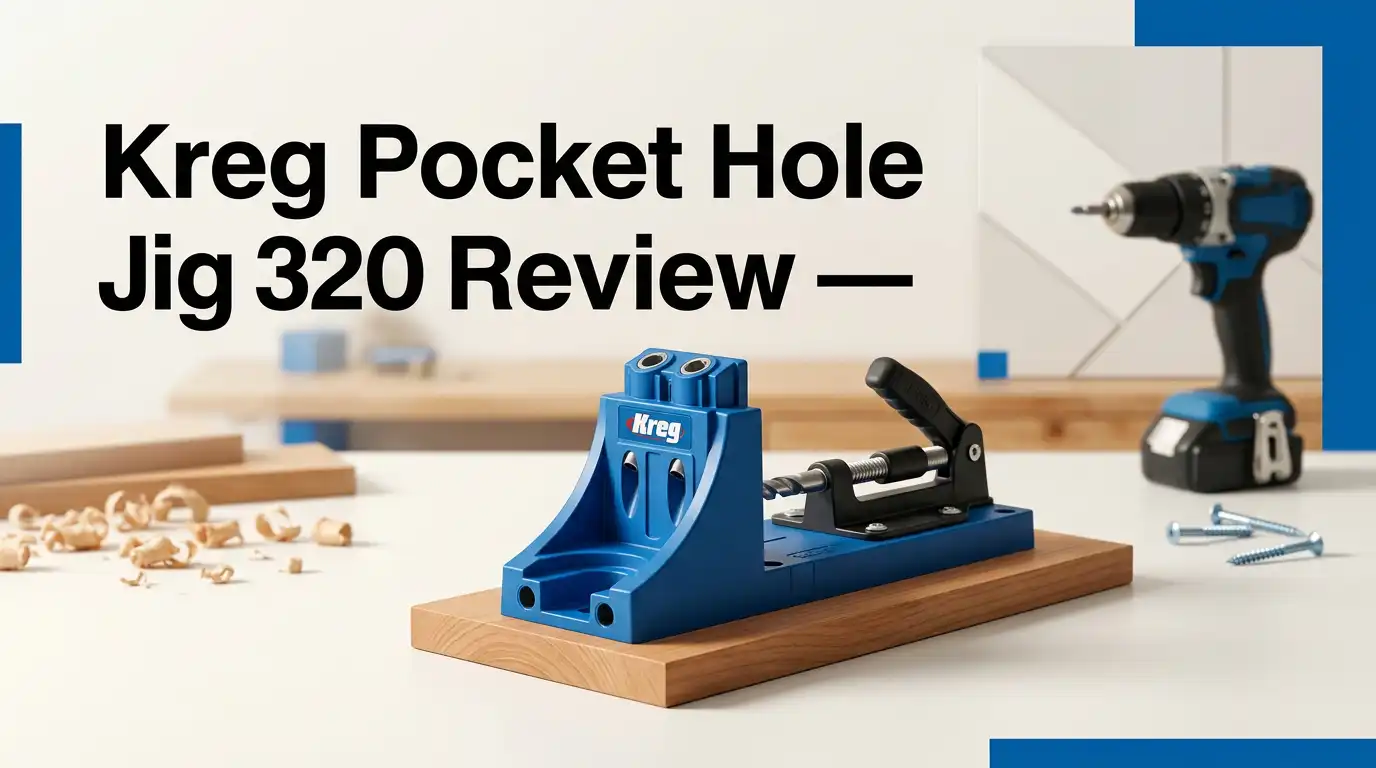
The Kreg 320 replaced the older K4 style jigs for portable work. Kreg built it around a single idea: drill pocket holes anywhere, not just at a bench.
The jig body holds two drill guides. A plastic spacer sits between them. Pull the spacer out and the guides sit close together for narrow boards. Leave it in and the guides spread apart for wider stock.
Material capacity runs from 1/2 inch to 1 1/2 inch. That covers plywood, 1x lumber, and 2×4 framing stock. The kit ships with a stepped drill bit, a 6 inch square driver bit, a depth collar, a hex wrench, and a sample pack of screws.
Kreg backs the jig with a lifetime warranty. That matters because the steel guides are the part that wears out first, and Kreg sells replacements cheaply.
Unboxing Experience and First Impressions
The box is small. Smaller than you expect for a tool that builds furniture. Inside sits a hard plastic case with a clamshell lid and a simple latch.
Open the case and everything has a molded slot. The jig body sits in the center. The stepped bit lies in a channel beside it. The driver bit, wrench, and depth collar fill small pockets. Nothing rattles loose.
My first reaction was that the jig felt heavier than it looked. The glass filled nylon body has real density. The guides are chunky steel, not thin tubes.
The printed instructions are short and genuinely useful. Kreg includes a quick reference card showing drill depth and screw length for each material thickness. I taped mine inside the lid and still use it.
One small gripe. The case is tight. Once you add a face clamp and extra screws, the lid will not close.
Build Quality and Materials
Kreg uses glass reinforced nylon for the body. The plastic has a slight texture and resists flex. I clamped the jig hard onto oak and saw no bending at the guide base.
The drill guides are hardened steel. They stay sharp through hundreds of holes. The bit rides inside them without chatter, which is the whole reason the holes come out consistent.
The base has a rubber style pad that grips the workpiece. It stops the jig from creeping sideways when you press down on the drill. That pad does a lot of quiet work.
The thickness stops use a spring loaded pin. It clicks firmly into each position. After months of use, mine still clicks with the same resistance.
This is not a tool that feels disposable. The build quality sits far above the generic jigs sold under random brand names.
How the Drill Guides and Spacer Work
This is the part that confuses new buyers, so here is the plain version.
The jig has two guides for drilling two holes at once. Most joints need two holes. Drilling both without moving the jig saves real time.
Pull out the center spacer and the two guides sit closer. Use that setup on narrow pieces like 1×2 stiles. Leave the spacer in and the guides spread wider, which suits 1×4 boards and plywood panels.
You can also remove one guide entirely. That gives you a single hole jig for tight spots or odd angles.
The thickness setting slides the whole guide block up or down. Match the number on the block to your board thickness. Set the bit collar to the same number and the hole lands in the right spot every time.
Top 3 Alternative for Kreg Pocket Hole Jig 320

Last update on 2026-10-15 / Affiliate links / Images from Amazon Product Advertising API
Kreg Pocket Hole Jig 520PRO

Last update on 2026-10-15 / Affiliate links / Images from Amazon Product Advertising API
Kreg Pocket Hole Jig 720PRO

Last update on 2026-10-15 / Affiliate links / Images from Amazon Product Advertising API
Kreg R3 Jr Pocket Hole Jig System
Setting Up the Jig in Under a Minute
Setup follows four steps. Measure the board. Set the guide block. Set the bit collar. Clamp and drill.
Say you are drilling 3/4 inch plywood. Press the pin, slide the guide block to the 3/4 position, and release. Then slide the depth collar on the bit to the 3/4 mark and tighten the hex screw.
Clamp the jig to the board face. Drop the bit into the guide. Run the drill at full speed and push in one steady motion. Pull back once to clear chips.
The first hole takes two minutes because you are reading the card. By the tenth hole you stop reading.
The learning curve is honestly short. Anyone who can use a cordless drill can make a clean pocket hole on their first try with this jig.
Real World Performance on Different Woods
I ran the jig through plywood, pine, poplar, red oak, and construction 2×4 stock.
Plywood gave the cleanest results. The stepped bit cut through the veneer without tearout on the exit side. Joints pulled flush and tight.
Pine drilled fast. The only issue was slight fuzzing around the hole mouth, which sanding removed in seconds.
Red oak needed more pressure and more chip clearing. Pull the bit back twice instead of once. The hole walls still came out smooth and the screw threads bit properly.
Construction lumber worked fine at the 1 1/2 inch setting. The joint held a bench frame that I then sat on without flex.
Hole quality was never the problem in any test. The guides do their job.
Clamping Options and the Face Clamp
The base model ships without a clamp. That surprises a lot of first time buyers.
You need something to hold the jig to the board. A standard C clamp works. A bar clamp works. Kreg sells a Classic Face Clamp with a round pad that drops into the jig recess, and that is the version most people should buy.
The face clamp costs extra but it makes the jig usable one handed. You squeeze, it locks, you drill, you release.
Without a clamp, the jig is nearly unusable. Holding it by hand lets it shift and the bit wanders. It is also unsafe.
Some sellers bundle the jig with the clamp for a few dollars more. Take that bundle. Skipping it is a false saving you will regret on your first project.
Portability and Storage
This is where the Kreg 320 beats every benchtop jig.
The jig weighs barely more than a pound. It drops into a tool bag, a drawer, or a jacket pocket. I carried it up a ladder to fix a loose cabinet rail without a second thought.
You can clamp it inside an assembled box. Try that with a bench mounted jig. You cannot.
Repair work is the hidden strength here. Broken drawer, wobbly chair rail, sagging shelf cleat. The 320 reaches places other jigs never see.
The hard case keeps the bit from getting lost. Losing the stepped bit is the fastest way to turn this jig into a paperweight, so the molded slot earns its keep.
Storage footprint is roughly the size of a paperback book.
What the Kreg 320 Does Not Do Well
Honest reviews list the failures, so here they are.
No built in clamp. Every hole needs a separate clamping step. On a project with eighty holes, that step adds up to real frustration.
No vertical board support. The jig has no wings or stops to hold a long board upright. You drill sideways or toward yourself, which feels awkward on tall panels.
Dust collection is basic. There is a port on the back, but the fit with a shop vacuum hose is loose. Chips end up on the floor.
Small pieces are fiddly. Clamping a 4 inch block means wrestling with the clamp and the jig at the same time.
No micro adjustment. You get three thickness positions. Odd thickness stock like 7/8 inch needs a compromise setting.
None of these ruin the tool. They just define who it suits.
Pros and Cons of the Kreg Pocket Hole Jig 320
Pros
- Compact size fits in a bag and reaches tight spaces no benchtop jig can touch
- Hardened steel guides produce clean, consistent holes in plywood and hardwood
- Two guides plus a removable spacer cover narrow stiles and wide panels
- Thickness stops click firmly and hold their position after heavy use
- Glass filled nylon body resists flex under hard clamping pressure
- Lifetime warranty from Kreg and cheap replacement parts
- Hard case keeps the bit, collar, and wrench together
Cons
- No integrated clamp, so you buy and carry one separately
- Slower than automatic clamping jigs on repetitive production work
- No support wings for holding long boards vertically
- Dust port fits shop vacuum hoses poorly
- Only three thickness positions with no fine adjustment
- Case becomes too tight once you add a clamp and screws
- Awkward to clamp onto very small workpieces
Who Should Buy the Kreg 320
Buy this jig if you build a few projects per year. Shelves, planters, simple cabinets, garage storage, and furniture repairs all fall inside its comfort zone.
Buy it if your shop is a corner of a garage. The jig stores small and sets up anywhere.
Buy it if you already own clamps. The extra purchase stings less when a face clamp is already hanging on your wall.
Skip it if you drill hundreds of holes every week. Cabinet makers and small shop builders will save hours with a 720PRO.
Skip it if you only need one or two holes ever. The R3 Jr costs less and does that job.
The 320 lands in the sweet spot for serious hobby builders who value portability over speed.
Kreg 320 Compared to Other Kreg Jigs
The R3 Jr is the budget option. One guide, no spacer, lowest price. Good for repairs and occasional holes.
The 320 adds a second guide, the spacer, and a sturdier body. It drills two holes per clamping instead of one. That roughly halves your time.
The 520PRO brings a built in clamp with a rotating handle and a wider material support. It stays portable but clamps far faster.
The 720PRO is the benchtop model with automatic clamping and material support wings. It is the fastest option and the most expensive.
The honest ranking is simple. Pick the 320 for portability, the 520PRO for a balance, and the 720PRO for volume.
Price and Value in 2026
The Kreg 320 usually sits in the budget friendly range, well under the price of the PRO models. Bundles with the face clamp cost slightly more and represent better value.
Generic copies sell for less. They use softer steel guides that wear oval after a few dozen holes. An oval guide means a crooked hole and a joint that will not pull flush.
The lifetime warranty changes the math. Kreg honors it, and replacement guides and bits are inexpensive.
Compared against the cost of a single piece of furniture, the jig pays for itself on the first project.
Value verdict: strong, as long as you accept the manual clamping. If clamping speed matters more than price, spend the extra money on the 520PRO instead and skip the regret.
Tips for Cleaner Pocket Holes
Run the drill at full speed. Slow speed burns the wood and leaves fuzzy holes.
Clear chips once on softwood and twice on hardwood. Pull the bit most of the way out, then push back in.
Clamp the workpiece to the bench as well as clamping the jig. Two clamps beat one.
Match screw length to material thickness. Coarse threads for plywood and softwood, fine threads for hardwood.
Drill a test hole in scrap before you touch the real board. This single habit prevents most beginner mistakes.
Wax the stepped bit occasionally. It cuts cooler and lasts longer.
Keep a small brush in the case and clear sawdust from the guides after each session.
Frequently Asked Questions
Does the Kreg 320 come with a clamp?
The base model does not. You need a face clamp or a C clamp separately. Many bundles include the Kreg Classic 2 inch Face Clamp, and that bundle is the better buy.
What material thickness does it handle?
Anything from 1/2 inch to 1 1/2 inch thick. The thickness stops click into 1/2 inch, 3/4 inch, and 1 1/2 inch positions.
Can beginners use this jig?
Yes. Setup takes four simple steps and the included reference card lists the right depth and screw length. Most people drill a clean hole on their first attempt.
Is the Kreg 320 better than the 520PRO?
The 520PRO clamps faster and supports material better. The 320 costs less and packs smaller. Choose based on how many holes you drill.
Do pocket hole joints hold strong?
Yes. Pocket hole joints hold well in shear and work fine for cabinets, shelves, and frames. They are weaker in pure tension, so avoid them on joints that get pulled apart.
Can it drill angled or curved pieces?
It works on flat faces. Curved or angled pieces need extra support and careful clamping, and results vary.

Hi, I’m Leah Ray — the voice behind CraftBench Vault. I’m a passionate woodworking enthusiast dedicated to reviewing the best wood cutting tools and woodworking products. Through honest research and hands-on experience, I help fellow crafters make smarter buying decisions. Welcome to my workshop!