WEN 3421 8″ x 12″ Mini Lathe Review 2026: Worth Buying?
Mini lathes promise a lot. They promise pens, bowls, chess pieces, and bottle stoppers from a corner of your garage.
The WEN 3421 sits at the very bottom of that price ladder, and it has sold thousands of units because of that. But a low price always raises one honest question. Does this little machine actually turn wood, or does it just look like it does?
This review covers the unboxing, the real power limits, the parts that break, and the projects it handles without complaint. You will also see where it clearly fails, because an honest review has to say that part out loud.
In A Nutshell:
- The WEN 3421 is a true mini lathe, not a small full size lathe. It swings 8 inches over the bed and fits workpieces up to 12 inches between centers. Pens, handles, bottle stoppers, and tiny bowls are its natural home.
- The 3.2 amp motor is the weak link. It runs smooth and quiet at idle, but it stalls when you push a roughing gouge into hardwood. Owners report the spindle stopping under light tool pressure. Light cuts and sharp chisels are not optional here. They are mandatory.
- Variable speed from 750 to 3200 RPM is genuinely useful. You get a dial, not a belt swap, and a soft start motor that ramps up instead of lurching. That feature alone beats many lathes at double the price.
- Cast iron construction keeps vibration low. At roughly 46 pounds the machine feels planted once you bolt it down. Bolting it down is required, not suggested.
- Quality control is the real gamble. Some units arrive with blunt spur centers, stripped tailstock knobs, or control boards that fail inside a month. WEN support and the two year warranty handle most of it, but you may wait on parts.
- Best value for beginners who turn small. If you want bowls larger than 6 inches or plan to turn every day, buy a bigger machine instead.
WEN 3421 8″ x 12″ Variable Speed Mini Benchtop Wood Lathe

Last update on 2026-10-15 / Affiliate links / Images from Amazon Product Advertising API
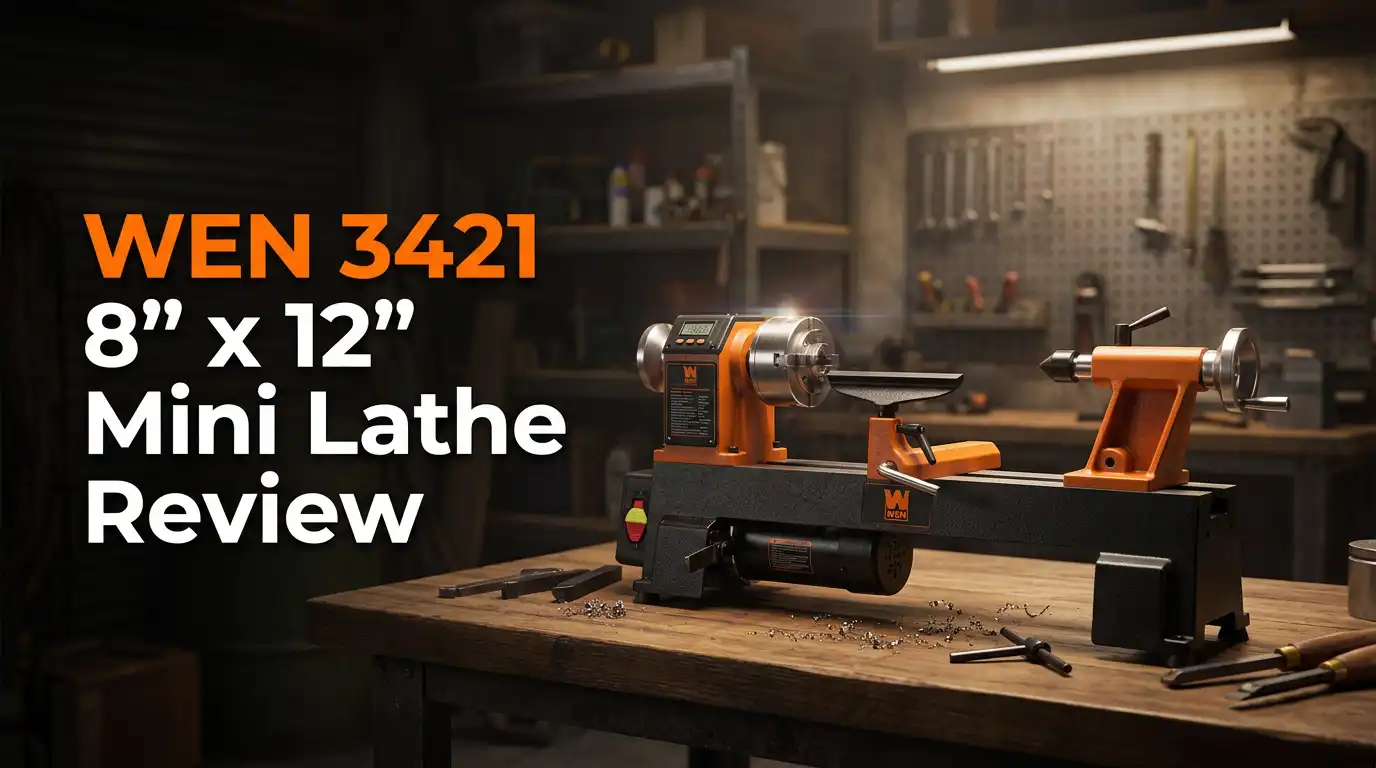
The WEN 3421 is a benchtop wood lathe built around a 3.2 amp soft start motor. It swings 8 inches over the bed and holds workpieces up to 12 inches long between centers. The headstock and tailstock both use an MT1 taper, which is the standard small lathe fitting for pen mandrels and drill chucks.
Speed runs from 750 RPM to 3200 RPM through a single dial. The body is cast iron, and the whole unit weighs about 46 pounds.
WEN markets it squarely at hobbyists. The box, the manual, and the accessory list all point at pen turning. That focus matters, because buyers who expect furniture legs or salad bowls will feel let down fast. Treat the 3421 as a small parts machine and it makes sense.
Unboxing Experience: What Arrives In The Box
The lathe ships in a single cardboard box with foam blocks at both ends. Mine arrived with no shipping damage, and most owners report the same. It is heavy enough that you will want two hands to lift it onto a bench.
Inside the carton you get the lathe body with headstock and tailstock already mounted. A separate parts bag holds the 2.3 inch faceplate, an MT1 spur center, an MT1 live cup center, a knockout rod, two tool rests at 4.5 inches and 7 inches, and a flat wrench. The tool rest handle and tailstock lock handle thread on by hand.
The manual is the pleasant surprise. It is written for beginners, it explains each turning chisel type, and it includes a printed drilling template for bench mounting. WEN even slipped a few jokes into it. Nice touch.
Build Quality And Cast Iron Construction
Pick the 3421 up and it feels like more machine than the price suggests. The bed, headstock, and tailstock are cast iron. The casting work is clean, the ways are flat, and the paint holds up. At 46 pounds it has enough mass to absorb the wobble of an out of round blank.
The sliding parts move well on most units. Tool rest, banjo, and tailstock all glide along the bed and clamp with lever handles. Those levers are faster than wrenches and they are one reason beginners like this lathe.
The weak spots are the small hardware pieces, not the castings. Clamping knobs and handles are the usual failure reports. Several owners found the tool rest knob fouling the rest itself, which prevents a solid lock. That is a design and tolerance issue, not a wear issue.
Motor Power And Speed Range
Here is where honesty matters. The 3.2 amp motor is roughly 1/2 horsepower on paper and behaves like much less under load. WEN claims over 50 percent more power than competing 8 inch lathes, and that claim refers to a very low bar.
The good part is the delivery. Soft start keeps the spindle from jerking a blank loose. Variable speed from 750 to 3200 RPM lets you rough at low speed and sand at high speed with a twist of the dial. No belt moving, no cover opening.
The bad part is stalling. Push a roughing gouge into dry hickory or maple and the spindle stops. Owners report the same with acrylic pen blanks. The motor does not burn out. It simply gives up. Sharp tools and shallow passes keep it alive.
Top 3 Alternatives for WEN 3421 8″ x 12″ Mini Lathe

Last update on 2026-10-15 / Affiliate links / Images from Amazon Product Advertising API
WEN LA3421 8 Inch by 13 Inch Variable Speed Mini Benchtop Wood Lathe

Last update on 2026-10-15 / Affiliate links / Images from Amazon Product Advertising API
SHOP FOX W1704 1/3 Horsepower Benchtop Lathe

Last update on 2026-10-15 / Affiliate links / Images from Amazon Product Advertising API
WEN LA3424 12 Inch by 18 Inch 5 Speed Benchtop Wood Lathe
Setup And Mounting On A Bench
Setup takes about fifteen minutes. You thread on two handles, drop in the spur center and live center, and clamp a tool rest. That is it.
Mounting is the step people skip, and it is the step that decides how the lathe performs. The base has three mounting holes tapped for M8 by 1.25 bolts. WEN does not include those bolts. Buy three M8 bolts and large fender washers before the lathe arrives.
Many owners bolt the lathe to a thick board instead of the bench itself, then clamp that board down. This gives you a portable setup you can store on a shelf. It works well because the board adds mass.
An unbolted 3421 walks across the bench and shakes on any unbalanced blank. Bolt it down. No shortcuts here.
Real Turning Performance On Pens And Small Bowls
Pens are what this lathe does best. Fit a pen mandrel in the MT1 headstock taper, support it with the live center, run around 1800 RPM, and the 3421 behaves beautifully. Owners have turned fifty, a hundred, several hundred pens without trouble.
Small bowls work with limits. A 5 inch dry blank on the faceplate spins with minor vibration that disappears once the piece runs round. Green softwood cuts far easier than dry hardwood on this machine.
Handles, bottle stoppers, ornaments, chess pieces, and spindle work all fall inside its comfort zone. One long term owner turns Christmas ornaments on it daily for hours at a time. His trick is roughing between centers first, then moving the piece to a chuck. The spur slips before the motor stalls, which protects the electronics.
Where The WEN 3421 Falls Short
This lathe does several things poorly, and pretending otherwise helps nobody.
It does not rough dry hardwood at any reasonable pace. It does not hold speed when you take a confident cut. It does not come with a chuck, and the stock faceplate at 2.3 inches is small for bowl work. It has no indexing, no reverse, and no digital speed readout.
Quality control is inconsistent. Reports include spur centers with four blunt edges that split blanks instead of driving them, tailstock knobs stripped out of the box, replacement knobs that fit no better, and control board components that fail within weeks.
The 12 inch capacity between centers also disappears fast once a drive center and live center eat into it. Plan for about 10 usable inches on spindle work.
Pros
- Very low entry price for a cast iron lathe with real variable speed control.
- Soft start motor ramps up gently and reduces the risk of a blank breaking loose.
- Speed dial from 750 to 3200 RPM with no belt changes needed.
- Quiet operation that surprises almost every owner. You can turn at night without complaints from the house.
- Low vibration once bolted down, thanks to 46 pounds of cast iron.
- Generous accessory kit including two tool rests, faceplate, spur center, live center, knockout rod, and wrench.
- Beginner friendly manual with a bench drilling template and plain explanations of each chisel.
- Two year warranty plus a responsive WEN help line and parts network.
- Compact and portable enough to store on a shelf between projects.
Cons
- Underpowered motor that stalls under light to moderate tool pressure.
- Struggles badly with dry hardwood and acrylic blanks.
- No chuck included, and a chuck is close to essential for bowl work.
- Clamping knobs and handles are the most common failure point reported by owners.
- Spur center sometimes ships blunt and needs sharpening before first use.
- Control board failures appear in a small but real share of units.
- No reverse, no indexing, no speed display.
- Mounting bolts not included, which blocks proper setup on day one.
- 8 inch swing limits bowls to roughly 6 inches of practical diameter.
Tool Rest, Banjo And Tailstock Notes
The two tool rests cover most small work. The 4.5 inch rest suits pens and short spindles. The 7 inch rest handles longer passes without constant repositioning. Both drop into the banjo and lock with a lever.
The banjo slides along the bed and locks the same way. On a good unit this works smoothly. On a bad unit the lock knob contacts the rest before the clamp bites, and the rest creeps during a cut. A creeping tool rest is a safety problem, not a convenience problem. Fix it or return the lathe.
The tailstock quill uses an MT1 taper and advances with a handwheel. Owners often install a drill chuck here to bore pen blanks, which is one of the best uses of this machine. Lock the tailstock before every cut.
Accessories Worth Buying
Budget for extras before the lathe lands. A pen mandrel with bushings is the first purchase for most buyers. A 1/2 inch MT1 drill chuck turns the tailstock into a drill press for blanks.
A sharpening solution matters more than expensive chisels. Owners repeatedly report that cheap Harbor Freight chisels work fine on this lathe when kept razor sharp, while dull premium tools stall the motor instantly. A simple sharpening jig or a diamond card pays for itself.
A small four jaw chuck opens up bowl and hollow form work, though the spindle thread limits your options. Check the thread size against the chuck before you order.
Add three M8 by 1.25 bolts, fender washers, a face shield, and a dust mask. Acrylic dust is unpleasant.
Noise, Vibration And Dust
Noise is a genuine strength. Review after review mentions how quiet the motor runs. There is no belt whine and no gear chatter. You hear the cut more than the machine, which actually helps you learn tool control.
Vibration stays low on balanced work. Mount a square blank between centers and you will feel it until the piece runs round, which is normal on any lathe. Unbalanced bowl blanks are different. Drop the speed to 750 RPM, stand to the side, and let it settle.
Dust goes everywhere, as with every lathe. The open design gives no containment. Position the machine where shavings can fall freely and plan on sweeping. A shop vacuum nozzle clamped near the headstock catches a fair share of fine dust.
Who Should Buy The WEN 3421
Buy this lathe if you are brand new to turning and want to find out whether the hobby sticks. Buy it if pens, stoppers, ornaments, and small handles are your goal. Buy it if your bench space is tight and you need something you can lift off and store.
Skip it if you already know you want bowls. An 8 inch swing and a 3.2 amp motor will frustrate you within a month. Skip it if you turn dry hardwood exclusively. Skip it if downtime for warranty parts would stop a business.
Several owners describe the exact same path. They learn on the 3421, enjoy it, then move to a Jet or a larger WEN and keep the mini for pens. That is a reasonable outcome, not a failure.
Price And Value In 2026
The 3421 remains one of the cheapest cast iron lathes with variable speed on the market. WEN has since released the LA3421, which stretches capacity to 13 inches between centers and refreshes the styling. The older 3421 often sells for less, so check both listings before you buy.
Value depends entirely on your expectations. Judged as a lathe, it is mediocre. Judged as a pen lathe at this price, it is hard to beat. The accessory bundle, the speed control, and the two year warranty carry a lot of weight at the low end.
Compare it against used machines too. An older full size lathe at the same price will out turn this one, but it will not have variable speed and may need parts.
Maintenance And Warranty
Maintenance is simple. Blow or brush chips off the bed, headstock, and tailstock after every session. Wipe the ways and add a light machine oil to the quill and lead screw now and then. Check the drive belt for cracks a few times a year.
Keep the fasteners tight. Vibration loosens hardware on every lathe, and loose hardware causes most of the complaints about this one.
WEN covers the 3421 with a two year warranty and runs a phone help line plus a service technician network. Owners who reported fried control boards did get replacement parts. Keep your receipt and register the tool, because proof of purchase is required. Response times vary, so expect a wait if a board fails.
Final Verdict: A Capable Starter With Clear Ceilings
The WEN 3421 earns its place as a first lathe. It is quiet, it is smooth, the speed dial is a real feature, and the cast iron body feels honest. For pens and small spindle work it performs above its price.
It is also genuinely underpowered, and the hardware quality varies more than it should. Anyone expecting to rough dry hardwood or turn real bowls will outgrow it quickly, or get angry at it quickly.
Buy it with clear eyes. Treat it as a small parts machine, keep your chisels sharp, bolt it down properly, and take light cuts. Do that and the 3421 will teach you turning for less money than almost anything else on the market. Push it harder and it will push back.
Frequently Asked Questions
Can the WEN 3421 turn bowls?
It can turn small bowls, with limits. The 8 inch swing allows blanks up to 8 inches in theory, but practical bowl diameter sits closer to 5 or 6 inches. The 2.3 inch faceplate is small for bowl work, so most owners add a chuck. Green softwood cuts far more easily than dry hardwood. Expect to take light passes and expect some stalling. Bowl turners generally outgrow this machine fast.
Does the WEN 3421 come with turning chisels?
No. The box includes the lathe, two tool rests, a faceplate, a spur center, a live cup center, a knockout rod, and a flat wrench. Chisels are a separate purchase. WEN sells a beginner set, and many owners use inexpensive sets successfully. Sharpness matters far more than brand on this lathe, because dull tools stall the motor.
What size bolts mount the WEN 3421 to a bench?
The base holes are tapped for M8 by 1.25 metric bolts. WEN does not include them. Buy three bolts of suitable length plus large fender washers. Many owners mount the lathe to a thick board first, then clamp that board to a bench or portable table. This keeps the setup movable while still adding mass.
Why does my WEN 3421 keep stalling?
Stalling usually comes from dull chisels, cuts that are too aggressive, or the wrong speed for the workpiece. The 3.2 amp motor has little reserve power. Sharpen your tools, reduce cutting pressure, and take thinner passes. Check the drive belt tension as well. Roughing between centers before moving to a chuck also helps, because the spur slips instead of loading the motor.
Is the WEN 3421 or the LA3421 better?
The LA3421 is the newer version. It offers 13 inches between centers instead of 12 and carries updated styling, with the same 3.2 amp motor and the same 750 to 3200 RPM range. Performance is close to identical. Pick whichever is cheaper at the time, unless you need that extra inch of length.
How long does the WEN 3421 last?
Many owners report years of regular use with no issues, including one who runs it for hours daily. Others report control board failures within a month. The failure rate is a minority, but it is real. Regular cleaning, tight fasteners, and light cuts extend its life considerably. The two year warranty covers most early problems.

Hi, I’m Leah Ray — the voice behind CraftBench Vault. I’m a passionate woodworking enthusiast dedicated to reviewing the best wood cutting tools and woodworking products. Through honest research and hands-on experience, I help fellow crafters make smarter buying decisions. Welcome to my workshop!