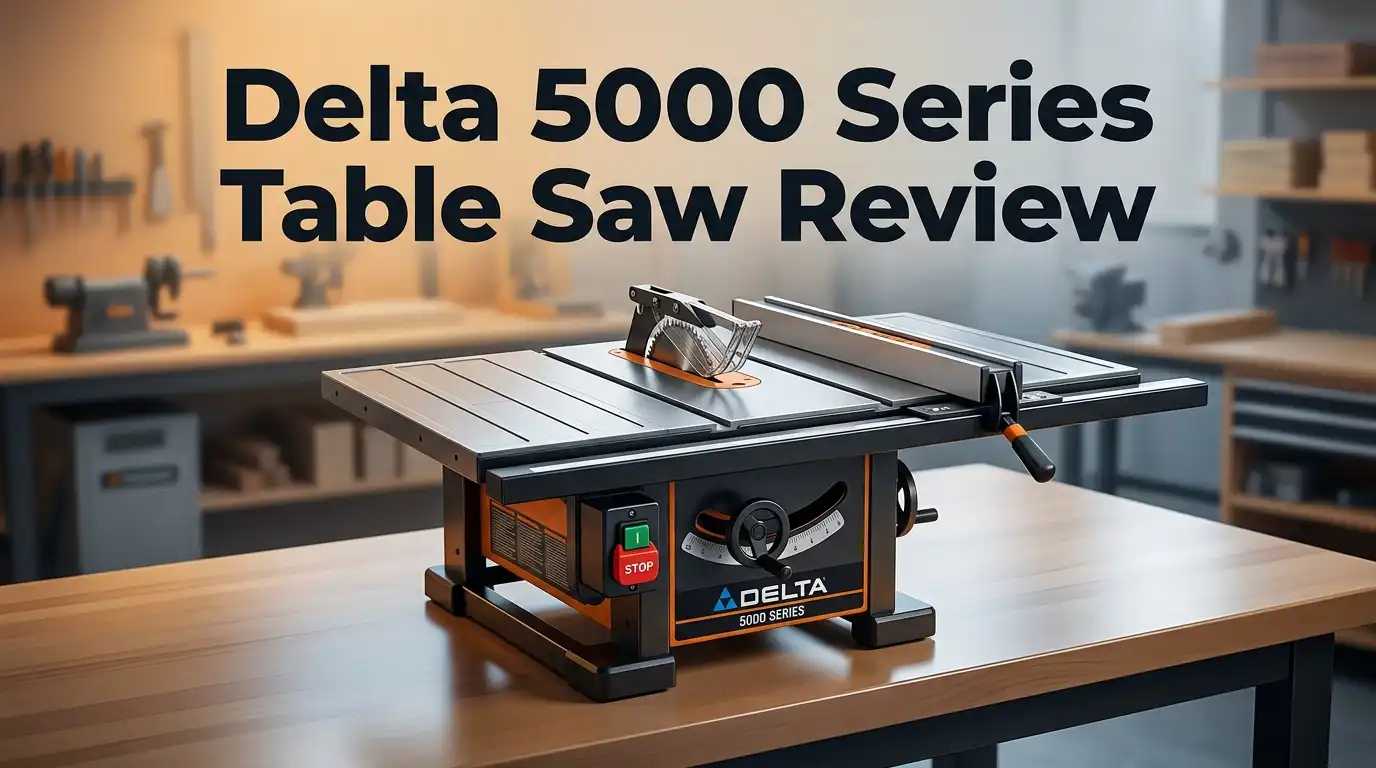
Delta 5000 Series Table Saw Review 2026: Worth It?
The Delta 5000 series sits in that tricky middle space between a jobsite saw and a full cabinet saw. It costs real money. It weighs well over 200 pounds.
And it promises cast iron accuracy with a contractor saw footprint. So the question nearly every buyer asks is simple. Does this saw actually earn its price in 2026, or is the used cabinet saw market a smarter play?
This review covers the unboxing, the assembly headaches, the fence, the dust collection, and the parts Delta still gets wrong. No fluff. No marketing talk. Just what you need before you spend over a thousand dollars.
In a Nutshell:
- The fence is the star. The Biesemeyer style fence with a one piece rail system locks square and stays square. Most owners report almost no adjustment needed out of the box, which is rare at this price.
- Power is adequate, not amazing. The 15 amp induction motor runs at 3450 RPM and is rated near 1.75 HP. It rips hardwood fine. It is not a 3 HP cabinet saw, and it will bog in thick wet oak if you rush the feed.
- Cast iron matters here. The cast iron top gives you flat reference surfaces and low vibration. The stamped steel extension wings on cheaper models flex and ring, so the cast wing versions are worth the upgrade.
- Assembly takes two people and two hours. This is the biggest complaint. Parts are heavy, the stand needs careful squaring, and moving it into a basement alone is miserable.
- Dust collection is good for an open frame design. The 2.5 inch port pulls most chips, but expect floor cleanup because the base is not enclosed.
- Value depends entirely on your options. At current pricing near $1,600 to $1,800, a used Unisaw or Powermatic beats it on raw power. If you want new, warrantied, and precise, the Delta makes sense.
What Is the Delta 5000 Series Table Saw?

Last update on 2026-10-19 / Affiliate links / Images from Amazon Product Advertising API
The Delta 5000 series is a family of 10 inch left tilt contractor table saws. Delta built this line for carpenters, remodelers, and serious hobby woodworkers who need cabinet saw accuracy without cabinet saw weight.
Every model shares the same core. You get a 15 amp induction motor, a 5/8 inch arbor, 3450 RPM, a belt drive, and a cast iron table. Blade tilt runs 45 degrees to the left. Dado capacity is 13/16 inch by 8 inch stacked.
The models differ mainly in rip capacity and wing material. The 36-5000T2 gives you 30 inches of rip. The 36-5100T2 stretches to 50 inches. The 36-5052T2 pushes to 52 inches with cast iron wings.
Think of it as a Unisaw lite. Same Delta design language, same fence family, lighter frame, lower price.
Unboxing Experience and First Impressions
The box arrives on a pallet. That tells you everything. Mine showed up strapped down with the saw body nested in heavy foam and the rails packed in a long separate carton.
First impression? The cast iron top is genuinely nice. It came coated in that familiar oily shipping film, and it took a rag plus mineral spirits to clean off. Underneath, the machining was smooth with no casting pits.
The fence felt heavy in a reassuring way. The rails were straight. The hardware came in labeled bags, which saved real time.
What disappointed me was the included blade. It is a basic carbide tipped unit that cuts, but it leaves saw marks in plywood. Budget for a quality 40 tooth combination blade immediately. The throat plate also felt thin and tinny compared to the rest of the machine.
Assembly and Setup Experience
Delta claims quick assembly with fewer parts. That claim is half true. The stand goes together fast. Lifting a 200 plus pound saw body onto that stand does not.
Get a helper. Seriously. Two people turn this into a one hour job. One person turns it into a two hour fight with a risk of a dropped casting.
The rail installation is where patience pays. You must set the rails parallel to the blade before you trust any fence reading. Most owners found alignment was close out of the box, needing only small tweaks.
The wings need attention too. Bolt them on loosely, lay a straightedge across the seam, then tighten in steps. A card scraper and a feeler gauge help here. Expect to spend an extra 30 minutes dialing in flatness if you want glue ready rip cuts.
Top 3 Alternatives for Delta 5000 Series Table Saw


Last update on 2026-10-17 / Affiliate links / Images from Amazon Product Advertising API
DEWALT DWE7491RS Table Saw

Last update on 2026-10-17 / Affiliate links / Images from Amazon Product Advertising API
SKILSAW SPT99 Worm Drive Table Saw

Last update on 2026-10-17 / Affiliate links / Images from Amazon Product Advertising API
JET ProShop II JPS-10 Table Saw
Motor Power and Cutting Performance
The 15 amp induction motor is the heart of this saw. Delta rates the contractor grade motor around 1.75 HP on 120 volts, and the dual voltage models accept a 240 volt setup for better efficiency.
In real cutting, the saw handles 4/4 and 6/4 hardwood without complaint. Ripping hard maple at a steady feed produced clean, square edges with no burning.
Push into 8/4 white oak and you will hear the motor load up. It recovers, but you must slow the feed rate. That is normal physics for a sub 2 HP saw, not a defect.
The belt drive deserves credit. Vibration is noticeably lower than any direct drive jobsite saw. A nickel stands on edge on the table while the saw idles. Blade brake stopping also works as advertised, killing blade spin within seconds of shutdown.
The Biesemeyer Style Fence System
This is why people buy the 5000 series. The Biesemeyer style fence rides on a heavy duty one piece rail, and it clamps with a single front lever.
The fence body is tall and square. It stays parallel when you lock it, which is the whole point. Dual rip windows let you read measurements from either side of the blade, and that detail saves time during repeat cuts.
Deflection is minimal. Push hard against the far end of the fence and you get almost no movement.
The design also lets you flip or shift the fence face to support thin stock. That flexibility beats most fences in this price class.
My one gripe? The cursor needs recalibration after any blade change if you depend on the scale. Measure from the blade teeth for critical cuts instead of trusting the tape.
Cast Iron Table and Extension Wings
The main table measures 20 inches wide by 27 inches deep. Add wings and you reach roughly 40 inches of surface on the cast models, or about 50 inches wide with the steel wing setups plus the extension board.
Cast iron is the right call here. It damps vibration, resists dents, and stays flat over decades. Owners consistently recommend choosing cast wings over stamped steel if the budget allows.
The stamped steel wings on lower models work, but they are thinner, they ring under load, and they need more fussing to get coplanar.
Maintenance is simple. Wipe the top, apply paste wax or a dry lubricant, and keep moisture off it. Surface rust is the only real enemy of a cast iron table.
Miter slots are standard T slot size, so aftermarket sleds and gauges fit without modification.
Mobility and the Tubular Stand
Delta built the 5000 series on a tubular steel stand with integrated wheels. You get two fixed wheels and one swivel wheel.
The stand itself is solid. It does not rack, and it keeps the saw stable during heavy rip cuts. Footprint is reasonable for a one car garage shop.
Mobility is the mixed part. The wheel layout works like a wheelbarrow. You lift one end slightly and push. It rolls fine across a smooth concrete floor.
Owners describe the three wheel arrangement as awkward to steer in tight spaces. With one swivel wheel, precise repositioning takes a few back and forth moves.
If you plan to move the saw daily, a separate universal mobile base gives better control. For a shop where the saw moves once a month, the built in system is fine.
Dust Collection Performance
The saw uses a 2.5 inch dust port, and a 4 inch adapter ships in the box. That means it connects to both a shop vacuum and a real dust collector.
Hooked to a 4 inch collector, pickup is surprisingly good for an open base design. Most of the chips from below the table get captured before they reach the floor.
Here is the honest limitation. The frame is open. Fine dust escapes through the bottom and settles under the saw. You will still sweep after a long session of sheet goods.
The blade guard has no overhead dust port, so above table dust goes into the air. Wear a respirator for MDF work.
Owners who skirt the stand with plywood panels report a noticeable improvement. That simple mod costs twenty dollars and fixes most of the complaint.
Safety Features Worth Knowing

Last update on 2026-10-19 / Affiliate links / Images from Amazon Product Advertising API
Delta includes a modern safety package. The split guard design is tool free, and the riving knife rises and falls with the blade.
A lever inside the throat plate controls the riving knife position. That beats fumbling with wrenches, and it means people actually keep the knife installed.
Anti kickback pawls attach without tools as well. They bite into the workpiece and resist a dangerous launch during ripping.
The on off switch is large, paddle style, and easy to slap with a knee or hip. That matters in an emergency.
The blade brake adds real value. It stops rotation within seconds of power off, which reduces the window where a spinning blade can catch a hand or sleeve.
None of this replaces push sticks, featherboards, and good habits. This saw has no flesh detection technology, so your attention remains the primary safety device.
Model Comparison: Which 5000 Series Saw Fits You?
Picking the right model comes down to rip capacity and wing material.
The 36-5000T2 offers 30 inches of right rip with steel wings. It weighs roughly 230 pounds. Choose it for a small shop where space beats sheet goods capacity.
The 36-5100T2 gives 50 inches of rip. Owners who break down full plywood sheets love it, though it eats floor space.
The 36-5052T2 is the flagship. You get 52 inches of right rip, 15 inches left of blade, cast iron wings, and about 269 pounds of mass. Length with rails reaches almost 85 inches.
All three share the same motor, same fence family, and the same 3 1/8 inch depth of cut at 90 degrees. Depth at 45 degrees drops to 2 1/4 inches across the line.
What the Delta 5000 Series Does Not Do Well
Honest reviews name the flaws, so here they are.
The throat plate is too thin. Making a zero clearance insert from the stock plate is frustrating. Many owners simply buy the dado insert or an aftermarket plate, which adds cost.
Price creep hurt this line. At roughly $1,600 to $1,800, the 5000 series now sits uncomfortably close to entry level cabinet saws with more power.
Assembly is a two person job, and Delta’s marketing undersells that reality.
Dust escapes the open base. Expect cleanup.
The included blade is forgettable. Plan on replacing it.
Customer ratings are mixed. Some Amazon listings show low average scores from small sample sizes, often tied to shipping damage on a heavy pallet item rather than the machine itself. Inspect the crate before you sign for delivery.
Pros and Cons of the Delta 5000 Series Table Saw
Pros
- Biesemeyer style fence locks square and resists deflection better than almost anything in this price range
- Cast iron table top stays flat, damps vibration, and lasts for decades
- Belt drive induction motor runs quieter and smoother than direct drive jobsite saws
- Tool free riving knife and anti kickback pawls make safety gear easy to keep installed
- Blade brake stops the blade within seconds for added protection
- Large rip capacity options up to 52 inches handle full sheet goods
- Dual voltage wiring lets you run 240 volts for better efficiency
- Dado capacity of 13/16 inch by 8 inch supports joinery work
- Delta backs the line with a 5 year pledge
Cons
- Heavy assembly that genuinely requires a second person
- Thin throat plate makes DIY zero clearance inserts difficult
- Open base leaks fine dust onto the shop floor
- Motor bogs in thick hardwood if you feed too fast
- Three wheel mobility system steers awkwardly in tight shops
- Included blade needs immediate replacement
- Price now overlaps used cabinet saws with more power
- Fence cursor needs recalibration after blade swaps
Who Should Buy the Delta 5000 Series?
This saw fits a specific buyer. You want new tool reliability, a warranty, and precision out of the box, and you are willing to pay for it.
It suits the serious hobby woodworker building furniture and cabinets in a garage shop. Rip accuracy and a flat cast iron top matter more to that person than raw horsepower.
It suits the finish carpenter who needs a shop saw that handles trim, plywood, and hardwood without the bulk of a cabinet saw.
Skip it if you cut thick hardwood all day. Buy a 3 HP cabinet saw instead.
Skip it if you move the saw to jobsites. A DEWALT or SKILSAW jobsite unit is far more practical.
Skip it if you enjoy hunting used machines. A grand buys a lot of vintage iron on the secondhand market.
Price, Value, and Warranty in 2026
Current pricing places the 5000 series roughly between $1,600 and $1,800 depending on model and rip capacity. The 36-5052T2 sits near the top of that range.
That price raises fair questions. The Delta 36-725T2, a close cousin with the same motor and a similar fence, often sells for far less at big box retailers. Many owners argue the cheaper model delivers 85 percent of the performance.
Where the 5000 series earns its premium is build quality. Heavier rails, better wings, cast iron options, and a sturdier stand add up.
Delta backs the line with a 5 year warranty, and parts availability remains solid thanks to the company’s long history and published service parts lists.
Value verdict? Fair if you buy on sale. Harder to justify at full retail against used cabinet saws.
Final Verdict: Is the Delta 5000 Series Worth It in 2026?
Yes, with conditions. The Delta 5000 series is a genuinely accurate, well built contractor saw with one of the best fences in its class.
Buy it if you want a new machine, you value the fence and cast iron top, and you can catch it during a promotion. You will get clean, repeatable cuts for years.
Do not buy it expecting cabinet saw muscle. The motor is honest but modest.
My recommendation leans toward the cast iron wing models. The extra mass pays off every single cut.
Add a quality blade, an aftermarket zero clearance plate, and a skirt around the stand for dust. With those three cheap upgrades, this saw performs close to machines costing far more.
Frequently Asked Questions
How much horsepower does the Delta 5000 series have?
The saw uses a 15 amp induction motor rated near 1.75 HP at 120 volts. Delta lists amperage rather than horsepower on some documents, which causes confusion. The motor runs at 3450 RPM and accepts 240 volt wiring on dual voltage models.
What is the maximum cutting depth?
You get 3 1/8 inches of depth at 90 degrees and 2 1/4 inches at 45 degrees. That handles 4x material in two passes and all standard sheet goods.
Can I install a dado stack?
Yes. The arbor supports a stacked dado up to 13/16 inch wide and 8 inches in diameter. You need the separate dado throat plate, which Delta sells as an accessory.
Does the Delta 5000 series come assembled?
No. It ships in a crate on a pallet and needs full assembly. Plan for one to two hours and bring a helper, because the saw body alone weighs over 200 pounds.
Is the fence a real Biesemeyer?
It is a Biesemeyer style fence built on the same design principles, with a single front lock and a one piece rail. It is not the premium Biesemeyer unit sold for cabinet saws, but it performs very close.
How good is the dust collection?
Good for an open frame saw. The 2.5 inch port with a 4 inch adapter captures most below table chips. Fine dust still escapes the open base, so expect light floor cleanup after each session.
Should I buy the 30 inch or 52 inch rip model?
Choose 52 inches if you break down full plywood sheets regularly. Choose 30 inches if shop space is tight. The 52 inch version stretches nearly 85 inches wide with rails installed.

Hi, I’m Leah Ray — the voice behind CraftBench Vault. I’m a passionate woodworking enthusiast dedicated to reviewing the best wood cutting tools and woodworking products. Through honest research and hands-on experience, I help fellow crafters make smarter buying decisions. Welcome to my workshop!