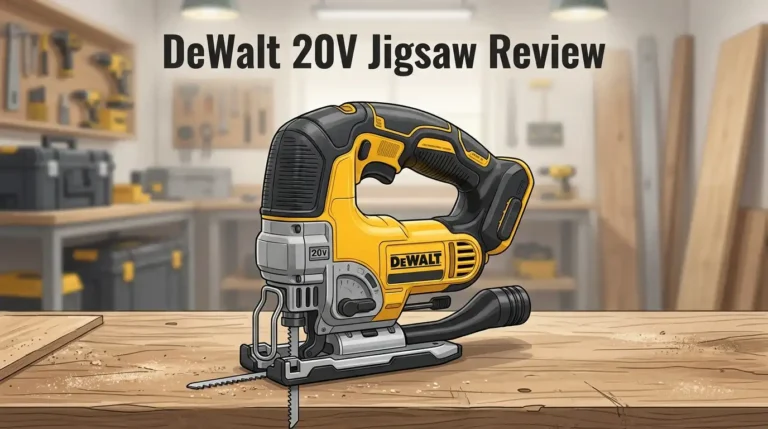
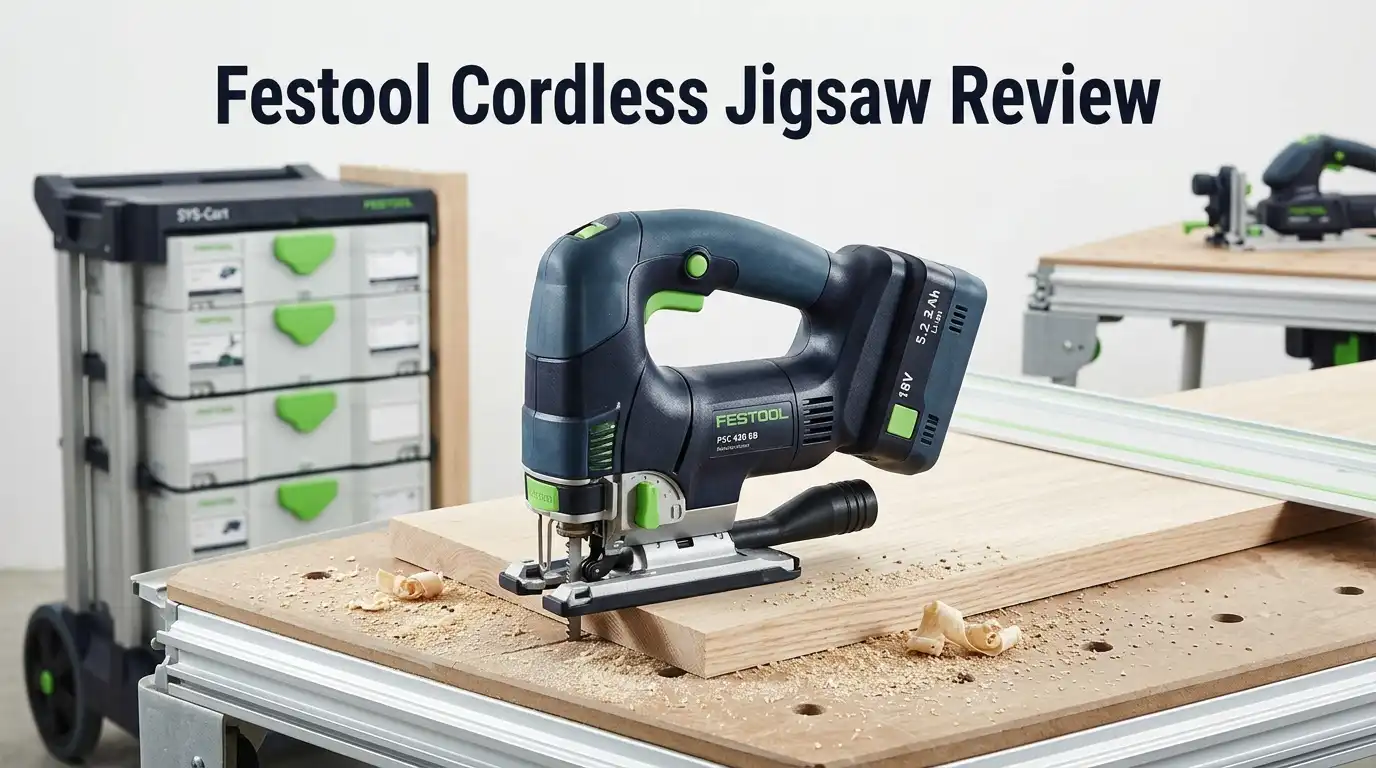
Festool Cordless Jigsaw Review 2026: Worth It?
Most jigsaws wander. You draw a clean line, you follow it carefully, and the blade still drifts off course by the time you reach the end of the cut. Then you flip the board over and find a torn, fuzzy edge waiting for you.
The Festool Carvex promises to fix both problems. It costs three times what a Makita or DeWalt costs, which makes every buyer pause. So the real question is simple. Does the premium price buy real performance, or does it buy a green plastic case and a reputation?
I spent weeks cutting plywood, hardwood, melamine, and aluminium with this saw. I liked a lot of it. I disliked some of it more than I expected. Here is the honest version.
In a Nutshell:
- Cut quality is the headline feature. The triple blade guide plus the zero clearance Splinterguard gives square edges and almost no tearout on veneered plywood and melamine. This is the main reason people pay Festool money, and the saw delivers on it.
- The strobe light is clever but divisive. A synced LED freezes the blade so it looks like it is standing still. Some users love it. Others find it gives them eye strain and wish Festool offered a plain fixed work light instead. You can switch it off.
- Dust extraction is genuinely good, not perfect. Hooked to a CT extractor, the Carvex clears most of the cut line so you can actually see your pencil mark. It still leaks dust around the shoe on bevel cuts.
- Blade changes frustrate people. The release lever feels stiff, and the blade sometimes needs coaxing to seat properly. Several long term owners list this as their biggest complaint.
- Price is the real barrier. The bare tool runs around $400 to $500, and a kit with battery, charger, and Systainer climbs well past that. You are paying roughly triple the price of a capable DeWalt or Makita barrel grip.
- Best fit: finish carpenters, cabinet installers, and woodworkers who cut expensive veneered sheet goods daily. Weekend users will struggle to justify the spend.
Festool Carvex PSC 420 EB Basic Barrel Grip

Last update on 2026-10-18 / Affiliate links / Images from Amazon Product Advertising API
This is the barrel grip version, and it is the one most woodworkers choose. Your hand sits low and directly over the blade, which gives you far better feel during curved cuts. You steer with your palm instead of your wrist.
The brushless EC TEC motor pushes 1,500 to 3,800 strokes per minute with a 1 inch stroke length. Maximum depth in wood is 4 3/4 inches, and roughly 3/8 inch in soft steel. Weight sits near 4 pounds bare, so it feels dense rather than heavy.
The barrel grip also lets you rotate the dust port out of your way, a small detail the D handle version does not share. Four pendulum settings cover everything from clean veneer cuts to fast rough work in construction lumber.
Festool Carvex PSBC 420 D Handle Version

Last update on 2026-10-18 / Affiliate links / Images from Amazon Product Advertising API
The D handle model uses the identical motor and base system. The difference is purely how you hold it. A top mounted handle with a variable speed trigger sits above the body, which many carpenters prefer for overhead cuts and one handed work on site.
The trigger matters more than people expect. You feather the speed as you enter a cut, which reduces chipping on laminate. On the barrel grip you set speed with a dial beforehand and live with it.
Ergonomics split opinion here. Some users report hand fatigue after long sessions because the grip is tall and the saw sits high. Others say it feels natural immediately. If you can, hold both versions in a store before you commit your money.
Unboxing Experience
The Systainer arrives feeling heavier than you expect. Open the latch and the saw sits in a moulded insert, blade already fitted, with a surprisingly sparse set of extras.
You get the saw, two T shank wood blades, a chip catcher, and the Splinterguard. That is it on the Basic version. No battery. No charger. No extra base plates. The first reaction from most buyers is mild disappointment, because the box looks half empty for the price.
What does impress is the fit and finish. Panel gaps are tight, the base plate slides off without tools in about four seconds, and the switchgear has a solid mechanical click to it. The Systainer itself stacks with the rest of the Festool system, which becomes useful fast if you already own a CT extractor.
Top 3 Alternatives for Festool Carvex Jigsaw


Last update on 2026-10-18 / Affiliate links / Images from Amazon Product Advertising API
Makita XVJ01Z 18V LXT Brushless Barrel Grip Jig Saw

Last update on 2026-10-18 / Affiliate links / Images from Amazon Product Advertising API
DEWALT DCS335B 20V MAX XR Cordless Barrel Grip Jig Saw

Last update on 2026-10-19 / Affiliate links / Images from Amazon Product Advertising API
Makita XVJ03Z 18V LXT Lithium Ion Cordless Jig Saw
Cutting Performance on Real Material
I ran the Carvex through 3/4 inch birch plywood, 1 1/2 inch hard maple, melamine shelving, and thin aluminium sheet. The plywood results were the standout. With a fine tooth blade and the Splinterguard seated, both faces came out clean enough to glue up without sanding.
Square cuts are where this saw earns its reputation. The triple blade guide grips the blade on three sides and stops the lean that plagues cheaper saws. I measured my edges with a square and found almost no drift across a 4 foot cut.
Thick hardwood slows it noticeably. At full depth in maple the motor bogs if you push, so you learn to let the blade set the pace. Aluminium cut fine with cutting wax and a metal blade, though the chips get everywhere.
The Stroboscopic Light Explained
This feature confuses people, so here is the plain version. An LED pulses in sync with the blade movement. At the right speed the blade appears frozen in place, which lets you see your line clearly instead of watching a blurred smear of steel.
When it works, it works well. You track a pencil line in low light with unusual accuracy. The problem is that it only syncs properly in certain speed ranges, and outside those ranges the blade looks like it is slowly crawling, which is distracting.
A real complaint from long term owners is eye strain. Some simply turn the strobe off and use the light in steady mode. Festool deserves credit for making it switchable, but calling this a must have feature overstates things.
Dust Extraction and Visibility
Connect a 27mm hose to a Festool CT extractor and the Carvex pulls most of the dust straight off the cut line. Combined with the chip catcher, you can cut MDF indoors without creating a fog in the room.
It is not sealed, though. Dust escapes around the shoe whenever you bevel the base, and the chip catcher has to come off for some cuts, which immediately drops performance. On a cordless setup with no vacuum attached, expect a normal pile of sawdust like any other jigsaw.
Compared with a Bosch or Makita, extraction is clearly better but not in a different league. The visibility gain is the real benefit. Seeing your line while cutting a curve in dark walnut changes how accurate you can be.
Blade Changes and the Release Mechanism
Here is the part that annoys owners most. Festool uses a lever release, and the blade drops free when you flip it. In theory this is fast and toolless.
In practice the lever feels stiff, the blade sometimes needs a push to seat fully, and the chip catcher gets in the way. Several experienced users describe blade changing as the weakest part of the tool. I share that view after dozens of swaps.
The saw also uses standard T shank blades, which is good news. You are not locked into Festool consumables, though the Festool blades do cut noticeably cleaner than bargain packs. There is an arbor reset function if the blade mount gets knocked out of alignment, which is a thoughtful touch.
Battery Life and Runtime
The Carvex runs on the standard Festool 18V platform. A 4.0Ah pack gives plenty of cutting for a work day of trim and cabinet installs. Rough cutting thick stock drains it much faster, as you would expect.
Runtime is adequate rather than impressive. The brushless motor is efficient, but a jigsaw under load pulls hard. I would not plan a full day of 2 inch hardwood cutting on a single battery.
The bigger issue is ecosystem cost. If you do not already own Festool batteries, add a charger and two packs to your budget. That pushes a complete setup past the price of three competing jigsaw kits. Festool batteries also do not fit other brands, which locks you in further.
Base Plates and Accessory System
The base changes without tools. Press the release, slide the old shoe off, slide the new one on. It takes seconds and the system feels secure.
Festool sells angle bases for bevel cuts, a circle cutting attachment, a guide rail adapter, and various hard and soft shoes for different materials. The guide rail adapter is the genuinely useful one because it lets you make long straight cuts with rail accuracy.
Here is the catch. Almost every accessory costs extra, and the prices follow Festool logic rather than hardware store logic. The base angle unit alone runs well over a hundred dollars. The modular design is excellent engineering, but it functions as an upsell path, and buyers should factor that in honestly.
What the Festool Carvex Does Not Do Well
Authentic reviews need to say this clearly. The Carvex has real weaknesses.
Blade changing is fiddly and feels cheap relative to the price. The strobe causes eye strain for a meaningful number of users. There is no built in tilting base on the standard model, so bevel cuts require buying a separate shoe, which competitors include as standard.
Ergonomics are polarising. Multiple owners report hand discomfort after extended use, and the saw sits taller than rivals. Cut consistency in thick hardwood disappoints some buyers who expected magic for the money.
The price is the biggest flaw. At roughly triple a DeWalt barrel grip, the performance gap is real but not threefold. You are paying for the last ten percent of accuracy.
Pros and Cons
Pros
- Outstanding cut squareness thanks to the triple blade guide, which keeps edges at 90 degrees even on long cuts
- Near zero tearout on veneered plywood and melamine with the zero clearance Splinterguard fitted
- Excellent dust extraction with a CT vacuum, which keeps your cut line visible throughout
- Toolless base plate swaps that take seconds and lock down securely
- Smooth brushless motor with four pendulum settings and low vibration
- Accepts standard T shank blades, so you are not tied to proprietary consumables
- Systainer storage integrates with the wider Festool system
Cons
- Very high price, roughly triple comparable brushless barrel grip saws
- Blade release mechanism feels stiff and awkward in daily use
- Strobe light causes eye strain for some users and only syncs in certain speed ranges
- No bevel base included, sold as a separate accessory
- Ergonomics divide opinion, with reports of hand fatigue
- Battery and charger usually sold separately, raising true cost further
The New PSC-E 18 Compact Option
Festool recently added a smaller jigsaw to the range. The PSC-E 18 strips the concept back to essentials. It weighs around 2.3kg, handles material up to a modest thickness, and cuts at 90 degrees only.
No bevel. No strobe. No swappable bases. That sounds like a downgrade until you handle it. Early users describe it as noticeably lighter and easier to control than the Carvex for straightforward work.
If you mostly cut sheet goods square and value handling over features, this model deserves a look. It also costs less than the Carvex. The trade off is obvious. You lose the versatility that justifies the Carvex platform in the first place, so choose based on the cuts you actually make.
Who Should Buy the Festool Carvex
Buy it if cut quality directly affects your income. Cabinet installers, finish carpenters, and furniture makers working in veneered or prefinished material will recover the cost in reduced sanding and fewer ruined panels.
Buy it if you already own Festool batteries and a CT extractor. The saw performs best inside its own ecosystem, and you skip the extra battery spend.
Skip it if you cut plywood a few weekends a year. A Makita XVJ01Z or DeWalt DCS335B gives you eighty percent of the result for a third of the price, and the difference will not show in most projects.
Skip it if blade changes and small annoyances bother you. Precision at this price should come without friction, and here it does not quite.
Frequently Asked Questions
Is the Festool Carvex worth the price in 2026?
It is worth it for professionals cutting expensive material daily. The squareness and tearout control are measurably better than cheaper saws. For hobby use the value case falls apart quickly.
Does the Carvex use standard jigsaw blades?
Yes. It accepts common T shank blades from Bosch, Makita, and others. Festool blades cut cleaner, but you are not locked in.
Barrel grip or D handle, which should I choose?
Choose barrel grip for curves, bench work, and maximum control. Choose the D handle for site work, overhead cuts, and the variable speed trigger. Hold both first if possible.
Can I turn the strobe light off?
Yes. The light switches to steady mode. Many owners run it that way permanently to avoid eye strain.
Does it bevel out of the box?
No. The standard base cuts at 90 degrees only. Bevel cuts need the separate angle base accessory, which costs extra.
How does it compare with the DeWalt DCS335B?
The DeWalt cuts well and costs far less. The Festool wins on cut squareness, dust extraction, and base versatility. The gap is real but smaller than the price difference suggests.

Hi, I’m Leah Ray — the voice behind CraftBench Vault. I’m a passionate woodworking enthusiast dedicated to reviewing the best wood cutting tools and woodworking products. Through honest research and hands-on experience, I help fellow crafters make smarter buying decisions. Welcome to my workshop!