
Jet Table Saw Review 2026: Worth The Money?
Buying a table saw feels like a big commitment. You spend real money. You give up real floor space. And you live with that choice for the next decade.
Jet sits in an interesting spot in 2026. The brand costs more than DeWalt. It costs less than SawStop. It promises cabinet saw quality in a contractor saw body. That promise sounds great on paper. But paper does not cut plywood.
This review covers the good, the frustrating, and the parts Jet does not advertise. You will learn how it rips hardwood, how the fence holds a setting, why the dust collection disappoints, and whether the price still makes sense next to newer competition.
In A Nutshell:
- Build quality is the main reason to buy Jet. The cast iron table, the heavy trunnions, and the single belt drive all feel a class above most hybrid saws. Vibration stays low. A nickel stands on edge while the blade spins.
- The ProShop fence is genuinely excellent. It locks parallel, slides smoothly, and repeats cuts within a few thousandths. This fence alone separates Jet from budget saws.
- The 1.75 HP motor has limits. It rips 8/4 hard maple, but it slows down. A thin kerf blade is not optional. It is required.
- Dust collection underperforms the marketing. The shroud helps. The open bottom cabinet still leaks fine dust onto your floor.
- There is no flesh detection technology. In 2026 that matters. SawStop owns that feature, and safety conscious buyers notice the gap.
- Value depends on your patience level. Jet rewards woodworkers who tune machines and keep them for twenty years. It frustrates people who want plug and play convenience.
Why Jet Still Matters In 2026


Last update on 2026-10-23 / Affiliate links / Images from Amazon Product Advertising API
Jet has been selling woodworking machines since 1958. The brand started as an importer and grew into a full line manufacturer. Today Jet sits under the JPW Industries umbrella alongside Powermatic, which is the premium stablemate.
That family connection explains a lot. Jet machines borrow engineering from Powermatic and sell for less. You get similar castings, similar fence logic, and similar service support without the yellow paint premium.
In 2026 the table saw market splits into three camps. Budget jobsite saws dominate the under six hundred dollar space. Safety focused cabinet saws own the top. Jet lives in the middle, where serious hobbyists shop.
This middle ground is shrinking. Jobsite saws got better. Rack and pinion fences now hold decent accuracy. Meanwhile safety technology pushed premium buyers upward. Jet has to justify its position with pure mechanical quality.
It mostly succeeds. Owners who have run Jet saws for fifteen years report almost no drift in accuracy. Trunnions stay put. Arbors stay true. Bearings keep quiet. That kind of longevity rarely shows up in early reviews, because early reviews only cover the first month.
Jet also wins on parts availability. Fence faces, belts, switches, and inserts all stay in stock. Try finding a replacement trunnion for a discount brand saw from 2015. You cannot. Long term serviceability is an underrated buying factor, and Jet handles it well.
Jet ProShop II 10 Inch Table Saw
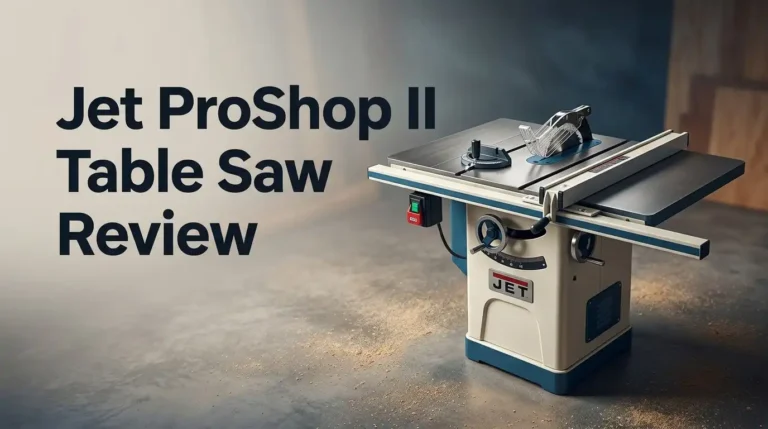
The ProShop II is the saw most people mean when they say “Jet table saw.” It carries the model number JPS-10 and sells in several versions. You choose 30 inch or 52 inch rip capacity. You choose cast iron wings or steel wings. You choose 115V or 230V wiring.
The core specs stay the same across versions. The motor makes 1.75 HP and pulls 14.8 amps on a 115V circuit. Arbor speed reaches 4000 RPM. Maximum cut depth measures 3.125 inches at 90 degrees and 2.125 inches at 45 degrees. The cast iron table measures 20 by 27 inches before you add wings.
Jet calls this a contractor style saw, but the design borrows heavily from cabinet saws. You get a magnetic paddle switch. You get a quick release riving knife plus a low profile riving knife for non through cuts. You get an arbor lock for fast blade changes. You get a 4 inch dust port and a blade shroud.
The single belt drive deserves attention. Older contractor saws used multiple belts that needed constant tensioning. Jet simplified this. Tensioning takes one adjustment, and vibration drops noticeably.
Table height sits at 34.75 inches, which suits most users without a riser. Dado capacity reaches 8 inches diameter and 13/16 inch width. The miter gauge uses standard T slots, so aftermarket sleds and gauges fit without modification.
This is a saw built for a one person shop that runs real projects, not a saw built for a framing crew.
Unboxing And First Impressions
The delivery arrives on a pallet. That is your first clue. This machine weighs well over two hundred pounds packed, and the freight driver will not carry it into your garage. Plan for help or a pallet jack.
The crate opens from the top. Inside you find the main cabinet strapped down, the table wings boxed separately, the fence rails in a long sleeve, and a parts carton holding hardware, the miter gauge, both riving knives, the blade guard, and the wrenches.
Everything arrives coated in shipping grease. This surprises first time buyers. The cast iron table looks almost black under that film. Mineral spirits and paper towels handle it. Budget twenty minutes for cleaning alone, and do it before assembly so you can see machined surfaces clearly.
The castings feel serious. Lifting a single table wing tells you where your money went. Edges come machined flat, and the mounting bolt holes line up without persuasion.
The fence is the showpiece. It slides out of its box heavier than expected, with a solid extruded body and replaceable laminate faces. The cam lock clamps with a satisfying click rather than a wobble.
Not everything impresses. The blade guard plastic feels adequate rather than premium. The included blade is a basic 40 tooth combination unit that you will replace within a month. The manual uses small diagrams that require good lighting and patience.
First impression overall: this feels like a machine, not an appliance.
Assembly And Setup Time
Give yourself a full afternoon. Three to four hours is realistic for one person working carefully. Two people cut that roughly in half, mostly because the table wings and fence rails need steady hands.
The order matters. Mount the base and stand first. Bolt the wings next, then attach the front and rear rails, then install the fence and finally the blade guard assembly.
Wing alignment takes the longest. You want the wings dead flush with the main table, and Jet leaves that to you. The trick is to clamp a long straightedge across the joint, snug the bolts lightly, tap the wing with a rubber mallet until the straightedge shows no gap, then torque down. Rushing this step haunts you later, because a low wing drags your workpiece.
Blade to slot alignment usually arrives close from the factory. Check it anyway with a dial indicator on a miter bar. Owners commonly report needing a small adjustment, often under 0.005 inches. The trunnions adjust from underneath, and the process works better than on many competitors because the bolts are accessible.
Fence squaring takes ten minutes. Loosen two bolts, align the fence to the miter slot, retighten.
Dust collection hookup is simple. The 4 inch port accepts standard hose. Jet asks for a minimum of 350 CFM, so a shop vacuum will not do the job properly.
Once dialed in, the saw holds its settings remarkably well.
Top 3 Alternative For Jet ProShop II Table Saw

Last update on 2026-10-23 / Affiliate links / Images from Amazon Product Advertising API
DEWALT Table Saw 10 Inch with Foldable Rolling Table Saw Stand

Last update on 2026-10-23 / Affiliate links / Images from Amazon Product Advertising API
SawStop Jobsite Saw PRO with Mobile Cart Assembly

Last update on 2026-10-23 / Affiliate links / Images from Amazon Product Advertising API
BOSCH 4100XC-10 10 In. Worksite Table Saw with Gravity Rise Wheeled Stand
Cutting Power And Motor Performance
Here is where honesty matters most. The 1.75 HP motor on a 115V circuit is good, not great.
Softwoods disappear. Plywood, MDF, poplar, and pine all cut without any drop in RPM. Sheet goods feel effortless because the cast iron table supports the material and the low vibration keeps the cut clean.
Hardwood changes the conversation. Ripping 4/4 oak or maple works fine at a steady feed rate. Ripping 8/4 hard maple makes the motor work audibly. You hear the pitch drop. Push too fast and the thermal overload trips. That reset switch on the power panel exists for a reason, and you will meet it eventually.
Two things fix most of this. First, run a thin kerf blade with a low tooth count for ripping. A 24 or 30 tooth thin kerf blade removes less material and transforms the experience. Multiple owners describe this upgrade as night and day. Second, rewire to 230V if your shop allows it. The motor supports it, amp draw halves, and voltage sag under load disappears.
Choose the 230V version if you have the circuit. The performance gain costs nothing extra at purchase.
Compared to a true 3 HP cabinet saw, the ProShop II simply has less muscle. It will not rip thick wet lumber all day. It will handle furniture scale hardwood work at a reasonable pace, which describes what most home shops actually do.
Fence Accuracy And Rip Capacity
The ProShop fence system is the best part of this saw. That is not marketing language. It is the consistent theme in owner feedback across forums and retailer reviews.
The fence body uses a heavy extrusion with laminate faces on both sides. It rides on a front rail with a rear support, and the cam lock engages with firm pressure. Set it, lock it, and it stays.
Accuracy holds within a few thousandths of an inch across the travel when properly adjusted. That means repeat cuts match. It means a rip at 12 inches measures 12 inches at the front and back of the blade. For joinery work this matters more than horsepower.
Rip capacity depends on your version. The 30 inch model rips 30 inches right of the blade and 13.5 inches left. The 52 inch model handles full sheet goods with room to spare.
Pick carefully. The 30 inch version saves roughly two feet of shop width, which small garages need. The 52 inch version makes cutting plywood far easier but eats space and costs more.
One documented annoyance exists. Some owners who bought extended rails separately found the fence body sitting slightly narrower than the rails, creating a small fitment gap. It does not affect accuracy, but it looks unfinished.
The scale and cursor read accurately after calibration. Recheck the cursor after your first blade change.
Dust Collection Reality Check
Jet advertises an improved dust shroud around the blade and a 4 inch port. Both exist. Both help. Neither solves the problem completely.
With a real dust collector pulling 350 CFM or more, the saw captures most of the sawdust generated below the table. Chips leave through the port. The shroud directs material toward the outlet instead of letting it pile inside the cabinet.
The weakness sits in the cabinet design. This is a contractor style body, not a fully enclosed cabinet. Air leaks in from multiple openings, which kills static pressure and lets fine dust escape onto the floor and the motor housing. Owners consistently describe dust collection as the weakest feature.
Above the table, nothing gets captured unless you add an overarm guard with its own hose. The stock blade guard has no dust port. For crosscuts and dado work, dust sprays upward.
Three fixes help. Seal the visible gaps in the lower cabinet with foam tape or sheet metal. Add an overarm dust collection guard from an aftermarket supplier. Run a proper collector rather than a shop vacuum, because vacuums produce high suction and low volume, which is the wrong combination here.
Expect to sweep after every session. If a clean shop ranks high on your list, plan on spending extra money to get there.
Safety Features You Actually Use
Jet includes a sensible safety package, and most of it gets used daily rather than removed and forgotten.
The quick release riving knife is the highlight. Riving knives prevent the workpiece from pinching the back of the blade, which is the main cause of kickback. Jet made removal and installation fast with a lever instead of tools. Features you can engage in five seconds actually stay engaged.
A second low profile riving knife ships in the box for non through cuts like dados and grooves. This is thoughtful, because most saws force you to work unguarded during those operations.
The blade guard uses independent transparent leaves. Each side lifts separately, so the guard rides over uneven stock instead of lifting completely. Visibility through the plastic is decent when clean.
The magnetic paddle switch turns the saw off with a hip bump. It also prevents restart after a power interruption, which stops the saw from surprising you when the breaker resets.
Now the gap. The Jet ProShop II has no flesh detection system. SawStop pioneered that technology, and in 2026 it is widely available. A blade that stops within five milliseconds of skin contact turns an amputation into a scratch. Jet cannot match that.
This single omission drives many buyers to SawStop despite Jet’s better value. If you teach beginners, work tired, or simply value insurance over horsepower, weigh this seriously.
Jet Deluxe XACTA Saw For Serious Shops

Last update on 2026-10-23 / Affiliate links / Images from Amazon Product Advertising API
If the ProShop II sounds underpowered for your work, Jet has an answer. The Deluxe XACTA Saw steps up to a true cabinet saw with a 3 HP motor running on 230V single phase power. Versions exist with 30 inch or 50 inch rip capacity, and a 5 HP option serves production shops.
The differences go beyond the motor. The XACTA uses a fully enclosed cabinet, which improves dust collection dramatically compared to the open base ProShop. It adds a Poly V belt drive for smoother power transfer and quieter operation. The trunnions mount to the cabinet rather than the table, so adjustments hold better and blade alignment stays truer under heavy use.
The work surface expands significantly. Cast iron wings ship standard. The table feels like a workbench, which matters when you handle long boards alone.
Weight climbs past four hundred pounds. That mass is a feature, not a drawback. Heavy machines absorb vibration, and vibration is what ruins cut quality.
Who needs this saw? Anyone ripping thick hardwood regularly. Anyone running an 8 inch dado stack through oak. Anyone building furniture as a business rather than a hobby.
Who should skip it? Anyone without a 230V circuit, anyone in a shared garage, and anyone who moves their saw. The XACTA does not move once installed, and the price sits well above the ProShop II.
What The Jet Table Saw Does Not Do Well
Every honest review needs this section. Here is where Jet falls short.
Portability does not exist. The ProShop II weighs roughly 250 pounds assembled. Without a mobile base, it stays where you put it. Jet does not include one. Budget an extra purchase.
Fine dust escapes constantly. Covered above, but worth repeating. The open cabinet design leaks, and the blade guard offers no overhead capture.
The 115V motor bogs in thick hardwood. A 1.75 HP motor cannot pretend to be 3 HP. Feed rates slow, and the overload protection trips if you push.
The stock blade is forgettable. It cuts, but it leaves mill marks and it struggles in hardwood. Plan to spend one hundred dollars or more on a quality blade immediately.
Assembly demands skill. Aligning wings, checking blade to slot parallelism, and tuning the fence all fall on you. Buyers expecting an out of box ready machine feel frustrated.
No flesh detection. The safety gap versus SawStop is real and unfixable.
The included miter gauge is average. It works for rough crosscuts. It will not deliver repeatable precision angles. Most owners replace it or build a crosscut sled.
None of these problems are dealbreakers for an experienced woodworker. All of them matter to someone buying their first serious saw without knowing what tuning involves.
Pros And Cons Of The Jet Table Saw
Pros
- Cast iron table and wings deliver a flat, stable, vibration free work surface that stays accurate for years.
- The ProShop fence locks parallel and repeats cuts within a few thousandths of an inch.
- Quick release riving knife plus a second low profile knife makes safe operation genuinely convenient.
- Single belt drive runs smoother and quieter than older multi belt contractor saws.
- Arbor lock turns blade changes into a two minute job instead of a wrestling match.
- Magnetic paddle switch with relocated reset button is easy to reach in an emergency.
- Standard T slot miter gauge accepts aftermarket sleds and jigs without modification.
- Excellent parts availability and long term support through JPW Industries.
- Multiple configurations let you match rip capacity, wing material, and voltage to your shop.
- Owner reports show fifteen year service lives with minimal maintenance.
Cons
- Dust collection leaks badly from the open lower cabinet and offers nothing above the table.
- The 1.75 HP motor struggles with thick hardwood rips and trips its overload if pushed.
- No flesh detection safety technology, which competitors now offer at similar price points.
- Assembly takes three to four hours and requires alignment skill.
- Heavy shipping grease covers everything on arrival and must be cleaned before setup.
- No mobile base included despite the substantial weight.
- The stock blade and miter gauge both need replacing for serious work.
- Price sits well above capable jobsite saws that many hobbyists find sufficient.
Price And Value In 2026
Jet ProShop II pricing generally lands between roughly two thousand and twenty five hundred dollars depending on rip capacity, wing material, and retailer promotions. Prices shift, so verify current numbers before deciding.
That figure asks a fair question. A DeWalt jobsite saw costs a fraction of it. A SawStop Jobsite Pro costs around the same. A SawStop Professional Cabinet Saw costs more.
Value here comes from longevity and accuracy, not from features. You are buying iron, bearings, and a fence that does not drift. Spread over fifteen years, the cost per year looks reasonable. Compare that to replacing a budget saw twice in the same period.
The competitive squeeze is real though. At similar money, SawStop offers flesh detection. At half the money, jobsite saws offer rack and pinion fences and true portability. Jet answers with better cut quality and better long term durability, which are harder to demonstrate in a store.
Who gets the best value? The woodworker who builds furniture, cabinets, and joinery in a dedicated shop space, who plans to keep the machine indefinitely, and who enjoys tuning tools rather than resenting it.
Who overpays? The occasional DIY user cutting shelves and trim. A four hundred dollar saw does that job. The extra money buys precision that light projects never demand.
Watch for holiday promotions and freight included deals, which appear regularly through woodworking specialty retailers.
Final Verdict: Should You Buy A Jet Table Saw
Yes, with conditions.
Buy the Jet ProShop II if you want cabinet saw cut quality without cabinet saw price or footprint. The table is flat. The fence is excellent. The vibration is low. The saw holds its settings across years rather than months. Cut quality on this machine embarrasses saws costing half as much.
Buy the Deluxe XACTA instead if you rip thick hardwood regularly and have 230V power available. The extra horsepower and the enclosed cabinet solve the ProShop’s two biggest weaknesses at once.
Skip Jet entirely in two situations. First, if you need portability, because these saws do not travel. Second, if flesh detection safety ranks as your top priority, because SawStop simply wins that comparison and no amount of Jet build quality changes it.
Set your expectations correctly and you will love this saw. Expect to clean grease, spend an afternoon assembling, buy a good blade, add a mobile base, and improve dust collection yourself. Do those five things and you own a machine that will outlast your interest in woodworking.
Expect a plug and play appliance and you will feel disappointed on day one.
For the hobbyist who takes woodworking seriously and wants one saw for the next two decades, Jet remains one of the smartest buys on the market in 2026.
Frequently Asked Questions
Is Jet a good table saw brand?
Yes. Jet has manufactured woodworking machines since 1958 and sits under JPW Industries alongside Powermatic. Owners regularly report ten to twenty years of accurate service. Castings are heavy, trunnions hold alignment, and replacement parts stay available. The brand competes on mechanical quality rather than gadgets.
How much horsepower does the Jet ProShop II have?
The ProShop II uses a 1.75 HP motor drawing 14.8 amps at 115V. Arbor speed reaches 4000 RPM. A 230V version exists and performs better under load because amp draw drops by half. Jet also sells 3 HP and 5 HP XACTA cabinet saws for heavier work.
Does the Jet table saw come with a blade?
Yes, a basic combination blade ships in the box. It cuts acceptably in softwood and plywood but leaves mill marks in hardwood. Most owners replace it quickly with a quality thin kerf blade, which also improves motor performance noticeably.
Can a Jet ProShop II rip hardwood?
It rips hardwood up to about 4/4 and 6/4 thickness comfortably. Thicker stock like 8/4 hard maple slows the motor and can trip the thermal overload. A thin kerf ripping blade with 24 to 30 teeth makes a large difference. For constant thick hardwood work, choose a 3 HP cabinet saw.
How long does Jet table saw assembly take?
Plan three to four hours alone and roughly two hours with a helper. The steps include cleaning shipping grease, mounting the base, bolting the wings flush, installing rails and fence, then checking blade to slot alignment. Careful wing alignment takes the most time and matters the most.
Does the Jet table saw have flesh detection like SawStop?
No. Jet does not offer any blade braking or flesh detection technology. If that safety system is your priority, SawStop is the only brand that provides it. Jet does include a quick release riving knife, a low profile riving knife, an independent leaf blade guard, and a magnetic paddle switch.
Is dust collection good on the Jet ProShop II?
It is average. The blade shroud and 4 inch port capture most below table chips when connected to a collector moving at least 350 CFM. Fine dust still escapes from the open lower cabinet, and nothing gets captured above the table. Sealing gaps and adding an overarm guard both help.
Should I choose the 30 inch or 52 inch rip capacity?
Choose 30 inches for small shops and garages where floor space is tight. Choose 52 inches if you break down full sheets of plywood regularly and have the room. The 52 inch version costs more and adds roughly two feet of width to the machine.

Hi, I’m Leah Ray — the voice behind CraftBench Vault. I’m a passionate woodworking enthusiast dedicated to reviewing the best wood cutting tools and woodworking products. Through honest research and hands-on experience, I help fellow crafters make smarter buying decisions. Welcome to my workshop!