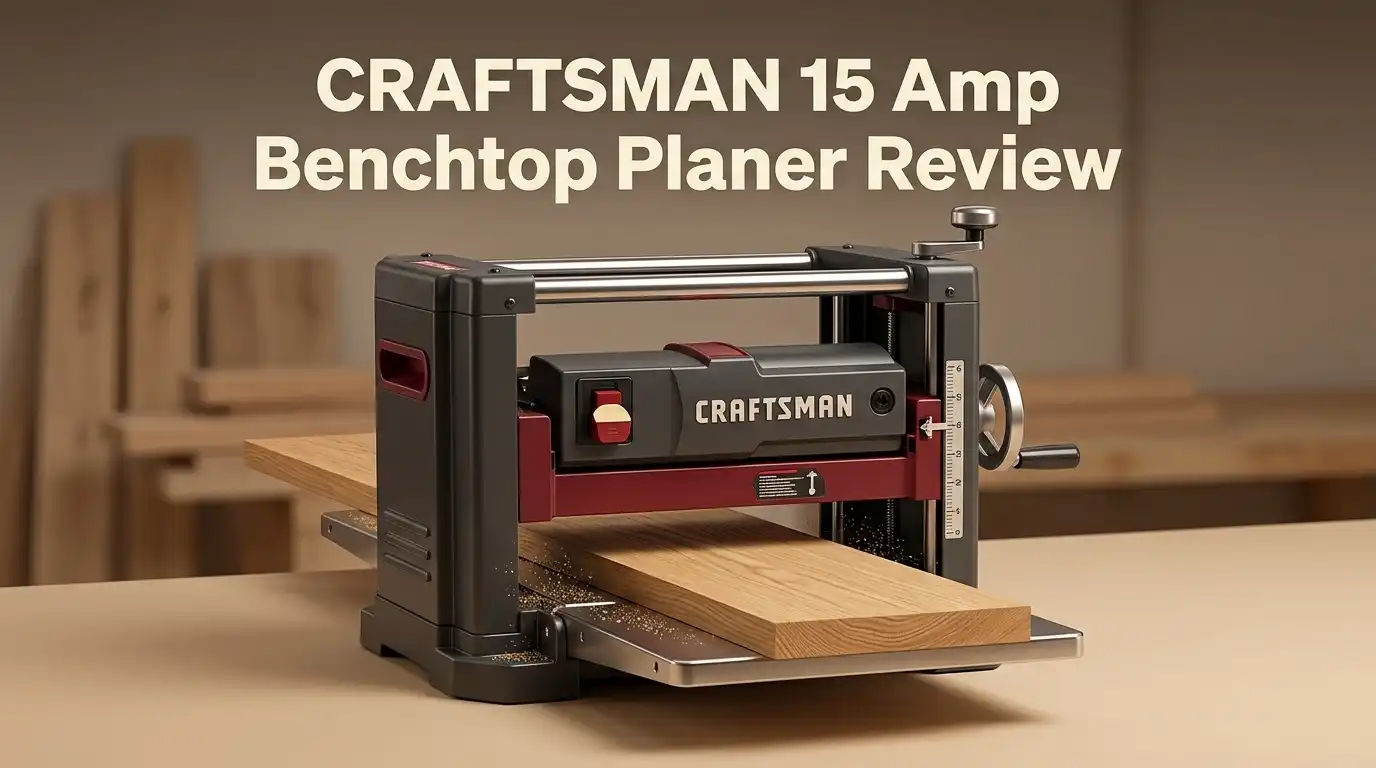
CRAFTSMAN 15 Amp Benchtop Planer Review 2026: Worth Buying?
Flattening rough lumber by hand takes hours. A benchtop planer does it in minutes. The CRAFTSMAN 15 Amp Benchtop Planer, model CMEW320, sits in the budget corner of the thickness planer market and promises serious stock removal for a price that does not wreck your tool budget.
I spent weeks running maple, pine, oak, and reclaimed pallet wood through this machine. I measured snipe. I counted blade changes. I listened to it scream.
This review covers everything the box does not tell you, including the parts CRAFTSMAN would rather you skip. If you want an honest look before you spend your money, keep reading.
In a Nutshell:
- Power is genuinely strong. The 15 amp motor spins the cutter head at 8,000 RPM and delivers 16,000 cuts per minute. It muscles through hard maple and white oak without bogging down, as long as you take light passes.
- Cut quality is good, not flawless. The two knife, solid steel cutter head leaves a smooth surface that still needs sanding. You will not get a glass finish straight off the machine like a spiral head planer produces.
- Snipe exists but stays manageable. Expect light snipe on the first and last few inches of a board. Infeed and outfeed support fixes most of it. Sacrificial boards fix the rest.
- It is loud. Very loud. Hearing protection is not optional with this machine. Plan for roughly 95 to 100 decibels during a cut.
- Value is the real selling point. At its typical price near $299, it costs roughly half of the most popular premium benchtop planer. For hobby woodworkers, that gap matters a lot.
- It is heavy for a portable tool. At about 61 pounds, you will want a dedicated stand or a rolling cart rather than hauling it around daily.
CRAFTSMAN 15 Amp Benchtop Planer CMEW320 Overview


Last update on 2026-10-29 / Affiliate links / Images from Amazon Product Advertising API
The CMEW320 is a corded thickness planer built for benchtop use. It accepts boards up to 12.25 inches wide and planes them to a consistent thickness. CRAFTSMAN markets it toward hobbyists, DIY builders, and small shop woodworkers who buy rough lumber and want to dimension it themselves.
The machine uses a four post design with a cast aluminum base and a steel cutter head mounted on ball bearings. A poly V belt drives the cutter head, which helps the motor transfer power without slipping under load. The knives are high carbon steel, double edged, and reversible, so you get two cutting lives from every blade set.
CRAFTSMAN backs the planer with a three year limited warranty. That is a reassuring number at this price point, and it signals the company expects the unit to survive regular hobby use.
Unboxing the CRAFTSMAN Planer
The box arrives heavy and compact. Mine weighed in near 67 pounds with packaging, so I recommend a second pair of hands or a hand truck. The planer sits inside dense foam with the dust port, the crank handle, and the hardware packed in a small cardboard tray on top.
Assembly took me about fifteen minutes. You bolt on the crank handle, attach the dust port with two screws, and fold out the infeed and outfeed tables. The manual is clear and uses actual photos rather than vague line drawings.
One thing surprised me. The cutter head arrives coated in a thick layer of shipping grease. Wipe it off with mineral spirits before your first cut, or that grease will transfer straight onto your boards. CRAFTSMAN mentions this, but it is easy to miss in the excitement of a new tool.
Key Specifications at a Glance
Numbers tell you a lot about what a planer can handle. Here is what CRAFTSMAN publishes for the CMEW320.
The motor draws 15 amps on standard 120 volt household power. The cutter head spins at 8,000 RPM and produces 16,000 cuts per minute with its two knife setup. Maximum planing width is 12.25 inches, and maximum thickness capacity is 6 inches. Maximum depth of cut per pass is roughly 3/32 of an inch, though you should rarely push it that far on hardwood.
The feed rate runs at a single fixed speed of about 26 feet per minute. The unit measures roughly 23.5 inches long, 17.5 inches wide, and 15.4 inches tall. Shipping weight lands near 61 pounds for the bare tool.
The cord measures 72 inches, which is short. Budget for a heavy gauge extension cord rated for 15 amp draw.
Top 3 Alternative for CRAFTSMAN 15 Amp Benchtop Planer

Last update on 2026-10-29 / Affiliate links / Images from Amazon Product Advertising API
DEWALT DW735X 13 Inch Three Knife Two Speed Thickness Planer

Last update on 2026-10-29 / Affiliate links / Images from Amazon Product Advertising API
WEN PL1326 15 Amp 13 Inch Spiral Benchtop Thickness Planer

Last update on 2026-10-29 / Affiliate links / Images from Amazon Product Advertising API
Makita 2012NB 12 Inch Portable Planer
Motor Power and Cutting Performance
The 15 amp motor is the strongest part of this machine. It matches the amperage of planers costing twice as much. During testing, I fed 8 inch wide hard maple at a 1/32 inch depth of cut and the motor held its speed without complaint.
Push it harder and the story changes. At a full 3/32 inch bite across a wide hardwood board, the motor audibly slows and the feed rollers can stall. Light passes are your friend here. Two shallow passes beat one aggressive pass every single time on this planer.
Pine, poplar, and cedar present no challenge at all. The machine eats softwood. For reclaimed pallet wood, check carefully for hidden nails first, because a single fastener will chip your knives instantly and knife replacement is not free.
Cut Quality on Hardwood and Softwood
Two knife cutter heads produce fewer cuts per inch than three knife or spiral designs. That math shows up in the finish. The CMEW320 leaves a surface that feels smooth to the hand but shows faint mill marks under raking light.
On softwoods, results look very good. Pine and poplar come off the machine ready for 150 grit sanding. On figured hardwoods such as curly maple, tearout becomes a real risk, especially if you plane against the grain direction.
Here is my honest take. This planer flattens and dimensions lumber well. It does not finish lumber. If you expected to skip sanding entirely, choose a spiral cutter head model instead. For everyone else, a quick pass with a random orbit sander erases the mill marks in under a minute per board face.
Snipe: How Bad Is It Really?
Snipe is the shallow dip a planer cuts into the first and last few inches of a board. Every lunchbox planer does it. CRAFTSMAN advertises a snipe minimizer design, and the extended infeed and outfeed tables do help.
In my testing, snipe measured roughly 0.005 to 0.010 inches deep over the final 2 to 3 inches of a board. That is average for this class of machine and better than some competitors.
Three fixes work well. First, support long boards with roller stands set slightly above the table height. Second, lift gently on the board as it enters and exits. Third, run sacrificial boards ahead of and behind your workpiece so the snipe lands on scrap. Combining all three nearly eliminates the problem.
Knife Changes and Blade Life
CRAFTSMAN uses a quick change knife system. You loosen the retaining bolts with the included wrench, lift the knife out, flip it or swap it, and retighten. The knives are self indexing, so you do not need to set the height manually.
A full knife change took me about ten minutes the first time and under five minutes after that. That simplicity is a genuine win compared to planers that require dial indicators and fussy alignment.
Blade life depends entirely on what you feed the machine. Clean softwood gives you plenty of board feet per edge. Dirty reclaimed lumber or dense tropical hardwood dulls the high carbon steel much faster than carbide would. Buy a spare set of knives when you buy the planer, because waiting on a shipment mid project is frustrating.
Dust Collection Performance
The CMEW320 includes a vacuum port for dust collection. This is a passive port, meaning the planer does not blow chips out on its own. It relies entirely on your shop vacuum or dust collector to pull debris away.
Connected to a 4 inch dust collector, the system works reasonably well. Most chips go into the bag. Connected to a standard shop vacuum with a reducer, performance drops and the port can clog during heavy cuts.
Compare this to premium planers that use a dedicated fan to eject chips. The CRAFTSMAN approach leaves more cleanup for you. Without any collection attached, chips pile up fast and spray across the shop. Running this planer with no dust collection is a mistake you only make once.
Noise Levels and Shop Comfort
Let me be direct. This planer is extremely loud. Universal motor planers all produce high pitched noise, and the CMEW320 sits at the louder end of the range. Expect something near 95 to 100 decibels under load.
That volume matters for more than comfort. Sustained exposure above 85 decibels causes permanent hearing damage. Wear over ear hearing protection every time, not just on long sessions.
Noise also affects where you can use it. If you share walls with neighbors or work in a garage near bedrooms, this machine will create friction. The Makita 2012NB runs noticeably quieter at around 83 decibels and makes a better choice for noise sensitive situations. Keep that tradeoff in mind if your shop sits close to living spaces.
Build Quality and Portability
The CMEW320 feels solid for its price. The base is cast aluminum, the column posts are steel, and the tables show minimal flex under a long board. Fit and finish are respectable, though you will notice plastic in places where premium planers use metal.
The depth adjustment crank turns smoothly and the scale reads clearly. The thickness lock lever holds position well and reduces vibration during cuts.
Portability is where the marketing oversells. At roughly 61 pounds, this is not a tool you casually carry to a job site. There is no carry handle on top, only side grips. Mount it on a mobile base or a dedicated stand and treat it as a stationary shop tool. Your back will thank you.
Setup and Calibration Tips
A few setup steps improve results dramatically. Start by checking that the infeed and outfeed tables sit level with or slightly above the main bed. Use a straightedge and adjust the table screws if needed.
Next, wax the bed with paste wax. A slick bed reduces feed resistance and prevents boards from stalling under the rollers. Reapply every few projects.
Verify the depth scale against a test cut with calipers. Factory scales often read a few thousandths off. Note the difference and work around it.
Finally, set up roller stands before you start, not after your first sniped board. Good support turns a mediocre planer into a good one. These small habits take fifteen minutes total and change your experience with this machine completely.
What the CRAFTSMAN Planer Does Not Do Well
Honest reviews name the weaknesses, so here they are. The two knife head leaves mill marks that always require sanding. There is no second feed speed for a finishing pass, so you cannot slow the feed for cleaner results.
Dust ejection depends entirely on external collection, which adds cost and setup complexity. The 72 inch cord forces you into extension cord territory for most shop layouts.
Knife durability is modest. High carbon steel dulls faster than carbide inserts, and a single nail strike ruins an edge immediately. Replacement knife availability has also been inconsistent at times.
Reliability reports are mixed. Some owners report years of trouble free use while others report motor or feed roller failures within the first year. The three year warranty helps, but it does not eliminate the hassle of a shop down day.
Pros and Cons
Pros
- Strong 15 amp motor handles hardwood and softwood with light passes
- 12.25 inch width capacity is wider than many competing budget planers
- Quick change, self indexing knives make blade swaps fast and simple
- Excellent price compared to premium benchtop planers with similar power
- Reversible double edged knives give two cutting lives per blade
- Three year limited warranty from a well known brand
- Snipe minimizer tables keep snipe within acceptable limits
Cons
- Extremely loud operation demands hearing protection every session
- Two knife head leaves mill marks that require sanding before finishing
- No fan assisted chip ejection, so dust collection must be external
- Single fixed feed speed with no finishing pass option
- Heavy at 61 pounds with no top carry handle
- Short 72 inch power cord
- Mixed long term reliability reports from owners
Who Should Buy It and Who Should Skip It
Buy the CMEW320 if you are a hobby woodworker who buys rough lumber and wants to dimension it at home. It pays for itself quickly against the price premium on surfaced boards. Beginners get a lot of capability for very little money here.
It also suits anyone building furniture, shelving, cutting boards, or shop projects where a light sanding pass is already part of the workflow.
Skip it if you run a production shop, plane figured hardwood regularly, or need the cleanest possible surface straight off the machine. Spiral cutter head planers solve those problems and justify their higher cost. Also skip it if noise is a serious constraint in your space, because this machine is genuinely punishing without hearing protection.
Value for Money in 2026
At a typical street price near $299, the CMEW320 competes directly with the WEN budget lineup and undercuts the DEWALT DW735X by a wide margin. The DEWALT remains the benchmark for lunchbox planers, with three knives, two feed speeds, and fan assisted chip ejection, but it costs roughly double.
Here is the practical math. Rough lumber often costs 30 to 40 percent less than surfaced lumber. Plane a few hundred board feet and the planer pays for itself.
Sales appear regularly, and the planer has dropped well below its list price during major shopping events. Watching for a discount is worth the patience. At a reduced price, the value argument becomes very hard to beat for a home shop.
Final Verdict
Last update on 2026-10-29 / Affiliate links / Images from Amazon Product Advertising API
The CRAFTSMAN 15 Amp Benchtop Planer earns a solid recommendation for hobby woodworkers on a budget. It delivers real power, useful width capacity, and simple maintenance at a price that makes home lumber milling practical.
It is not a premium machine and it does not pretend to be. You trade surface finish, noise comfort, and chip ejection for a much lower entry cost. Accept those tradeoffs and you will get good work out of it for years.
My advice is simple. Pair it with roller stands, a dust collector, hearing protection, and a spare knife set. Budget those extras into your purchase from the start. With that support, this planer turns rough boards into flat, square stock reliably and makes woodworking far more affordable.
Frequently Asked Questions
Does the CRAFTSMAN CMEW320 cause a lot of snipe?
It produces light snipe of roughly 0.005 to 0.010 inches on board ends. Roller stands, gentle lifting at entry and exit, and sacrificial boards reduce it to nearly nothing.
Can this planer handle hardwood like oak and maple?
Yes. The 15 amp motor handles oak, maple, and similar hardwoods well at shallow depths. Take 1/32 inch passes rather than maximum depth cuts for best results.
How wide of a board can it plane?
The maximum planing width is 12.25 inches. Maximum thickness capacity is 6 inches.
Do I need a dust collector with it?
Practically, yes. The vacuum port is passive and relies on external suction. Without collection, chips spray across your shop and can clog the port.
How often do the knives need replacing?
It depends on your material. Clean softwood gives long edge life. Dirty reclaimed wood or dense hardwood dulls knives faster. The knives are reversible, so flip them before buying new ones.
Is it loud enough to need hearing protection?
Absolutely. Expect roughly 95 to 100 decibels under load. Always wear over ear hearing protection during operation.
What warranty does CRAFTSMAN provide?
CRAFTSMAN offers a three year limited warranty on the CMEW320.
Is it better than the DEWALT DW735X?
No, the DEWALT performs better with three knives, two feed speeds, and fan assisted chip ejection. However, the CRAFTSMAN costs roughly half as much and suits hobby budgets far better.

Hi, I’m Leah Ray — the voice behind CraftBench Vault. I’m a passionate woodworking enthusiast dedicated to reviewing the best wood cutting tools and woodworking products. Through honest research and hands-on experience, I help fellow crafters make smarter buying decisions. Welcome to my workshop!