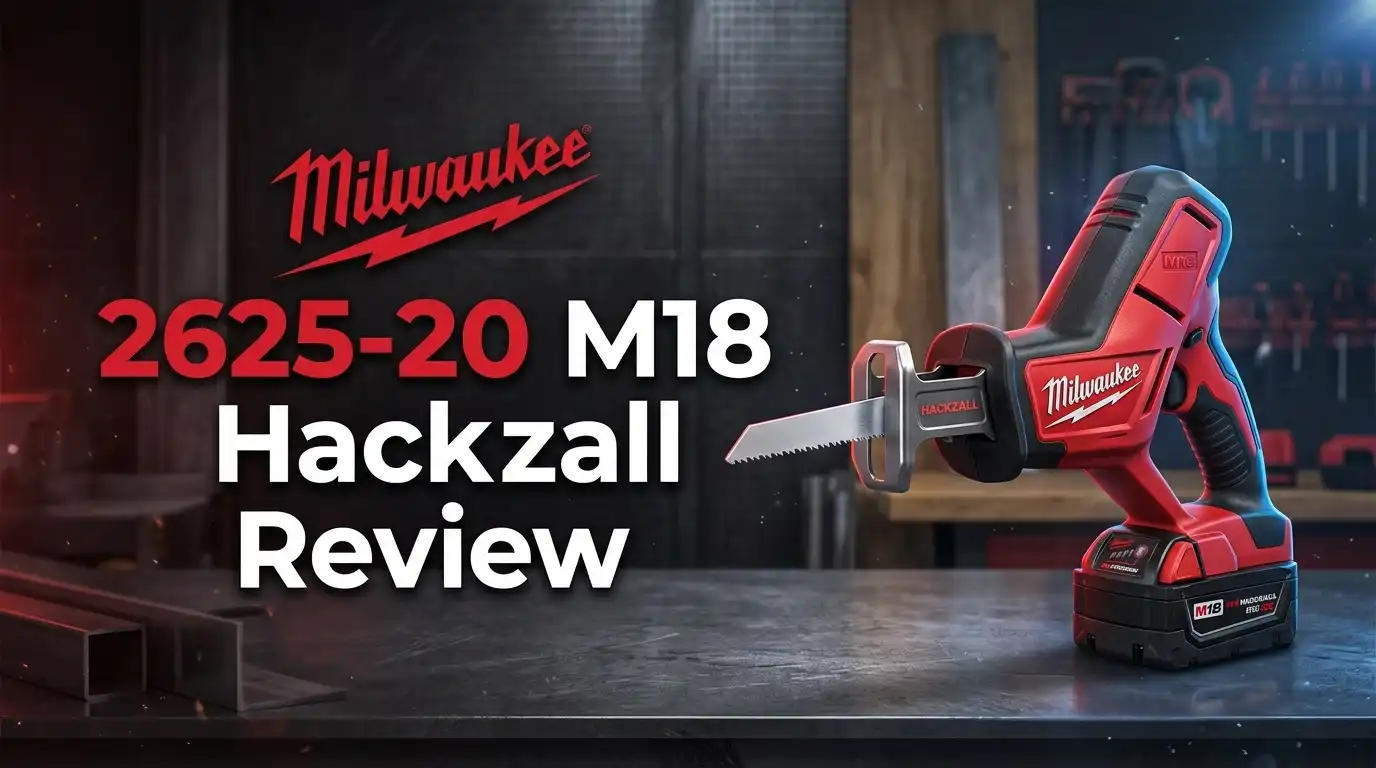
Milwaukee 2625-20 M18 Hackzall Review 2026: Still Worth It?
The Milwaukee 2625-20 M18 Hackzall is one of those tools that quietly earns a permanent spot in your bag.
It weighs about as much as a loaded cordless drill. It cuts pipe, conduit, drywall, roots, and rusted bolts with one hand. And it has been on job sites long enough that plumbers, electricians, and remodelers already know its name by heart.
But 2026 brings a fair question. With brushless saws everywhere and the M18 FUEL version sitting on the same shelf, does this older brushed model still deserve your money?
In A Nutshell:
- The 2625-20 is a one handed recip saw built for tight spaces. It delivers 0 to 3,000 strokes per minute with a 3/4 inch stroke length, which is plenty for pipe, conduit, drywall, and branch work. It is not a demolition saw, and treating it like one will disappoint you.
- Weight is the headline feature. At roughly 4.1 pounds bare and around 13 inches long, you can hold it overhead or snake it into a joist bay without wrecking your shoulder. This is where it beats a full size Sawzall every single time.
- The Dual Gear Anti Vibration System genuinely works. Milwaukee uses a counterbalance setup that cancels a big chunk of the shake. Your hand stays steadier, and blade walk at the start of a cut drops noticeably.
- It runs a brushed motor, not brushless. That means shorter runtime, more heat under load, and less power than the FUEL model. For light and medium cutting, you will barely notice. For heavy nail embedded lumber, you will.
- The QUIK LOK blade clamp is fast but not flawless. Blade swaps take seconds when clean. Fill it with sawdust and metal shavings, and the collar gets stiff. This is the single most common complaint owners raise.
- Value in 2026 is strong on the bare tool. If you already own M18 batteries, this is an inexpensive way to add a saw that solves problems a drill cannot. Buyers starting fresh should compare the kit and the FUEL version first.
What Is The Milwaukee 2625-20 M18 Hackzall?

Last update on 2026-10-28 / Affiliate links / Images from Amazon Product Advertising API
The 2625-20 is Milwaukee’s 18 volt one handed reciprocating saw. Think of it as a Sawzall that went on a diet. Instead of a long two handed body, you get a pistol grip tool you can run with a single hand while the other hand holds the pipe, the ladder, or the flashlight.
The motor pushes the blade at up to 3,000 strokes per minute with a 3/4 inch stroke. A variable speed trigger lets you creep into a cut slowly and then open it up. A built in LED lights the blade area, which matters more than you think inside a dark cabinet.
It accepts both standard Sawzall blades and shorter Hackzall blades. The 2625-20 ships as a bare tool, so no battery and no charger come in the box.
Unboxing Experience: What Actually Arrives
Open the box and the first reaction is usually the same. It is smaller than expected. The saw sits in a thin cardboard tray, wrapped in plastic, with a single general purpose blade already clipped into the clamp. Milwaukee includes a manual and a parts diagram. That is the entire contents of the bare tool package.
There is no case. No battery. No charger. No blade assortment. Some buyers feel shortchanged here, so set expectations before ordering.
Picking it up for the first time is the good part. The grip is rubber overmolded and shaped for a full hand, not a pinch. The balance sits right over your wrist, which is exactly why this tool works one handed. The kit version, model 2625-21, arrives with a battery, charger, and a soft tool bag if you want more in the box.
Full Specifications Breakdown
Here is the short version of the spec sheet, translated into plain language.
The motor is brushed and runs on the M18 platform, so it works with every M18 REDLITHIUM battery, compact or XC. Stroke speed runs from 0 to 3,000 strokes per minute through the variable speed trigger. Stroke length is 3/4 of an inch, which is shorter than a full size recip saw and explains the gentler feel.
Overall length measures about 13 inches. Bare tool weight lands near 4.1 pounds. The housing mixes metal and polymer, with metal where the gearcase takes abuse. Blade changes happen through the QUIK LOK clamp with no tools required.
Milwaukee backs the tool with a five year warranty, which stays one of the strongest in the cordless category.
Top 3 Alternatives For Milwaukee 2625-20 M18 Hackzall

Last update on 2026-10-28 / Affiliate links / Images from Amazon Product Advertising API
Milwaukee 2719-20 M18 FUEL Hackzall

Last update on 2026-10-28 / Affiliate links / Images from Amazon Product Advertising API
Milwaukee 2420-20 M12 Hackzall

Last update on 2026-10-28 / Affiliate links / Images from Amazon Product Advertising API
DEWALT DCS369B ATOMIC 20V MAX Reciprocating Saw
Design And Build Quality
Milwaukee built this saw like a trade tool, not a weekend toy. The front gearcase is metal and shrugs off the drops that happen on real sites. The rear housing is impact resistant polymer with reinforcement ribs where the body meets the battery foot.
The grip deserves specific praise. It is thick enough to fill a gloved hand and the rubber zones sit exactly where your palm and fingers land. Fatigue after a long cutting session is noticeably lower than on bare plastic grips.
The shoe is fixed, not pivoting or adjustable. That is a real limitation, and I cover it later. The LED sits above the trigger and throws light forward onto the blade. It stays on briefly after you release the trigger.
Fit and finish feels tight. No rattles, no flex in the housing, no wobble in the blade clamp when new.
Cutting Performance On Wood
Wood is where this saw feels most comfortable. Two by fours cut cleanly in a few seconds with a sharp six tooth per inch blade. Plywood, OSB, and trim cut almost instantly. Tree branches up to about three inches disappear without drama.
The short 3/4 inch stroke means the blade removes less material per pass than a full size saw. You compensate with speed, not force. Pushing harder does not make it cut faster. It just bogs the brushed motor and heats it up.
Nail embedded lumber is the honest weak point. The saw will get through it, but slowly, and the motor gets warm. This is a trimming and access saw, not a demolition saw.
For cutting a hole in subfloor, notching a stud, or trimming a joist end, it performs beautifully.
Metal And PVC Cutting Results
Metal work is the Hackzall’s natural home, and plumbers figured this out years ago. Half inch and 3/4 inch copper pipe cuts in under five seconds with a bimetal blade. EMT conduit goes just as fast. Threaded rod, small bolts, and light angle iron all surrender quickly.
PVC and ABS are effortless. Use a fine tooth blade to avoid melting and chunking at the edges.
The anti vibration system matters most here. Metal cutting usually sets up harsh feedback through the handle. This saw smooths that out enough that you can hold position accurately with one hand.
Black iron pipe and thick stock will slow it down. For anything above about an eighth inch of hardened steel, expect patience and a fresh blade. Let the blade do the work and keep it cool.
The Dual Gear Anti Vibration System
This is Milwaukee’s standout engineering feature on the 2625-20. Instead of a single drive gear slamming the blade back and forth, the tool uses a dual gear counterbalance that offsets the reciprocating mass.
In practice, the saw shakes less at the start of a cut. That translates into less blade walk, which means your cut starts where you aimed it. On a one handed tool, that is not a small thing.
You still feel vibration. Nobody should expect a smooth ride from a recip saw. But compared to older one handed saws, the difference is obvious within five seconds of pulling the trigger.
Long cutting sessions leave your hand far less numb. Anyone cutting dozens of pipe runs in a day will appreciate this more than any spec number on the box.
QUIK LOK Blade Clamp And Blade Changes
The QUIK LOK clamp is a twist collar. Rotate it, the old blade drops out, push the new one in, release. A blade change takes about three seconds when everything is clean.
It accepts both Sawzall blades and the shorter Hackzall blades. Shorter blades work better in tight spots because less blade sticks out past the material.
Now the honest part. This clamp is the most common failure point owners report. Sawdust, drywall grit, and metal shavings pack into the mechanism. Over months, the collar gets stiff and eventually becomes hard to twist by hand.
Blow it out with compressed air regularly and add a drop of light oil. Owners who do this rarely have trouble. Owners who ignore it often end up ordering a replacement clamp kit or sending the tool in for service.
Battery Life And Runtime Expectations
Runtime depends entirely on which M18 battery you attach. A 2.0Ah compact pack keeps the tool light and handles light duty tasks, but you will swap it often during steady work.
A 5.0Ah XC pack roughly doubles your working time and gives better sustained power under load. It also adds weight and makes the saw bottom heavy, which partly defeats the one handed advantage.
My preference is a 3.0Ah pack as the sweet spot. It balances well and lasts through most jobs.
Because the motor is brushed, it draws more current than a brushless equivalent. Expect noticeably shorter runtime per charge than the FUEL model. Heavy continuous cutting also builds heat, and the tool will trigger battery protection if you push it hard without breaks.
Where This Saw Falls Short
No tool is perfect, and pretending otherwise helps nobody. Here are the real weaknesses.
The shoe does not pivot or adjust. A fixed shoe limits blade angle control and prevents you from shifting the shoe to use fresh teeth on a worn blade. Competing saws offer this.
The brushed motor is dated in 2026. It means less power, shorter runtime, and more heat than brushless rivals at a similar size.
The blade clamp needs maintenance or it will stiffen up. This is the complaint I see most often from long term owners.
There is no rafter hook and no LED brightness worth bragging about. The light helps, but it is dim compared to newer tools.
Heavy demolition is off the table. The short stroke and modest power make long cutting sessions slow.
Pros And Cons
Pros
- Genuinely light at about 4.1 pounds, making overhead and one handed work comfortable
- Compact 13 inch body reaches into joist bays, cabinets, and wall cavities a full size saw cannot
- Dual Gear Anti Vibration System reduces shake and improves cut accuracy
- Tool free QUIK LOK clamp accepts both Sawzall and Hackzall blades
- Variable speed trigger gives real control for starting delicate cuts
- Built in LED lights dark work areas
- Works with every M18 battery you already own
- Five year Milwaukee warranty and wide service network
- Lower price than the FUEL version, especially as a bare tool
Cons
- Brushed motor means less power and shorter runtime than brushless options
- Fixed shoe with no pivot or adjustment
- Blade clamp stiffens without regular cleaning
- Struggles with nail embedded lumber and thick steel
- No case, battery, or extra blades in the bare tool box
- Gets warm during extended heavy cutting
Milwaukee 2625-20 vs 2719-20 FUEL Hackzall
This is the comparison most buyers actually need. The 2719-20 is the FUEL upgrade and it changes three important things.
First, it uses a POWERSTATE brushless motor, which delivers more cutting power and better runtime per charge. Second, it has a 7/8 inch stroke instead of 3/4 inch, so it removes more material per pass. Third, it adds REDLINK PLUS electronics for overload protection.
The FUEL model costs more. It also weighs slightly more.
Choose the 2625-20 if you cut pipe, conduit, PVC, and light wood occasionally, and price matters.
Choose the 2719-20 if you cut daily, work in metal often, or want the saw to handle tougher material without complaint. Professionals almost always end up happier with the FUEL version.
Maintenance Tips To Extend Tool Life
A little care keeps this saw running for years. Start with the blade clamp. Blow it out with compressed air after every dusty job. Add a single drop of light machine oil into the collar monthly. This one habit prevents the most common failure.
Keep the vents on the motor housing clear. Blocked vents trap heat, and heat kills brushed motors faster than anything else.
Use sharp blades. A dull blade forces you to push harder, which loads the motor and the gearcase. Replacing a two dollar blade is cheaper than replacing a saw.
Wipe the body down after exposure to concrete dust or moisture. Store batteries off the tool, indoors, at moderate temperature.
If the clamp fails anyway, Milwaukee sells a replacement blade clamp kit and the repair is straightforward.
Price And Value In 2026
The bare tool remains one of the better deals in the M18 lineup. If you already own M18 batteries, adding this saw costs a fraction of a new platform purchase and immediately expands what you can do on site.
The 2625-21 kit includes a battery, charger, and bag. That version makes sense only if you are starting fresh on M18, and even then, compare it against buying the bare tool plus a separate battery.
Value depends entirely on honest expectations. As an occasional use access and trim saw, it is excellent money. As a daily driver for metal heavy work, the FUEL model earns its higher price within a few months.
Watch for seasonal bundles. Milwaukee frequently pairs bare tools with free batteries, which shifts the math considerably.
Who Should Buy It And Who Should Skip It
Buy the 2625-20 if you are a plumber, electrician, HVAC tech, or remodeler who already runs M18 batteries. Buy it if you need a saw that fits where your Sawzall cannot. Buy it if one handed control matters more than raw power. Homeowners with M18 tools will also find it handy for branches, old fence boards, and renovation work.
Skip it if you plan serious demolition. Skip it if you cut thick steel daily. Skip it if you need an adjustable shoe or orbital action.
Also skip it if you own no M18 batteries and only need a saw once a year. A corded recip saw costs less and never runs out of power.
Final Verdict
The Milwaukee 2625-20 M18 Hackzall remains a smart buy in 2026 for the right person. It is light, controllable, genuinely useful in tight spaces, and backed by a five year warranty. The anti vibration system is not marketing fluff, and the QUIK LOK clamp works well when maintained.
It is also showing its age. The brushed motor and fixed shoe put it a step behind newer brushless competitors, and heavy cutting exposes its limits quickly.
My recommendation is simple. If you already own M18 batteries and want an affordable one handed saw for pipe, conduit, and access cuts, this tool earns its place. If you cut hard material every day, spend the extra money on the FUEL version and never think about it again.
Frequently Asked Questions
Does the Milwaukee 2625-20 come with a battery?
No. The 2625-20 is sold as a bare tool. It includes the saw, one general purpose blade, and a manual. If you want a battery, charger, and bag included, look for the 2625-21 kit instead.
Can the 2625-20 use regular Sawzall blades?
Yes. The QUIK LOK clamp accepts both standard Sawzall blades and shorter Hackzall blades. Shorter blades work better in confined spaces because less blade extends past the cut, reducing the chance of hitting something behind the material.
How fast does the Milwaukee Hackzall 2625-20 cut?
The motor runs from 0 to 3,000 strokes per minute with a 3/4 inch stroke length. Half inch copper pipe typically cuts in under five seconds with a sharp bimetal blade. Two by fours take a few seconds with a coarse wood blade.
Is the 2625-20 brushless?
No. It uses a brushed motor. The brushless upgrade is the 2719-20 M18 FUEL Hackzall, which also has a longer 7/8 inch stroke and better runtime.
Why is my Hackzall blade clamp hard to turn?
Dust and metal shavings pack into the clamp mechanism over time. Blow it out with compressed air and apply a drop of light oil. If it stays stuck, Milwaukee sells a replacement blade clamp kit, and the repair is a common DIY fix.
Can it handle demolition work?
Not well. The short stroke and brushed motor make it slow on nail embedded lumber and heavy framing. Use a full size Sawzall for demolition and keep the Hackzall for access cuts and tight space work.
What battery size works best with it?
A 3.0Ah pack offers the best balance of runtime and weight. Compact 2.0Ah packs keep it nimble for overhead work. XC 5.0Ah packs extend runtime but make the tool noticeably bottom heavy.

Hi, I’m Leah Ray — the voice behind CraftBench Vault. I’m a passionate woodworking enthusiast dedicated to reviewing the best wood cutting tools and woodworking products. Through honest research and hands-on experience, I help fellow crafters make smarter buying decisions. Welcome to my workshop!