
Milwaukee 2719-20 M18 FUEL Hackzall Review 2026: Worth Buying?
Cutting pipe above your head with a full size reciprocating saw feels like wrestling an angry animal. Your arms shake. Your shoulders burn. The blade bucks.
That frustration is exactly why the one handed saw category exists, and the Milwaukee 2719-20 M18 FUEL Hackzall sits near the top of that pile.
This saw promises speed, control, and far less vibration than a traditional recip saw. Milwaukee claims it cuts up to 50% faster than competing one handed models. That is a big claim for a tool that weighs about as much as a loaded cordless drill.
In a Nutshell:
- Power that punches above its size. The POWERSTATE brushless motor pairs with a 7/8 inch stroke length and 0 to 3000 SPM. That combination gives a theoretical cutting speed near 2,656 inches per minute, which beats almost every one handed saw in the 18V class.
- Vibration control is the star feature. A dual gear counterbalance mechanism cuts vibration by up to 4x compared to traditional recip saws. Your wrist notices this within the first ten cuts, especially during overhead work.
- Light enough for one hand, strong enough for two. The bare tool weighs about 4 pounds 1 ounce. Add a 5.0Ah pack and you are near 5 pounds 11 ounces, which starts to feel heavy overhead.
- The shoe does not adjust. It pivots, but it does not extend. You cannot shift the contact point to use a fresh section of blade teeth, and that is the biggest complaint from long term owners.
- It is a bare tool buy. No battery, no charger, no case in the box. Budget extra unless you already own M18 packs.
- Best suited to plumbers, electricians, HVAC techs, and remodelers doing light to medium demo. Heavy demolition still belongs to a full size Sawzall.
What Is the Milwaukee 2719-20 M18 FUEL Hackzall?

Last update on 2026-10-28 / Affiliate links / Images from Amazon Product Advertising API
The Milwaukee 2719-20 is a compact, one handed reciprocating saw that runs on the M18 battery platform. Milwaukee calls this design a Hackzall. The motor sits at an angle instead of inline, which shortens the body and moves the grip into a pistol style position.
That layout changes everything about how the saw feels. You hold it like a drill, not like a jackhammer. The trigger sits under your index finger. The lock off switch sits right at your thumb.
The FUEL badge matters here. It means a POWERSTATE brushless motor, REDLINK PLUS electronics, and REDLITHIUM battery communication. Together they deliver longer tool life, overload protection, and more consistent power as the pack drains.
This is a bare tool. You get the saw and one blade. Everything else comes from your existing M18 kit.
Unboxing Experience and First Impressions
The box is plain Milwaukee red cardboard. Nothing fancy. Inside you find the saw wrapped in plastic, a general purpose blade already clipped in, and a thin manual with the parts list.
The first thing you notice is the grip. Rubber overmold wraps from the nose, over the top, and down into the handle. It feels tacky in a good way, and it adds a bit of drop protection when the saw slides off a ladder shelf.
The second thing you notice is the balance. The saw sits level in your palm without a battery, then tips slightly rearward once a pack snaps on. A 2.0Ah pack keeps that balance sweet. A 12.0Ah pack turns it into a pendulum.
First impression verdict: it feels dense and serious, not toyish. The blade clamp spins with a firm click. The shoe pivots smoothly with no slop.
Key Specifications at a Glance
Numbers tell a clean story with this saw, so here they are in plain language.
The stroke length measures 7/8 inch, which is best in class for a one handed model. Stroke speed runs from 0 to 3000 SPM through a variable speed trigger. Overall length sits around 14 inches.
Bare tool weight lands at 4 pounds 1 ounce. With a 2.0Ah battery you reach roughly 5 pounds. With a 5.0Ah XC pack you reach about 5 pounds 11 ounces.
Milwaukee backs the tool with a 5 year warranty. A rubber seal and weep holes protect the internals against water and sawdust, which matters for plumbers working under sinks and in crawl spaces.
Compare that 7/8 inch stroke to the brushed M18 Hackzall at 3/4 inch and the M12 FUEL at 5/8 inch. The extra travel removes more material per stroke, and you feel that difference immediately in 2x material.
Top 3 Alternatives for Milwaukee 2719-20 M18 FUEL Hackzall

Last update on 2026-10-28 / Affiliate links / Images from Amazon Product Advertising API
DEWALT ATOMIC 20V MAX Reciprocating Saw DCS369B

Last update on 2026-10-28 / Affiliate links / Images from Amazon Product Advertising API
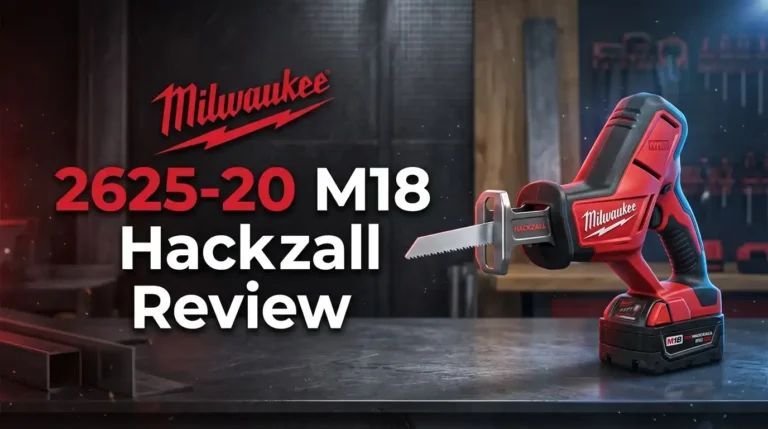
Milwaukee 2625-20 M18 Hackzall Reciprocating Saw

Last update on 2026-10-28 / Affiliate links / Images from Amazon Product Advertising API
Milwaukee 2520-20 M12 FUEL Hackzall Bare Tool
Cutting Performance in Wood, Metal, and PVC
This is where the 2719-20 earns its price tag. In clean 2×4 and 2×6 lumber, the saw pulls itself through the cut once the teeth bite. You guide it. You do not force it.
PVC behaves even better. A 2 inch drain line parts in a couple of seconds with almost no chatter. The pivoting shoe stays planted against the pipe, which keeps the cut square.
Metal is the real test. EMT conduit, threaded rod, and nail embedded wood all cut cleanly when you feather the trigger at the start. Ease in, let the teeth catch, then squeeze fully.
Where it struggles: thick cast iron, large timbers, and long demolition sessions. The saw has no orbital action, and the short body limits leverage. For a wall of studs, grab a full size Sawzall instead.
Vibration Control and Comfort
Milwaukee built a dual gear counterbalance into this tool, and it works. Vibration drops up to 4x compared to a traditional recip saw. The saw hums rather than hammers.
That difference shows up in two ways. First, cut starts in metal happen faster because the blade stops skating across the surface. Second, your hand stays usable after thirty minutes of work.
Anyone who has finished a day of overhead cutting with numb fingers will understand why this matters more than raw speed. Reviewers across the trades consistently call this the smoothest saw in its class.
The handle angle helps too. You push forward rather than down, which keeps your wrist in a neutral position. Comfort is the strongest argument for choosing this saw over a cheaper brushed model.
Battery Life and Runtime
Runtime depends entirely on the pack you choose, and that choice changes the tool’s personality.
A 2.0Ah compact pack keeps the saw light and nimble. Expect enough runtime for a service call with several pipe cuts, but not a full demo session. This setup is the sweet spot for overhead and tight space work.
A 5.0Ah XC pack roughly doubles your cuts per charge. The tradeoff is weight and a taller footprint that can block you in cramped bays.
REDLINK PLUS intelligence protects the tool and pack from overload, overheating, and over discharge. The saw simply shuts down instead of frying itself, then resumes once things cool.
One honest note: aggressive metal cutting drains packs fast. Keep a spare on the charger if you cut a lot of conduit or rebar.
Blade Changes and Everyday Handling
The blade clamp uses a simple twist collar. Rotate it, drop the blade in, release. No tools needed.
Here is the catch. You cannot change blades one handed. One hand holds the saw, the other twists the collar. Milwaukee markets a one handed saw, but blade swaps still need two hands.
The clamp accepts standard recip blades, so you can run any brand you like. Shorter blades work best in this saw because long blades flex and wander without the extra body length to steady them.
An LED sits under the shoe and lights the cut line. It helps in a dark crawl space, though it is not bright enough to replace a work light. Handling overall feels natural, especially for anyone used to a pistol grip drill.
Where the Hackzall Falls Short
Every honest review needs this section, so here are the real weak points.
The shoe does not adjust for length. It pivots, but it stays fixed in depth. That means you always use the same section of blade teeth, so blades dull unevenly and you waste good teeth near the tip.
No orbital action. Faster wood cutting modes exist on full size saws. This one gives you straight reciprocating motion only.
Bare tool pricing stings. Expect to pay a premium over the brushed M18 Hackzall, and you still need a battery and charger.
It is not a demolition saw. Long cuts through thick material will overheat blades and drain packs. Treat it as a precision cutter, not a wrecking tool.
Weight climbs quickly with large batteries. Overhead work with a 5.0Ah pack tires your shoulder faster than you expect.
Milwaukee 2719-20 vs the Brushed 2625-20 Hackzall
The older 2625-20 remains popular because it costs noticeably less. It uses a brushed motor, a 3/4 inch stroke, and the same 3000 SPM rating.
Math explains the gap. The 2625-20 reaches roughly 2,250 inches per minute of theoretical cutting speed. The 2719-20 reaches about 2,656 inches per minute. That is close to a 20% advantage before you factor in vibration control and motor life.
The FUEL model also runs cooler, lasts longer, and holds power better as the battery drains. Milwaukee claims up to 3x longer tool life than competing one handed saws.
Choose the 2625-20 if you cut occasionally. Choose the 2719-20 if the saw rides on your truck every day and earns money.
Who Should Buy It and Who Should Skip It
Buy it if you are a plumber, electrician, HVAC tech, or remodeler. Service work involves short, awkward cuts in tight places, and this saw was built for exactly that.
Buy it if you already own M18 batteries. The bare tool price makes sense when the platform is already in your van.
Skip it if demolition is your main job. A full size Sawzall with orbital action cuts faster and handles abuse better.
Skip it if you need a saw twice a year. A budget corded recip saw costs far less and will serve a homeowner fine.
The right buyer here is someone who values control and comfort over brute force.
Pros and Cons
Pros
- Excellent cutting speed from the 7/8 inch stroke and POWERSTATE brushless motor
- Best in class vibration control thanks to the dual gear counterbalance
- Comfortable pistol style grip that works for one handed or two handed use
- Compact 14 inch body fits between studs, under sinks, and inside cabinets
- Pivoting shoe keeps the blade planted and reduces bucking
- Sealed against water and debris with weep holes for drainage
- Runs on the M18 platform shared with 125 plus other tools
- Strong 5 year warranty
Cons
- Shoe pivots but does not adjust for length
- No orbital cutting action
- Blade changes still require two hands
- Bare tool only, so no battery, charger, or case included
- Costs more than the brushed M18 Hackzall
- Gets heavy overhead with high capacity batteries
- Not built for sustained heavy demolition
Price and Value in 2026
Pricing moves around, but the 2719-20 typically lands in the mid range for bare tool compact saws, with kit versions costing significantly more once a battery and charger join the box.
Value depends on how often you cut. A tradesperson making twenty cuts a day recovers the premium in saved time and saved hands within a few months. A weekend user will not.
Watch for seasonal bundles. Milwaukee frequently pairs the Hackzall with a free battery during holiday promotions, and that deal changes the math completely.
Resale value stays strong too. Milwaukee FUEL tools hold price well on the used market, which softens the sting if you ever change platforms.
Maintenance and Blade Tips
Good blades matter more than the saw. Use bimetal blades with 18 TPI for conduit and thin metal. Use 6 TPI for wood and demolition style cuts.
Keep blades short. A 6 inch blade flexes far less than a 12 inch blade in this compact body.
Blow dust out of the blade clamp regularly. Grit in the collar is the most common cause of blades slipping loose.
Let the saw rest between heavy cuts. Overheated blades lose temper and dull in minutes. A cool blade cuts faster than a hot one, every single time.
Store the tool with the battery removed if it sits for weeks. That habit protects both the pack and the electronics.
Final Verdict
Last update on 2026-10-28 / Affiliate links / Images from Amazon Product Advertising API
The Milwaukee 2719-20 M18 FUEL Hackzall is the saw to beat in the one handed class. It cuts fast, stays smooth, and fits where bigger saws cannot reach.
The missing adjustable shoe and the absence of orbital action are real limitations. Neither one outweighs the comfort and speed you get in daily service work.
If you already run M18 batteries and cut pipe, conduit, or lumber for a living, this tool pays for itself. If you only need occasional cuts at home, spend less elsewhere.
Rating: 4.6 out of 5.
Frequently Asked Questions
Does the Milwaukee 2719-20 come with a battery?
No. The 2719-20 is a bare tool. You get the saw and one blade only. You need an M18 battery and charger separately, or you can buy a kit version that includes both.
What blades fit the M18 FUEL Hackzall?
Any standard universal shank reciprocating saw blade fits. Shorter blades between 4 and 6 inches work best because they flex less in this compact body.
Can you really use it with one hand?
Yes for cutting. The grip, trigger, and lock off switch all sit within reach of one hand. Blade changes still need two hands because you must twist the collar.
How does it compare to the M12 FUEL Hackzall?
The M18 version has a longer 7/8 inch stroke versus 5/8 inch on the M12, so it cuts noticeably faster. The M12 is lighter and better for very tight spaces.
Is it good for demolition work?
It handles light demo such as cutting nails, studs in tight spots, and old pipe. For tearing out walls or cutting large timbers, a full size Sawzall is the better choice.
What warranty does Milwaukee offer?
Milwaukee covers the tool with a 5 year limited warranty. M18 batteries carry their own separate warranty period.

Hi, I’m Leah Ray — the voice behind CraftBench Vault. I’m a passionate woodworking enthusiast dedicated to reviewing the best wood cutting tools and woodworking products. Through honest research and hands-on experience, I help fellow crafters make smarter buying decisions. Welcome to my workshop!