SawStop Professional Cabinet Saw 3 HP Review 2026: Worth It?
Buying a cabinet saw feels like a big decision. You spend thousands of dollars, you clear a large chunk of shop floor, and you live with that machine for decades.
The SawStop Professional Cabinet Saw with the 3 HP motor sits at the center of that decision for most serious woodworkers in 2026. It stops the blade in under five milliseconds when skin touches it. That one feature changed the table saw market forever.
This review covers all of that. It also covers the parts nobody likes to mention, like the extra cartridges you must buy and the blades this saw refuses to spin.
In a Nutshell:
- The safety system works as advertised. The blade stops in less than five milliseconds and drops below the table. Thousands of documented finger saves back this up. A serious injury becomes a small nick that needs a bandage.
- The 3 HP motor runs on 230V single phase power. You need a dedicated circuit. This is the single biggest hidden cost for home shops without 230V already wired in the garage.
- Fence accuracy is excellent out of the box. The T Glide fence locks without deflection. Many owners report they stopped measuring with a ruler after setup because the scale stays true.
- Dust collection reaches roughly 99 percent with the included dust collection blade guard and under table shrouding. You still need a real dust collector pushing at least 350 CFM. A shop vacuum will not cut it.
- Ownership costs continue after purchase. A standard brake cartridge runs about $119. The dado cartridge and dado insert cost extra. Plan for these in your budget.
- Pricing starts near $3,987 for the 52 inch fence setup in 2026. The 36 inch version sells closer to $3,881 at major dealers.
SawStop Professional Cabinet Saw 3 HP

Last update on 2026-10-26 / Affiliate links / Images from Amazon Product Advertising API
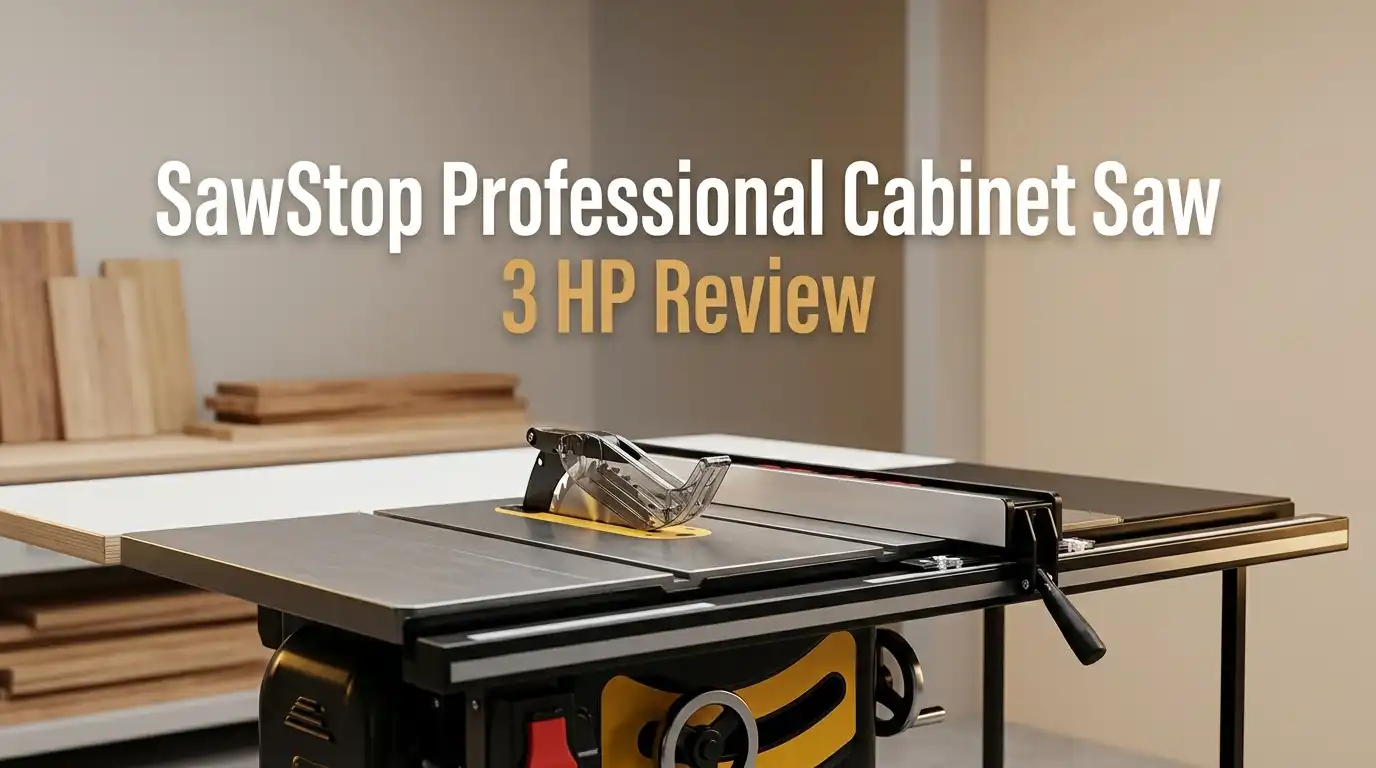
The Professional Cabinet Saw, model PCS31230, is SawStop’s best selling cabinet saw. It carries a 10 inch blade, a 3 HP alternating current motor, and a full cast iron trunnion assembly mounted to the cabinet rather than the table. That design matters. Cabinet mounted trunnions hold alignment better and transfer less vibration into your cut.
The saw ships with two cast iron extension wings, a miter gauge, a riving knife, a dust collection blade guard, a 10 inch blade, a standard brake cartridge, and a push stick.
You get a complete working saw on day one. With the 52 inch fence the footprint measures roughly 85 inches wide, 33 inches deep, and 34 inches tall. The 36 inch version shrinks that width considerably and fits better in a two car garage shop.
Unboxing and First Impressions
Your saw arrives on a pallet, strapped and crated, and it weighs between 367 and 449 pounds depending on the fence package. You are not carrying this inside alone. Most owners rent an engine hoist, borrow a pallet jack, or recruit three strong friends with a furniture dolly.
Cut the bands and the crate panels fall away to reveal a cabinet wrapped in plastic film with the castings coated in rust preventative grease.
The smell of machine oil hits you first. Then you notice the finish. The powder coat is thick and even. The handwheels are polished iron and feel heavy in your palm.
Smaller boxes hold the fence rails, extension table, wings, and hardware packs. Open everything and inventory the parts before you start. It saves an hour of frustration later.
Assembly and Setup Experience
Plan a full afternoon. Three to five hours is a realistic window for one person working carefully. The cabinet rolls off the pallet onto the integrated mobile base, which you assemble first. Two foot pumps raise the saw onto casters. A tap on the release lever lowers it gently back to the floor.
Bolting the cast iron wings on takes patience. You want them flush with the main table, so work in small increments and check with a straightedge. The rails and fence come next. The fence scale needs calibration, not construction. Most of the work is already done at the factory.
Then clean off the grease with mineral spirits and apply paste wax. Finally, check blade to miter slot alignment. Many owners find theirs within four thousandths after ten minutes of adjustment.
Top 3 Alternative for SawStop Professional Cabinet Saw 3 HP

Last update on 2026-10-26 / Affiliate links / Images from Amazon Product Advertising API
Grizzly Industrial G1023RL 10 Inch 3 HP 240V Cabinet Table Saw

Last update on 2026-10-26 / Affiliate links / Images from Amazon Product Advertising API
Powermatic PM1000 10 Inch Table Saw, 52 Inch Rip

Last update on 2026-10-26 / Affiliate links / Images from Amazon Product Advertising API
Laguna F2 Fusion 10 Inch Table Saw, 36 Inch Rip
How the Safety System Actually Works
The brake cartridge sits a sixteenth to an eighth of an inch from the blade. The blade carries a small electrical signal. Skin is conductive, so contact changes that signal instantly. The cartridge fires an aluminum pawl into the spinning blade teeth, and the blade’s own momentum drives the whole assembly below the table.
Total time is under five milliseconds. You feel a scratch instead of losing a finger. The control box runs self checks every time you power up. If a component fails a check, the motor will not start.
There is a Bypass Mode for cutting aluminum, very green lumber, and other conductive materials. You hold a key switch while starting. The system also triggers during coast down, so the protection does not vanish the moment you hit stop.
Motor Power and Cutting Performance
The 3 HP motor draws 13 amps at 230 volts. That is enough torque to rip three inch hardwood at full depth without bogging. Maximum cut depth is three inches at ninety degrees and roughly two and a quarter inches at forty five degrees.
Ripping eight quarter hard maple is where the 1.75 HP version struggles and the 3 HP version simply works. The motor holds speed. Burn marks come from technique or a dull blade, not from lack of power. Feed rate stays comfortable even in dense exotic species.
Belt drive keeps vibration low. Stand a nickel on edge on the table while the saw runs and it usually stays upright. That stability shows up directly in your cut quality, especially on long rips where blade wander ruins a glue line.
T Glide Fence Accuracy and Feel
The T Glide fence rides on twin rollers along a heavy gauge steel rail. The lock lever engages with one hand and holds without deflection at the far end. You can lean on the fence face and it does not move.
Measurement comes from a cursor and scale that stays accurate once calibrated. Many owners report they stopped double checking with a tape measure after a few weeks. That trust is the real value of a good fence.
The fence face slides forward and back, and the high low aluminum face on some packages flips to a low position for thin ripping. Resawing jigs and sleds attach easily because of the T slot profile. The 52 inch capacity handles full plywood sheets. The 36 inch version suits smaller shops and still rips most sheet goods comfortably.
Dust Collection Results
SawStop claims 99 percent dust capture. In real shop use that number holds up well. The included dust collection blade guard pulls chips from above the blade through a flexible hose. Below the table, a shroud wraps the blade and funnels waste into the four inch port.
You need a dust collector moving at least 350 CFM. A shop vacuum will not move enough air, no matter how powerful it sounds. That is the most common setup mistake.
Dado cuts are the weak spot. The blade guard comes off for dado work, so overhead collection disappears and chips fly. The optional overarm dust collection accessory solves this, but it adds several hundred dollars. For standard ripping and crosscutting, the stock setup keeps the shop remarkably clean.
Build Quality and Table Flatness
SawStop measures table flatness diagonally at a maximum gap of ten thousandths of an inch. Most units arrive better than that. The cast iron is ground smooth and takes wax well.
The trunnion and arbor assembly is the heart of any cabinet saw, and this one is heavy and precisely machined. Blade tilt is left, away from the fence, which is safer for bevel rips. Gas piston elevation makes raising the blade effortless compared to older geared designs.
The arbor runs true, so blade wobble measures near zero with a quality blade. Fit and finish genuinely feel premium. Doors close tight. Castings line up. The paint does not chip when you bump it with a board. This is where your money goes.
Mobile Base and Shop Space
The integrated mobile base is one of the best in the industry. Two pumps of the foot pedal lift the saw, and it rolls across a concrete floor with light pressure. Drop it and the saw sits dead solid on its feet.
That matters because the saw weighs over 400 pounds. Moving it without the base is miserable. The base supports the saw and the extension table together, so the whole assembly travels as one unit.
With the 52 inch fence you need about 11 feet of width for the saw itself, plus infeed and outfeed room. Measure your shop before you order the long rails. Many owners choose the 36 inch version and never regret it, since sheet goods often get broken down with a track saw first.
What This Saw Does Not Do Well
Honest reviews list the frustrations, so here they are.
The saw refuses blades outside its supported range. Thin kerf blades under three thirty seconds, stacks of blades, and small diameter blades will not pass the startup check. Luthiers who cut fret slots with a 6 inch slotting blade cannot use this saw for that job. Even Bypass Mode will not help, because the brake gap check still runs.
Dado work requires a separate dado cartridge and a separate insert. Both cost extra. Every other cabinet saw lets you cut dados on day one.
Error codes come as blinking red and green lights that you decode from a chart. It works, but a small text display would be friendlier. The extension table also feels light compared to the rest of the machine.
Pros and Cons
Pros
- The safety system stops the blade in under five milliseconds and has prevented thousands of serious injuries.
- The 3 HP motor rips thick hardwood without bogging down or burning.
- Table flatness holds to ten thousandths or better across the diagonal.
- The T Glide fence locks square and stays accurate for years without deflection.
- Dust collection reaches around 99 percent with the included guard and under table shrouding.
- The integrated mobile base lifts and rolls the saw with two foot pumps.
- Cabinet mounted trunnions keep alignment stable and reduce vibration.
- Resale value stays unusually high compared to competing cabinet saws.
Cons
- The 230V requirement forces an electrical upgrade in many home shops.
- Dado cartridge and dado insert are sold separately at added cost.
- Small diameter and ultra thin kerf blades will not run at all.
- Brake cartridges cost about $119 each after any activation.
- Wet, green, or pressure treated lumber can trigger the brake unexpectedly.
- The extension table feels flimsy next to the cast iron.
- Assembly needs several hours and at least two people.
Running Costs You Should Plan For
Budget beyond the sticker price. A standard brake cartridge costs roughly $119, and a dado cartridge about $139. Each activation means a new cartridge, and the activation often damages a few blade teeth too.
False triggers happen. Very wet lumber, pressure treated stock, and occasionally damp MDF carry enough conductivity to fire the brake. Use Bypass Mode and make a test cut when you are unsure. The red light flashes to warn you about conductive material.
Add a dedicated 230V circuit if your shop lacks one, which typically costs a few hundred dollars with an electrician. Add a dust collector if you do not own one. Add the dado insert, a zero clearance insert, and a good blade. Realistically, plan for $500 to $1,200 above the saw price.
Who Should Buy This Saw
This saw fits the woodworker who uses a table saw weekly and intends to keep working for decades. Furniture makers, cabinet shops, school shops, and committed hobbyists all land in that group. If you have kids, students, or employees near the machine, the safety case becomes very hard to argue against.
It also fits anyone who values accuracy over price. The fence and table quality reduce setup time on every project.
It does not fit everyone. If you cut lumber twice a year, a contractor saw serves you better for a fraction of the money. If you need 5 HP for constant production ripping, step up to the Industrial Cabinet Saw. If you need unusual blade sizes, buy a conventional saw instead.
Price and Value in 2026
Pricing in 2026 starts around $3,987 for the 3 HP model with the 52 inch T Glide fence configuration. The 36 inch package sells near $3,881 at large dealers. The Industrial Cabinet Saw with 3 HP starts closer to $5,154.
Compare that to a Powermatic PM2000 or a Grizzly G1023RL. The Grizzly costs significantly less and cuts well. The Powermatic sits in similar territory. SawStop includes the safety system at roughly the same price point as its closest premium rival, which is why so many buyers choose it.
One emergency room visit for a table saw injury can cost more than this entire saw. That math drives most purchase decisions. Resale value also stays strong, so your real cost of ownership is lower than it first appears.
Final Verdict
The SawStop Professional Cabinet Saw with the 3 HP motor earns its reputation. It is a genuinely excellent cabinet saw before you even discuss the brake. The table is flat, the fence is accurate, the motor has muscle, and dust collection works. Add the safety system and the value proposition becomes clear.
The frustrations are real but manageable. Separate dado cartridges annoy people. The blade restrictions eliminate a few specialty tasks. The 230V requirement adds cost. None of these outweigh the core strengths.
Would I recommend it? Yes, for anyone who uses a table saw regularly and can afford the entry price. Buy the 36 inch fence unless you truly need 52 inches. Budget for the dado cartridge up front. Then enjoy a saw that will outlast your shop.
Frequently Asked Questions
Does the SawStop 3 HP model need 230V power?
Yes. The PCS31230 runs on 230 volt single phase power and draws 13 amps. You need a dedicated circuit with the correct outlet. The 1.75 HP version can run on 110V, which is why many home shops choose it instead.
How much does a brake cartridge cost to replace?
A standard brake cartridge costs about $119 and a dado brake cartridge about $139. Replacement takes as little as 90 seconds. The saw itself absorbs the force of activation and does not get damaged.
Can I use a dado stack on this saw?
Yes, with an 8 inch stacked dado set up to 29/32 inches wide. You must buy the dado brake cartridge and a matching insert separately. Wobble dado sets and molding heads are not permitted.
Will wet wood trigger the brake?
Very green or pressure treated lumber can trigger it. Use Bypass Mode and make a test cut first. The red light on the control box flashes to warn you when material is conductive.
Is the 36 inch or 52 inch fence better?
The 36 inch fence suits most home shops and saves significant floor space. The 52 inch fence handles full plywood sheets more easily. Choose based on your shop width and whether you break down sheet goods elsewhere.
What dust collector size do I need?
SawStop recommends a minimum of 350 CFM at the 4 inch port. A stationary dust collector is required. Shop vacuums and portable extractors do not move enough air for proper extraction.

Hi, I’m Leah Ray — the voice behind CraftBench Vault. I’m a passionate woodworking enthusiast dedicated to reviewing the best wood cutting tools and woodworking products. Through honest research and hands-on experience, I help fellow crafters make smarter buying decisions. Welcome to my workshop!