
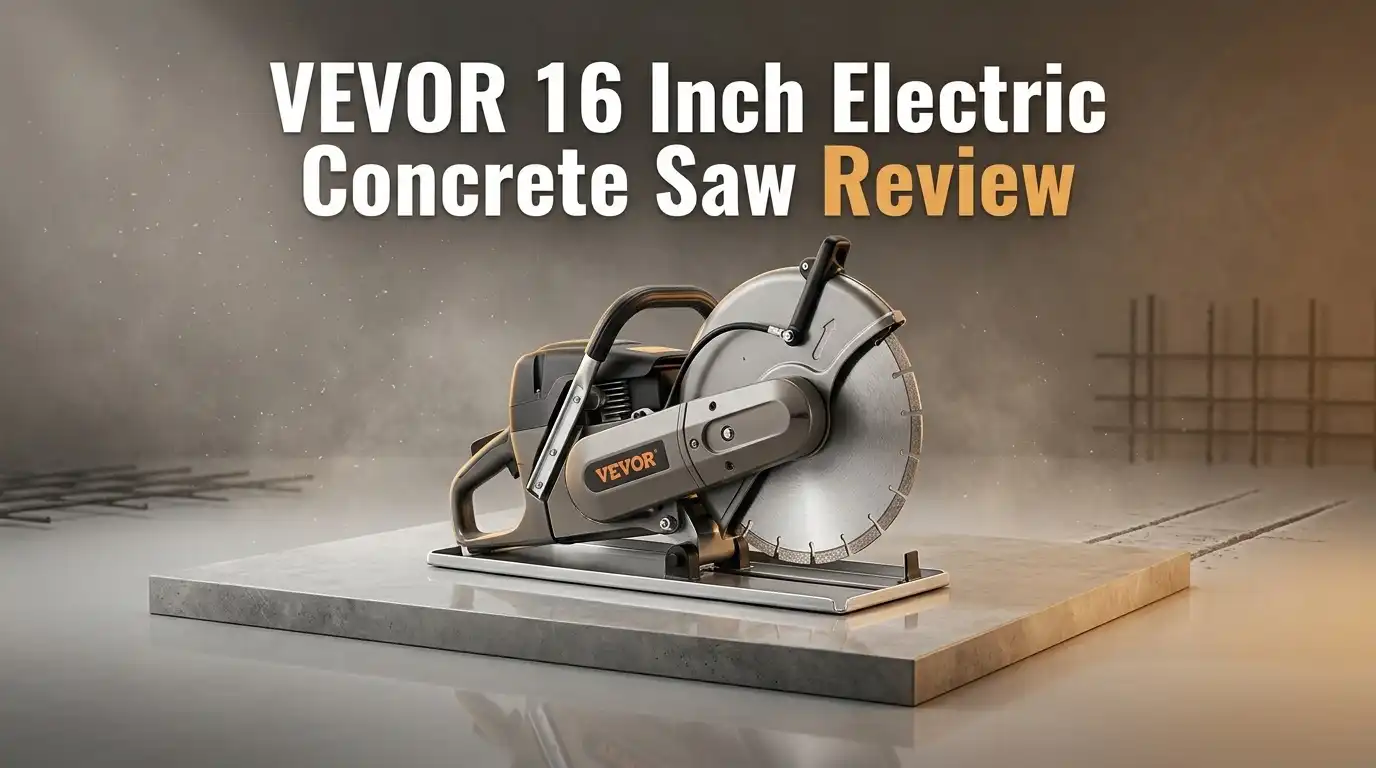
VEVOR 16 Inch Electric Concrete Saw Review 2026: Worth Buying?
Concrete cutting used to mean one thing. You drove to a rental yard, paid a daily fee, and wrestled a loud gas saw into your truck. VEVOR changed that math.
The VEVOR 16 Inch Electric Concrete Saw sells for roughly the price of four rental days, plugs into a wall outlet, and cuts up to six inches deep.
But cheap tools make big promises. Does this one hold up on a real slab? I spent time with this saw, read through owner feedback, and tracked the complaints that keep showing up.
In a Nutshell:
- The 3200W motor delivers real cutting power. This saw chews through brick, block, pavers, and unreinforced slabs. It is not a toy. Owners report cutting driveways, cinder block walls, and patios without stalling out.
- Breaker trips are the number one complaint. The motor pulls serious amperage. Multiple owners popped 20 amp and even 30 amp breakers during normal cuts. Plan your power supply before you plan your project.
- The six inch cutting depth beats most competitors. A 14 inch saw gives you about five inches. That extra inch matters on thick slabs and retaining wall blocks.
- The included blade is the weak link. Nearly every experienced owner says the same thing: buy a quality diamond blade separately. The stock blade dulls fast on rebar.
- Value is excellent, polish is not. You get strong performance for around two hundred dollars. You also get a plastic water nozzle, mixed customer service, and occasional alignment quirks.
- Best for homeowners and small contractors. Heavy daily production work still belongs to gas saws.
VEVOR 16 Inch Electric Concrete Saw Overview
No products found.
This saw sits in a strange spot in the market. Professional electric cutters from Makita or Husqvarna cost three to five times more. Budget 14 inch saws cost slightly less but cut shallower. VEVOR split the difference and built a 16 inch wet cutter with a 3200W motor for entry level money.
The design uses a worm drive layout with a wheeled base. You guide it along a line rather than carrying it like a handheld cutoff saw. That rolling base is a big deal for straight cuts. Your arms do steering work, not holding work.
The saw includes a water line, a pump, and a diamond blade in the box. VEVOR markets it for stone, brick, and concrete. Realistically, it shines on flat horizontal surfaces where the wheels can roll.
The Unboxing Experience
The box arrives heavy. Expect something close to sixty pounds of packed weight, so plan on two hands or a helper. VEVOR ships the saw in dense foam, and the parts survive transit well in most reports.
Inside you find the saw body, the blade already mounted or bagged separately, a submersible water pump, a length of clear water hose, a wrench for the blade bolt, and a thin paper manual. The manual is functional but brief. Translation quality is average.
Assembly takes about fifteen minutes. You attach the handle, connect the water hose, fit the blade guard, and torque the blade bolt. Nothing requires special tools. The first impression is solid metal with cheap plastic accents. The housing feels dense. The water nozzle feels like it came off a garden sprayer.
Key Specifications at a Glance
Specs tell you what to expect before the blade ever touches concrete.
The motor rates at 3200W and draws roughly 15 amps under load. Blade diameter is 16 inches. Maximum cutting depth reaches about 6.1 inches. No load speed runs near 4000 RPM. The saw operates as a wet cutter using the included pump, and it also handles dry cuts for short durations.
Safety items include a double switch to prevent accidental starts, slow start circuitry, overload protection, and a built in GFCI plug. That GFCI matters on a wet saw. Do not bypass it.
The unit weighs enough that lifting it onto a bench feels awkward, but the wheels carry it fine on flat ground. This is a push tool, not a carry tool.
Top 3 Alternatives for VEVOR 16 Inch Electric Concrete Saw

Last update on 2026-10-29 / Affiliate links / Images from Amazon Product Advertising API
Evolution R14DCT 14 Inch Electric Concrete Saw

Last update on 2026-10-29 / Affiliate links / Images from Amazon Product Advertising API
XtremepowerUS 2600W 14 Inch Concrete Saw Electric Cutter


Last update on 2026-10-29 / Affiliate links / Images from Amazon Product Advertising API
Makita 4114X 14 Inch SJS Electric Angle Cutter
Cutting Performance on Real Concrete
Here is where the saw earns its keep. On a three to four inch unreinforced slab, this saw cuts steadily. Feed pressure stays light. You walk it forward and let the blade work. A full depth pass on four inch concrete takes patience but finishes cleanly.
Brick and block go faster. Owners cutting cinder block walls report strong results with minimal effort. Pavers and retaining wall blocks also cut well, though the saw design favors flat work over vertical cuts.
Rebar is the dividing line. The saw will cut through it. It slows down noticeably, and the stock blade pays the price. Heavily reinforced slabs expose the power gap between this saw and a gas unit. One owner summed it up well: it is underpowered compared to gas, but it gets there if you let it work.
Power Draw and Breaker Trips
This deserves its own section because it affects nearly every buyer. The 3200W rating is not marketing fluff. The motor pulls hard, and standard household circuits struggle.
Owners report tripping 20 amp breakers every few minutes during continuous cutting. One user even popped a 30 amp breaker repeatedly. Generators create similar trouble. A 2500W generator cannot run this saw. A truck inverter rated at 2400W cannot either.
What works? A dedicated 20 amp circuit with a heavy 10 gauge extension cord. Thin cords cause voltage drop, and voltage drop causes heat and trips. Keep the cord as short as practical.
Buy the right cord before you buy the saw. This single detail separates frustrated owners from satisfied ones. Light feed pressure also reduces current draw significantly.
Wet Cutting and the Water Pump System
The included submersible pump drops into a bucket. Water travels through a clear hose to a nozzle near the blade. The system does its job. Dust drops dramatically, the blade runs cooler, and the cut line stays visible.
The pump itself is basic. It moves enough water for the blade but offers no flow control beyond pinching the line. Several owners report the nozzle fitting as the first thing to break or leak. A two dollar replacement barb fixes it.
Wet cutting creates slurry. Expect gray sludge everywhere within a few feet of the cut. Plan containment before you start. Indoor cutting requires plastic sheeting and a shop vacuum.
Wet operation also means the GFCI plug matters. Water plus 15 amps demands respect. Never run the saw without the water supply attached for long cuts.
Build Quality and Handling
The core of this saw feels sturdier than the price suggests. The motor housing, the gear case, and the frame are all metal. The blade guard is thick steel. Nothing flexes under normal use.
The wheeled base rolls smoothly on flat concrete. Rough surfaces bounce the saw slightly, which affects cut straightness. A chalk line and a steady pace solve most of that.
One recurring complaint deserves mention. Some owners report the base plate sits slightly out of square with the blade. That creates a cut that drifts off vertical. Check your blade to base alignment before your first project. Shimming the plate fixes mild cases.
Vibration stays moderate. Noise sits far below gas saw levels, which neighbors appreciate. You can hold a conversation near this saw with hearing protection on.
Blade Quality and Why You Should Upgrade
The included blade is adequate for soft block and a few short cuts. It is not adequate for a driveway project. Every experienced owner says the same thing.
A quality 16 inch diamond blade from a known brand transforms this saw. Cutting speed increases. Motor load decreases. Breaker trips become less frequent because the blade is doing work instead of rubbing. A good blade is the single best upgrade you can make.
Blade cost varies widely. A decent general purpose segmented blade runs well under the price of a rental day. A reinforced concrete blade costs more and lasts longer on rebar.
Buy one spare blade upfront. Rebar dulls edges faster than most first time users expect. Running a dull blade overheats the motor and shortens tool life.
Safety Features Worth Knowing
VEVOR included more safety hardware than I expected at this price. The double switch requires two deliberate actions to start the motor. That prevents bumps from firing the blade.
Slow start reduces the startup current spike and keeps the saw from jumping in your hands. Overload protection cuts power when the motor draws too much, which protects the windings during a bind.
The built in GFCI plug is the most important item. Wet cutting and electricity need a ground fault interrupter between them. Test it before every session.
Personal gear still matters. Wear eye protection, hearing protection, gloves, and sturdy boots. Silica dust is dangerous even during wet cutting. A respirator makes sense for any dry work, and dry work should stay short.
What This Saw Does Not Do Well
Honest reviews list failures. Here are the real ones.
It does not handle continuous production cutting. Long sessions heat the motor, and thermal protection shuts it down. This is a start and rest tool.
It does not run on common portable generators. The power demand rules out most jobsite generators under 4000W.
It does not match gas power on reinforced concrete. Expect roughly half the cutting speed of a comparable gas saw.
It does not cut flush to walls. The guard and base geometry leave a margin on every edge cut.
Customer service feedback is mixed at best. Several owners describe long response times and circular support conversations. Warranty claims take effort.
The included accessories feel like afterthoughts. Budget for a blade and a cord.
Pros and Cons
A quick balance sheet before you decide.
Pros:
- Strong 3200W motor cuts brick, block, pavers, and unreinforced slabs reliably
- Six inch cutting depth exceeds most 14 inch competitors
- Wheeled base produces straight cuts with low operator fatigue
- Wet cutting system controls dust effectively and extends blade life
- Built in GFCI, slow start, and overload protection improve safety
- Far quieter and cleaner than any gas powered alternative
- Pays for itself after roughly four rental days
Cons:
- Trips 20 amp breakers frequently during continuous cutting
- Will not run on most portable generators or truck inverters
- Included blade dulls quickly and needs replacement
- Base plate alignment varies between units
- Plastic water nozzle is a known weak point
- Customer service responsiveness receives poor marks from owners
- Slower than gas saws on heavily reinforced concrete
Who Should Buy This Saw
This saw fits a specific buyer. If you own a home with concrete projects on the list, it makes sense. Patching a driveway, trenching for drainage pipe, cutting a sump pit, demolishing a patio in sections, or trimming retaining wall blocks all fall within its range.
Small contractors doing occasional concrete work also benefit. The quiet operation lets you cut in neighborhoods and indoor spaces where gas saws are impractical.
Skip it if you cut concrete daily. Production crews need gas or high end electric units with proper power feeds.
Skip it also if your only power source is a generator. The math does not work.
The buy versus rent calculation is simple. Three or more separate concrete jobs favor buying. One weekend project favors renting.
Price and Value in 2026
The VEVOR 16 Inch Electric Concrete Saw typically lands around two hundred dollars, sometimes dipping lower during sales. Rental for a gas saw runs roughly fifty dollars per day before blade charges.
That means four project days break even. Many homeowners hit that in a single summer.
Compare it to professional electric cutters. A Makita 14 inch angle cutter costs significantly more and cuts shallower, though it offers better durability and support. Evolution builds a 14 inch electric saw with dust suppression at a mid range price.
VEVOR wins on dollars per inch of cutting depth. It loses on refinement and backing.
Value here is real but conditional. You must accept some rough edges and do a little setup homework. Buyers who do that report satisfaction.
Setup Tips for Best Results
A few habits make this saw behave much better.
Run a dedicated 20 amp circuit with a 10 gauge extension cord no longer than fifty feet. This prevents most breaker trips.
Score your line with a shallow quarter inch pass first. Then step the depth down in one inch increments. Full depth plunges are the fastest way to stall the motor.
Keep water flowing at all times during wet cuts. Dry running destroys blades.
Check blade to base square before your first cut and shim if needed.
Let the saw rest every ten minutes during long sessions. Cool motors last years. Hot motors last months.
Snap a chalk line and use a straight board as a guide for critical cuts.
Final Verdict
No products found.
The VEVOR 16 Inch Electric Concrete Saw delivers genuine cutting ability at a price that still surprises me. The motor is strong, the depth is generous, and the wet system works. For homeowners tackling driveways, patios, block walls, and drainage trenches, it replaces rental trips entirely.
It is not a professional tool. Breaker trips frustrate new owners. The stock blade underperforms. Support is thin. Alignment varies.
Go in with correct expectations and the right extension cord, and this saw earns a permanent spot in your garage. Go in expecting gas saw speed on rebar heavy slabs, and you will be disappointed.
Recommended for DIY and light commercial use. Rated four out of five for value, three out of five for refinement.
Frequently Asked Questions
How deep does the VEVOR 16 inch concrete saw cut?
Maximum cutting depth is about 6.1 inches. Reaching full depth requires multiple passes. Start shallow and step down in increments for the best results and the least motor strain.
Will this saw trip my circuit breaker?
Often, yes. The motor draws roughly 15 amps. Use a dedicated 20 amp circuit with a 10 gauge extension cord. Light feed pressure and a sharp blade reduce trips significantly.
Can I run it on a generator?
Most portable generators cannot handle it. Owners report failures with 2500W generators and 2400W truck inverters. You need at least 4000W of clean continuous output.
Does it cut through rebar?
Yes, but slowly. The stock blade wears quickly on steel. A quality reinforced concrete diamond blade handles rebar far better and protects the motor from extended load.
Is the included blade any good?
It works for soft block and short cuts. For driveway or slab projects, buy a quality 16 inch diamond blade separately. This upgrade improves speed, safety, and motor life.
Can I use it dry without water?
Short dry cuts are possible, but not recommended. Dry cutting creates hazardous silica dust and overheats the blade. Use the included pump and bucket for nearly all work.
How does it compare to a gas concrete saw?
Gas saws cut roughly twice as fast on reinforced concrete. The VEVOR is quieter, cleaner, lighter on maintenance, and usable indoors. Trade speed for convenience and cost savings.

Hi, I’m Leah Ray — the voice behind CraftBench Vault. I’m a passionate woodworking enthusiast dedicated to reviewing the best wood cutting tools and woodworking products. Through honest research and hands-on experience, I help fellow crafters make smarter buying decisions. Welcome to my workshop!