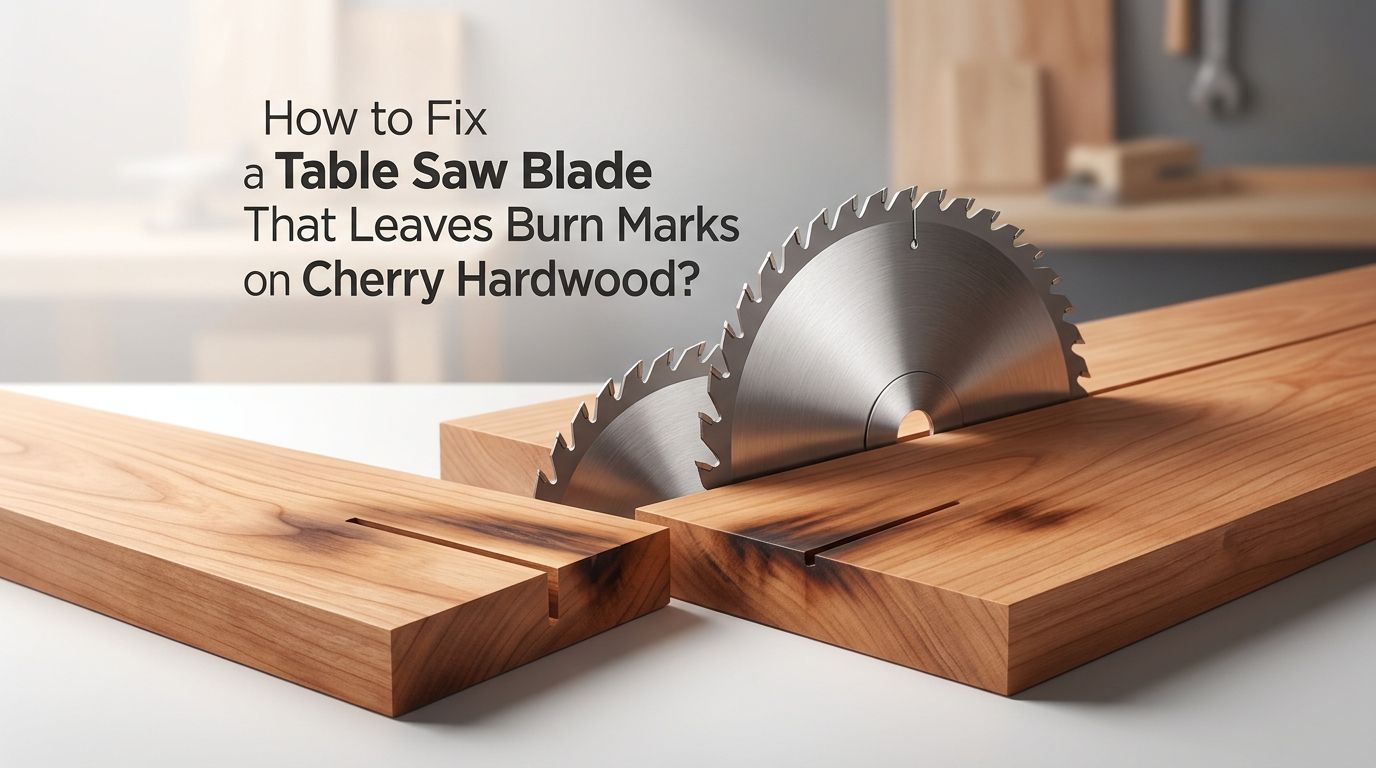
How to Fix a Table Saw Blade That Leaves Burn Marks on Cherry Hardwood?
You just ripped a beautiful piece of cherry hardwood on your table saw, pulled it away from the blade, and there it is: dark, ugly burn marks streaking across the edge. Your heart sinks. Cherry is expensive, and those scorch lines feel like money going up in smoke.
Here is the good news. Burn marks on cherry are one of the most common problems in woodworking, and they are almost always fixable. Cherry has a high sugar content in its wood fibers, which makes it far more likely to scorch than oak, poplar, or pine.
The heat from friction between the blade and the wood literally caramelizes those natural sugars, leaving behind dark brown or black streaks.
Key Takeaways
- Cherry wood burns easily because of its high sugar content. The natural sugars in cherry caramelize under heat, creating dark scorch marks that other wood species simply do not produce as quickly. This is not a defect in your saw or your technique alone. It is a property of the wood itself, and it means you need to take extra steps.
- A dull or resin coated blade is the number one cause of burn marks. When carbide teeth lose their sharp edge or get caked with pitch, they create more friction instead of cleanly slicing the wood fibers. Cleaning or replacing your blade is often the fastest fix.
- Fence and blade alignment matters more than most woodworkers realize. If your rip fence is not parallel to the blade, the wood pinches against the back teeth as it passes through. That pinch creates intense friction and leaves burns on one or both faces of the cut.
- Feed rate is critical with cherry. Feeding cherry too slowly gives the blade teeth extra time to rub against the wood, generating heat. A steady, moderately fast feed rate reduces contact time and prevents scorching.
- Using the right blade for the cut type eliminates most burning. A 24 tooth rip blade works best for ripping cherry, while a 60 to 80 tooth crosscut blade is ideal for crosscuts. Combination blades with 40 or 50 teeth can work but are more likely to cause burns on thick cherry stock.
- Existing burn marks can be removed with sanding, scraping, or a light skim cut. You do not need to throw away scorched boards. A card scraper, hand plane, or 120 grit sandpaper can restore the surface quickly.
Why Cherry Hardwood Burns So Easily on a Table Saw
Cherry is one of the most burn prone species in North American hardwood lumber. The reason comes down to chemistry. Cherry wood contains high levels of natural sugars and resins that react strongly to heat. When a table saw blade spins at 3,000 to 4,000 RPM and contacts cherry, friction generates significant heat at the cut surface.
That heat caramelizes the sugars in the wood cells. The result is a dark brown or black discoloration that penetrates below the surface. Maple is another species that burns easily for the same reason. Oak, by contrast, has much lower sugar content and rarely shows scorch marks under the same cutting conditions.
Understanding this chemistry helps you realize that burn marks on cherry are not always a sign of a bad saw or bad technique. Sometimes the wood simply needs more careful handling than other species.
Every adjustment you make, from blade selection to feed speed, should account for cherry’s sensitivity to heat. Think of cherry as a wood that demands a little extra attention at the table saw, and you will get clean, scorch free edges every time.
Check Your Blade for Dullness
A dull blade is the most frequent cause of burn marks on any wood, and cherry magnifies the problem. Carbide teeth that have lost their sharp edge do not cut wood fibers cleanly. Instead, they tear and rub, creating friction and heat that would not exist with a sharp blade.
Inspect your blade closely. Look at each tooth under good lighting or use a magnifying glass. Sharp carbide teeth have a clean, defined edge with no visible rounding or chipping.
If the teeth look rounded, nicked, or uneven, the blade needs sharpening or replacement. Most carbide blades can be professionally sharpened several times before they need to be retired.
A quick test is to cut a piece of softwood like pine. If the blade cuts pine cleanly with no effort, it is likely still sharp. If pine shows rough edges or burn marks, the blade is definitely dull.
Do not waste expensive cherry on a blade that cannot even cut pine cleanly. Sharpening services are affordable, often costing between $15 and $25 for a standard 10 inch blade, and the improvement in cut quality is immediate.
Pros of sharpening: Low cost, extends blade life, immediate improvement.
Cons of sharpening: Requires downtime while blade is out for service, and some budget blades are not worth resharpening.
Clean Resin and Pitch Buildup from the Blade
Even a sharp blade will burn cherry if its teeth are coated in resin and pitch. Wood resin builds up on blade teeth over time, creating a sticky layer that increases friction and traps heat. Cherry and pine are especially guilty of leaving heavy deposits on saw blades.
Cleaning a saw blade is simple. Remove the blade from your table saw and lay it flat in a shallow container. Fill the container with a cleaning solution. Many woodworkers use a mixture of hot water and liquid laundry detergent. Others prefer oven cleaner, mineral spirits, or citrus based blade cleaning products. Let the blade soak for 10 to 15 minutes.
After soaking, scrub each tooth with an old toothbrush or a brass bristle brush. You will see dark, sticky residue come off the teeth. Rinse the blade with clean water and dry it immediately to prevent rust. Apply a light coat of paste wax or a rust inhibitor before reinstalling the blade.
You should clean your blade every 10 to 20 hours of use, or any time you notice an increase in burning. This simple maintenance step alone can eliminate scorch marks on cherry without any other changes.
Pros of blade cleaning: Very inexpensive, easy to do at home, prevents future burns.
Cons of blade cleaning: Requires removing the blade, and soaking chemicals need safe handling and disposal.
Align Your Rip Fence Parallel to the Blade
A misaligned rip fence is a sneaky cause of burn marks that many woodworkers overlook. If the back of your fence angles even slightly toward the blade, the wood gets pinched between the fence and the rear teeth of the blade after the initial cut is made. Those rear teeth then rub against the freshly cut surface, generating intense heat and leaving burn marks.
To check alignment, raise your blade to its full height. Use a combination square, a dial indicator, or even a simple tape measure. Measure the distance from the fence to a single marked tooth at the front of the blade, then rotate the blade so that same tooth is at the back.
Measure again. The two measurements should be identical, or the back of the fence should be about 0.003 to 0.005 inches farther from the blade than the front.
If the fence is closer to the blade at the back, adjust it according to your saw’s manual. Most rip fences have adjustment screws or bolts that allow you to fine tune the alignment. This adjustment takes only a few minutes but can completely stop burn marks on your rip cuts.
Pros of fence alignment: Free fix, improves safety, produces cleaner cuts on all wood species.
Cons of fence alignment: Can be tricky on older or budget saws with limited adjustment options.
Align the Blade Parallel to the Miter Slot
Just as your fence needs to be parallel, your blade must also be parallel to the miter slots in your table saw’s surface. If the blade is slightly angled relative to the miter slot, it creates uneven contact with the wood during every cut. One side of the wood gets pressed harder against the teeth, causing friction and burns.
To check this alignment, place a combination square in the miter slot with the rule extending out to touch a blade tooth. Mark that tooth with a marker. Measure the gap between the rule and the tooth. Then rotate the blade 180 degrees so the marked tooth is at the back, and measure again.
If the measurements differ, you need to adjust the trunnion assembly that holds the blade arbor. On most contractor and cabinet saws, this involves loosening bolts under the table and shifting the trunnion until the blade runs true.
This is one of the most important calibrations you can make on any table saw. It affects not just burn marks but also cut accuracy and safety. A well aligned blade reduces kickback risk and produces cleaner edges on every piece of wood you cut.
Pros of blade alignment: Fixes burning on all cut types, improves accuracy, reduces kickback.
Cons of blade alignment: Can be time consuming, especially on contractor saws where trunnion access is limited.
Use the Right Blade for the Cut Type
Using the wrong blade for your cut type is a very common reason cherry burns. A blade designed for crosscutting has too many teeth for ripping, and all those extra teeth create unnecessary friction during a rip cut through thick cherry.
For rip cuts on cherry, use a dedicated rip blade with 24 teeth and large gullets. The large gullets carry sawdust away from the cut efficiently, reducing heat buildup. The fewer teeth mean less contact time with the wood during each revolution. This combination keeps temperatures low and burn marks away.
For crosscuts on cherry, switch to a crosscut blade with 60 to 80 teeth. These blades are designed to slice across wood grain cleanly. The many small teeth take tiny bites that produce smooth surfaces without generating excessive heat during the shorter contact time of a crosscut.
Combination blades with 40 to 50 teeth try to do both jobs. They work well for general purpose cutting on many species, but cherry often exposes their limitations. If you are doing extensive work with cherry, keeping separate rip and crosscut blades will give you the best results.
Pros of using dedicated blades: Best possible cut quality, least burning, each blade excels at its specific task.
Cons of using dedicated blades: Requires purchasing multiple blades and swapping them between cut types.
Adjust Your Feed Rate
Feed rate is how fast you push wood through the blade. With cherry, the speed at which you feed the board makes a dramatic difference in whether you get clean cuts or charred edges.
Feeding too slowly is the more common mistake. When you push cherry through the blade at a crawl, each tooth contacts the same spot on the wood multiple times.
Each pass adds more heat. The sugars in cherry start to caramelize, and you end up with dark scorch lines. Many woodworkers slow down because they think it will produce a smoother cut, but with cherry, the opposite is true.
Push cherry through the blade at a steady, consistent pace. You should feel the motor working but not bogging down. If the motor bogs or the wood chatters, you are feeding too fast. If the motor sounds like it is barely working, you are probably too slow. The sweet spot is a confident, smooth push that keeps the wood moving without pausing.
Avoid stopping mid cut at all costs. Even a one second pause can leave a visible burn mark on cherry. If you need to reposition your hands, use a push stick so you can maintain constant forward pressure through the entire cut. Practice on scrap cherry until you find a feed speed that leaves clean edges.
Pros of faster feeding: Reduces heat, prevents burns, faster workflow.
Cons of faster feeding: Requires confidence and good push stick technique, and pushing too fast can cause rough cuts or kickback.
Set the Correct Blade Height
Blade height affects how the teeth engage with the wood. A blade that is too low forces each tooth to take a larger, more aggressive bite at a shallower angle. This creates more friction and heat in the cut.
The general rule is to set the blade so the teeth rise about 1/4 to 3/8 of an inch above the top surface of the board. At this height, the teeth enter the wood at a downward angle that efficiently shears the fibers. The gullets clear sawdust effectively, and heat generation stays low.
Some woodworkers set the blade very low for safety reasons, exposing just barely enough tooth to cut through.
While this does reduce the severity of potential injuries, it also increases the angle at which each tooth hits the wood. For burn prone species like cherry, this shallow cutting angle generates extra friction. You may need to find a balance between safety preferences and cut quality.
If you are getting burns with the blade very low, try raising it slightly and see if the burn marks disappear. Even a small increase in blade height can change the cutting geometry enough to solve the problem. Always use a blade guard, riving knife, and push sticks regardless of blade height setting.
Pros of proper blade height: Cleaner cuts, less heat, better chip clearance.
Cons of proper blade height: Higher blade exposure increases injury risk if guards are not used.
Use a Riving Knife or Splitter
A riving knife or splitter sits behind the blade and keeps the two halves of a rip cut from closing together and pinching the blade. When wood pinches the blade, it creates enormous friction on the back teeth, which instantly scorches cherry.
Wood pinching happens because of internal stress in the lumber. As the blade separates the board into two pieces, stored tension in the grain can cause one or both sides to bend inward. The riving knife acts as a wedge that holds the kerf open, preventing the freshly cut edges from contacting the spinning teeth.
If your table saw came with a riving knife, make sure it is installed and properly adjusted. The riving knife should sit close to the blade without touching it, and it should be aligned so it does not deflect the workpiece. If your older saw only has a splitter, that will also help, though riving knives are more effective because they follow the blade through height changes.
Using a riving knife is one of the easiest things you can do to prevent burn marks during rip cuts. It also makes your saw dramatically safer by reducing kickback risk. There is no downside to using one.
Reduce Internal Wood Stress Before Cutting
Sometimes cherry burns because the wood itself is fighting the blade. Lumber with high internal stress can twist, cup, or pinch during a rip cut, forcing the wood against the blade in ways that create heat and scorch marks. Freshly dried lumber and boards cut near the center of the log are especially likely to have internal stress.
Before ripping cherry, examine the board for signs of stress. Look for cupping, twisting, or bowing. If a board is not flat, joint one face and one edge before ripping. This gives you a flat reference surface that contacts the table and fence evenly, reducing the chance of pinching.
Another technique is to rip the board slightly oversized and then let it sit for 24 hours. If the wood has internal stress, the two halves will shift during that rest period. You can then joint and rip again to final dimension. This two stage approach prevents the stress from affecting your final cut.
For boards that are severely stressed, consider cutting them into shorter lengths first. Shorter boards have less leverage to pinch the blade, which reduces burning and also makes the cut safer. This approach uses more material but produces better results.
How to Remove Existing Burn Marks from Cherry
If you already have burn marks on your cherry workpieces, you do not need to start over. Burn marks on cherry typically penetrate only 1/32 to 1/16 of an inch below the surface. Several methods can remove them effectively.
A card scraper is one of the best tools for this job. Hold a sharp card scraper at a slight angle to the wood surface and push it along the burned area. Thin shavings of darkened wood will curl away, revealing clean, unburned cherry underneath. Card scrapers do not clog like sandpaper, and they leave a surface that is ready for finishing.
A hand plane set to take a very light cut also works well. A few passes with a sharp block plane or smoothing plane will remove the burned layer quickly and leave a glass smooth surface.
If you prefer sanding, start with 120 grit sandpaper on a flat sanding block. Sand along the grain until the dark marks disappear. Then progress through 150 and 180 grit to smooth the surface. Avoid sanding without a block, as finger pressure creates uneven spots that show up under finish.
You can also make a skim cut on the table saw. Set the fence to remove about 1/16 of an inch from the burned edge. Use a sharp, clean blade and a steady feed rate. This final light pass usually produces a perfectly clean edge.
Prevent Burn Marks with a Two Pass Cutting Strategy
One of the most reliable ways to get clean cherry edges is the two pass cutting method. Instead of cutting to your final dimension in one pass, you cut slightly oversized and then make a second, very light pass to reach the final size.
Set your fence to cut about 1/16 to 1/8 of an inch wider than your target dimension. Make the first rip cut. This cut does the heavy work of removing material. It may or may not burn, and it does not matter because you are not keeping this edge.
Next, move the fence to your final dimension. Run the board through again, removing just that thin sliver of extra wood. Because this skim cut removes very little material, the blade encounters almost no resistance. There is minimal friction, minimal heat, and no burning. The result is a perfectly clean, smooth edge on your cherry.
This method works because the skim cut puts almost no load on the blade. The teeth slice through a paper thin amount of wood so quickly that heat never has a chance to build up. Many professional cabinet makers use this technique as standard practice for all burn prone hardwoods.
Pros of two pass cutting: Virtually eliminates burns, produces excellent surfaces, works every time.
Cons of two pass cutting: Takes more time, uses slightly more material, requires an extra step.
Putting It All Together: A Quick Troubleshooting Checklist
When cherry burns on your table saw, work through these solutions in order. Start with the easiest fixes first before moving to more involved adjustments.
First, check your blade. Is it sharp? Is it clean? Remove it and inspect the teeth for dullness and resin buildup. Clean or sharpen as needed. This single step fixes the majority of burning problems.
Second, check your alignment. Is the fence parallel to the blade? Is the blade parallel to the miter slot? Use a combination square or dial indicator to verify both measurements. Adjust anything that is off.
Third, evaluate your blade type. Are you ripping with a crosscut blade? Are you using a combination blade on thick stock? Switch to a dedicated rip blade with 24 teeth for rip cuts on cherry thicker than 3/4 of an inch.
Fourth, adjust your technique. Feed the cherry faster. Do not pause mid cut. Set the blade height to 1/4 inch above the stock. Use a riving knife. Consider the two pass method for critical pieces.
Following this checklist in order will solve burn marks on cherry in almost every case. Once you find the specific cause for your situation, clean cuts become easy and repeatable.
Frequently Asked Questions
Why does cherry wood burn more than other hardwoods on a table saw?
Cherry contains high levels of natural sugars in its wood fibers. These sugars caramelize under the heat generated by friction between the spinning blade and the wood surface. Maple burns easily for the same reason. Species like oak and poplar have lower sugar content and resist scorching much better. The key to cutting cherry without burns is reducing friction through sharp blades, proper alignment, and an appropriate feed rate.
Can I use a combination blade to rip cherry without getting burn marks?
A combination blade with 40 to 50 teeth can work for ripping cherry up to about 3/4 inch thick. For thicker stock, a combination blade tends to generate too much friction because it has more teeth than a dedicated rip blade. Switching to a 24 tooth rip blade gives you larger gullets for chip removal and fewer teeth to create heat. If you must use a combination blade, keep it very sharp, very clean, and push the cherry through at a brisk pace.
How often should I clean my table saw blade to prevent burn marks?
Most woodworkers should clean their blade every 10 to 20 hours of active cutting time. If you cut a lot of resinous woods like cherry or pine, clean more often. A quick visual inspection can tell you if the blade needs cleaning. Look at the teeth under good light. If you see a dark, sticky coating on the carbide, it is time to clean. Soaking in hot water with laundry detergent and scrubbing with a toothbrush takes about 15 minutes and makes a significant difference.
Will sanding remove deep burn marks from cherry?
Most table saw burn marks on cherry penetrate only about 1/32 to 1/16 of an inch. Sanding with 120 grit paper on a flat block will remove them. Deep burns from severe blade pinching may go slightly deeper. In those cases, a hand plane or card scraper removes material faster and more evenly than sandpaper. For the deepest burns, a skim cut on the table saw that removes 1/16 of an inch from the edge is the fastest solution.
Does blade height affect burning on cherry?
Yes, blade height plays a real role. A blade set very low above the wood surface forces each tooth to cut at a shallow angle, which creates more friction. Raising the blade so teeth extend about 1/4 to 3/8 of an inch above the board changes the cutting angle and reduces heat generation. This height allows the teeth to shear wood fibers more efficiently and helps the gullets clear sawdust from the kerf. Always use proper safety equipment including a blade guard and push sticks when running a higher blade setting.
Is it better to push cherry faster or slower through the table saw?
Faster is almost always better for cherry. Pushing too slowly lets each tooth contact the wood fibers multiple times per revolution, building up heat that scorches the sugars. A steady, moderate to fast feed rate reduces contact time and keeps temperatures low. Never pause mid cut, as even a brief stop can leave a visible burn line. Push the board through with consistent pressure from start to finish, using a push stick for the final few inches.

Hi, I’m Leah Ray — the voice behind CraftBench Vault. I’m a passionate woodworking enthusiast dedicated to reviewing the best wood cutting tools and woodworking products. Through honest research and hands-on experience, I help fellow crafters make smarter buying decisions. Welcome to my workshop!