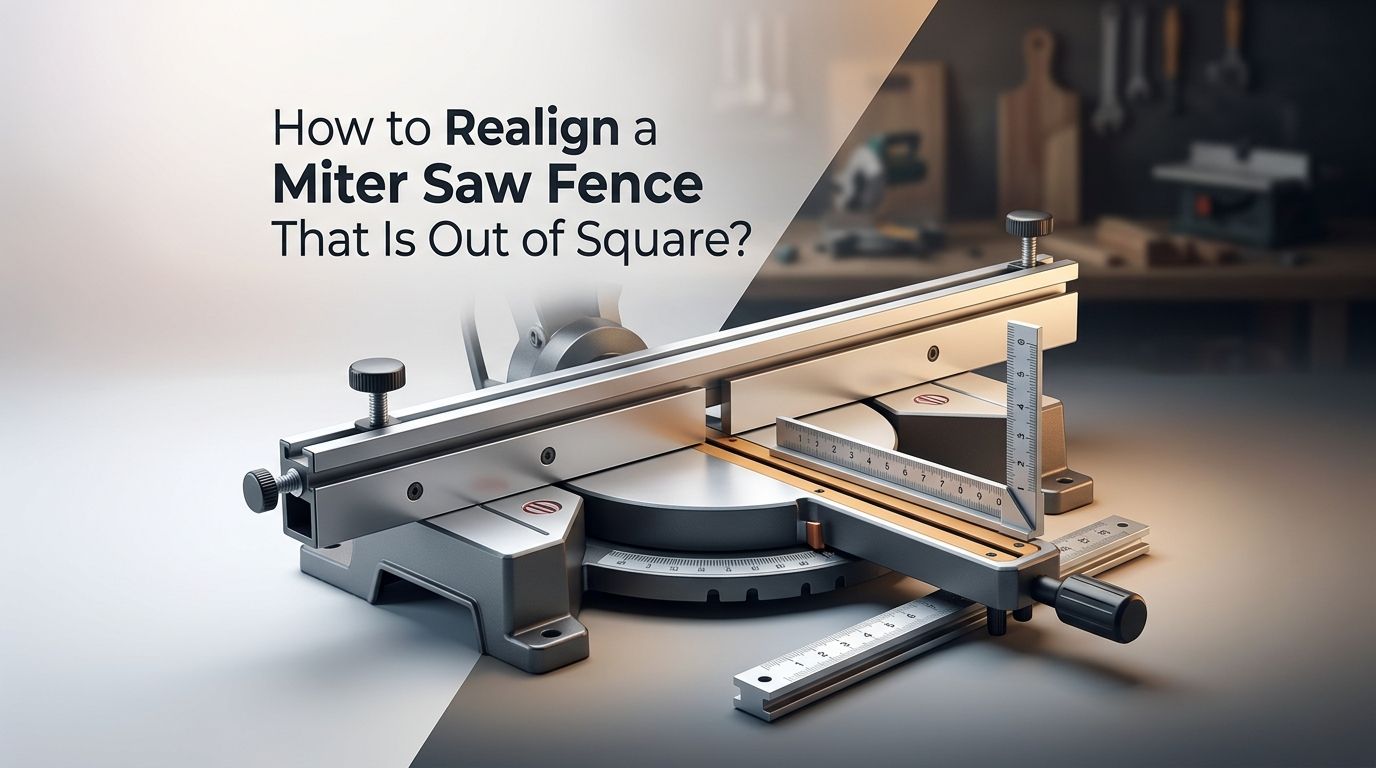
How to Realign a Miter Saw Fence That Is Out of Square?
Let me start with a frustrating scenario. You line up your workpiece, make a careful cut, and the angle is off. Your joints don’t meet flush. Your picture frames have gaps. Your trim work looks sloppy. The problem? Your miter saw fence is out of square.
This is one of the most common issues woodworkers face, and it can ruin an entire project if left unchecked.
A fence that sits even half a degree off from 90 degrees will produce inaccurate cuts every single time. The good news is that this is a fixable problem. You do not need to buy a new saw or take it to a repair shop in most cases.
In a Nutshell
- A miter saw fence must form a perfect 90 degree angle with the blade to produce accurate crosscuts. Even a tiny deviation will compound over longer workpieces and result in visible gaps in your joinery.
- You can check your fence alignment using a reliable square, a digital angle gauge, or the five cut method. Each approach has a different level of precision, and combining two methods gives you the most reliable result.
- Most miter saw fences can be adjusted using the bolts or screws that attach the fence to the saw’s base. These fasteners are usually located underneath or behind the fence. Loosening them allows you to shift the fence into the correct position.
- Shimming is a practical backup solution when the built in adjustment range is not enough. Thin pieces of aluminum tape, brass shim stock, or even painter’s tape can correct minor alignment issues quickly.
- Always verify your adjustment with a test cut on scrap wood. A square reading alone can be misleading due to blade runout or slight warping in your reference square.
- Regular maintenance prevents fence misalignment from recurring. Sawdust buildup, loose bolts, and vibration from repeated use all contribute to a fence drifting out of square over time. A quick check every few weeks saves hours of frustration.
Why Does a Miter Saw Fence Go Out of Square
Understanding the root cause helps you prevent the problem from returning. Miter saw fences shift out of alignment for several reasons. The most common cause is vibration. Every cut you make sends small vibrations through the entire tool. Over weeks and months, these vibrations can loosen the bolts that hold the fence in place.
Another frequent culprit is sawdust buildup. Fine dust particles collect between the fence and the base. This creates a tiny wedge that pushes the fence out of position. Many woodworkers overlook this simple issue.
Transport and storage also play a role. If you move your saw between job sites or bump it while rearranging your shop, the fence can shift. Some lower cost saws have fences that are held in place with minimal hardware, making them more prone to movement.
Finally, manufacturing tolerances vary. Not every miter saw arrives perfectly square from the factory. Checking alignment on a brand new saw is always a smart first step before starting any project.
Tools You Need to Check and Adjust the Fence
Before you start any adjustment, gather the right tools. You do not need anything expensive or specialized. A reliable combination square or machinist square is the most important item. Choose one that you trust. Cheap squares can themselves be inaccurate, which defeats the entire purpose.
A digital angle gauge is a helpful addition. These small devices attach magnetically to your blade and give you a precise reading. They typically measure to within 0.1 degrees.
You will also need basic hex wrenches or socket wrenches to loosen and tighten the fence bolts. Check your saw’s manual to find the correct sizes. Most saws use metric or standard hex bolts in the 4mm to 6mm range.
Keep shim material on hand. Aluminum foil tape, brass shim stock, or layers of painter’s tape all work well. A flashlight helps you see behind and beneath the fence where bolts may be hidden. Finally, have some scrap wood ready for test cuts.
How to Check if Your Fence Is Out of Square
The first step is confirming that your fence actually needs adjustment. Place your combination square flat against the fence so that the ruler extends straight toward the blade. The ruler should run parallel to the side of the blade body. Do not let the ruler touch the teeth, as the carbide tips have a slight set that will give a false reading.
Look for any gap between the square’s ruler and the blade. Even a small sliver of light indicates the fence is not at 90 degrees. Rotate the blade by hand to check against multiple points, since individual teeth or slight blade warping can affect your reading.
Pros of the combination square method: It is fast, affordable, and requires no batteries or calibration. Cons: The accuracy depends entirely on the quality of your square. A $5 square from a bargain bin may not be reliable.
For greater precision, use the five cut method, which we will cover in a later section. This mathematical approach eliminates reliance on a reference tool and gives you a measurable error.
How to Adjust the Fence Using Built In Adjustments
Most miter saws have a built in way to adjust the fence. The fence is usually attached to the base with two or more bolts. These bolts sit in slotted holes that allow the fence to slide slightly in either direction.
Start by setting your saw to the 0 degree miter position. Lock the turntable firmly. Now loosen the fence bolts just enough to allow movement. Do not remove them completely. You want the fence to shift with gentle pressure but not flop around freely.
Place your square against the fence and blade. Gently tap or push the fence until the square shows no gap on either side. This requires patience. Small movements make a big difference.
Once the fence looks square, tighten the bolts gradually. Alternate between bolts to apply even pressure. Check your square again after tightening, because the act of tightening can pull the fence slightly out of position.
Pros: This method uses the saw’s own design and requires no extra materials. Cons: Some saws have very limited adjustment range, and the slotted holes may not allow enough movement to correct larger errors.
How to Shim a Miter Saw Fence for Fine Adjustments
Shimming is an excellent technique when the built in adjustment range falls short. The idea is simple. You place a thin material between the fence and its mounting surface to push one end of the fence slightly forward or backward.
Aluminum foil tape is a popular choice because it is thin, durable, and easy to layer. Each layer adds roughly 0.002 inches of thickness. You can stack layers to increase the correction. Brass shim stock is another reliable option and is available in precise thicknesses from most hardware stores.
To shim your fence, first identify which end needs to move. If the right side of the fence is too far back, place shim material behind the right mounting point. Loosen the bolt, insert the shim, and retighten. Check with your square and make test cuts.
Pros of shimming: It provides extremely fine control. You can dial in adjustments at the thousandths of an inch level. Cons: Shims can compress or shift over time, especially tape. You may need to recheck the alignment periodically and replace the shim material.
The Five Cut Method for Precision Alignment
The five cut method is the gold standard for checking and achieving perfect fence alignment. It does not rely on the accuracy of any square or gauge. Instead, it uses math to reveal the exact error in your setup.
Here is how it works. Take a piece of plywood roughly 12 inches wide and 24 inches long. Label the edges 1 through 4. Make a crosscut on each edge, rotating the board 90 degrees after each cut. After four cuts, you will have trimmed all four edges.
Now flip the board so the last cut edge faces the fence and make a fifth cut, removing a narrow strip. Measure the width of this strip at both ends. The difference in width tells you exactly how far off your fence is.
Divide the difference by four, and you get the error per cut. This number shows you how much to adjust your fence. The method is incredibly precise and repeatable.
Pros: It gives a mathematical, objective measurement. It eliminates tool error from squares. Cons: It takes more time and requires a few calculations. Beginners may find it confusing on the first attempt.
How to Check the Blade Is Not the Problem
Before blaming the fence, make sure the blade itself is not causing the issue. A warped, dull, or improperly installed blade can produce cuts that appear out of square even when the fence is perfectly aligned.
Remove the blade and lay it on a known flat surface like a piece of glass or a machinist’s granite block. A warped blade will rock or wobble on the flat surface. Replace any blade that shows visible warping.
Check the blade’s arbor hole and flange. Sawdust trapped between the blade and the flange will tilt the blade slightly, producing angled cuts. Clean both surfaces thoroughly before reinstalling.
Also inspect the blade guard and any stabilizers. These parts should move freely and not press against the blade. A dragging guard can deflect the blade during a cut, creating an uneven kerf. Rule out all blade related issues before spending time on fence adjustments.
How to Align the Fence on a Sliding Miter Saw
Sliding miter saws have an extra layer of complexity. The sliding rails must be parallel to the blade, and the fence must be perpendicular to both the blade and the direction of travel. If the rails are out of alignment, the fence adjustment alone will not fix your cuts.
Start by checking the slide rails for play or looseness. Lock the slide mechanism and check for any wobble. Adjust the rail tension according to your saw’s manual. Most saws have set screws or gibs that control rail play.
Next, follow the same fence alignment process described earlier. On a sliding saw, you also need to verify that the blade path stays true through the entire length of the slide. Make a shallow scoring cut in a wide board and check if the kerf is consistent from front to back.
Pros of thorough sliding saw alignment: You get accurate cuts across the full capacity of the saw. Cons: The process takes longer, and some sliding saws have limited rail adjustment options, making perfect alignment difficult without professional help.
How to Keep Your Miter Saw Fence Square Over Time
Prevention is always easier than repair. Develop a habit of checking your fence alignment regularly. A quick test with a combination square every few weeks takes less than a minute and catches problems early.
Keep your saw clean. Blow out sawdust from behind and beneath the fence after every work session. Dust buildup is the silent enemy of fence alignment. A shop vacuum or compressed air works well for this task.
Tighten all fence bolts periodically. You do not need to crank them down with excessive force. Firm and snug is enough. Over tightening can strip the threads or crack the fence casting.
If you transport your saw, consider building a dedicated stand or case that protects the fence during movement. Bumps and drops during transport are a major cause of alignment loss. Store the saw in a dry environment to prevent rust on the adjustment surfaces.
Common Mistakes to Avoid During Fence Realignment
Several mistakes can sabotage your alignment efforts. The first is using a cheap or unchecked square as your reference. Always verify your square against a known straight edge or use the five cut method to eliminate this variable.
Another common error is adjusting the fence with the miter lock loose. The turntable must be locked firmly at 0 degrees before you adjust the fence. Any play in the turntable will make your readings inconsistent.
Do not rush the tightening process. Snugging one bolt fully before touching the other will pull the fence out of position. Alternate between bolts and tighten in small increments.
Some woodworkers forget to check both sides of the fence. Most miter saw fences have a left and right section. Both sides need to be in the same plane. If one side is further forward than the other, your workpiece will not sit flat, and your cuts will be off.
Finally, avoid ignoring the problem. A fence that is off by half a degree creates a gap of about 1/16 inch over 8 inches. That error is very visible in finished work.
When to Consider Professional Help or Replacement Parts
Sometimes a fence is damaged beyond simple adjustment. Cracks in the fence casting, stripped bolt holes, or worn adjustment slots all limit your ability to achieve accurate alignment. Inspect these areas carefully before investing time in adjustments that may not hold.
If your saw is still under warranty, contact the manufacturer. Many brands will send replacement fence assemblies at no cost. This is especially common with casting defects or premature wear.
For older saws, aftermarket fence systems are available from several manufacturers. These bolt on replacements often provide better rigidity and finer adjustment than the original parts. Check woodworking forums and review sites for recommendations specific to your saw model.
A local tool repair shop can also help. They have precision instruments and experience with many saw brands. The cost of a professional alignment is typically modest and may be worthwhile if you have tried everything else without success.
Final Thoughts on Getting a Perfect 90 Degree Fence
A properly aligned miter saw fence is the foundation of accurate crosscutting. Without it, no amount of skill or expensive blades will save your cuts. The adjustment process is straightforward and accessible to woodworkers at every skill level.
Start with a good diagnostic check using a trusted square or the five cut method. Make adjustments using your saw’s built in hardware first. Use shims for fine tuning. Verify every adjustment with test cuts on scrap wood. Then maintain your alignment through regular cleaning and inspection.
The entire process typically takes 15 to 30 minutes. That small investment of time will pay off in tighter joints, cleaner cuts, and less wasted material. Your projects will look more professional, and you will feel more confident at the saw.
Take the time to get this right. Your future self, standing in front of a perfectly mitered picture frame or a flawless crown molding joint, will thank you.
Frequently Asked Questions
How often should I check my miter saw fence alignment?
Check your fence alignment at least once a month during regular use. If you transport your saw between locations, check it every time you set up. A quick test with a combination square takes under a minute and catches small errors before they affect your projects. Frequent users who make hundreds of cuts per week should check more often.
Can I use a speed square to check fence alignment?
A speed square can give you a rough indication, but it is not precise enough for fine alignment work. Speed squares are stamped from sheet metal and can have small inaccuracies. A machinist square or a high quality combination square will give you far more reliable results. For the best accuracy, use the five cut method.
Why are my cuts still off after I squared the fence?
Several other factors can cause inaccurate cuts even with a square fence. Check your blade for warping, your miter detent for accuracy, and your workpiece for consistent contact with the fence. Also verify that the blade guard is not deflecting the blade during the cut. Each of these issues can produce errors that mimic a misaligned fence.
Is it worth buying a digital angle gauge for fence alignment?
A digital angle gauge is a worthwhile investment if you do frequent precision work. These gauges typically cost between $25 and $40 and measure angles to within 0.1 degrees. They are especially useful for setting bevel angles and checking blade to fence relationships. However, a good square and the five cut method can achieve similar accuracy at lower cost.
What should I do if my fence bolts are stripped?
Stripped fence bolts or bolt holes require more than a simple adjustment. You can try using a slightly larger bolt with a washer if the hole allows it. For stripped threads in the casting, a thread repair insert or helicoil kit can restore the threads. If the damage is severe, contact the manufacturer for a replacement fence assembly or consult a tool repair professional.

Hi, I’m Leah Ray — the voice behind CraftBench Vault. I’m a passionate woodworking enthusiast dedicated to reviewing the best wood cutting tools and woodworking products. Through honest research and hands-on experience, I help fellow crafters make smarter buying decisions. Welcome to my workshop!