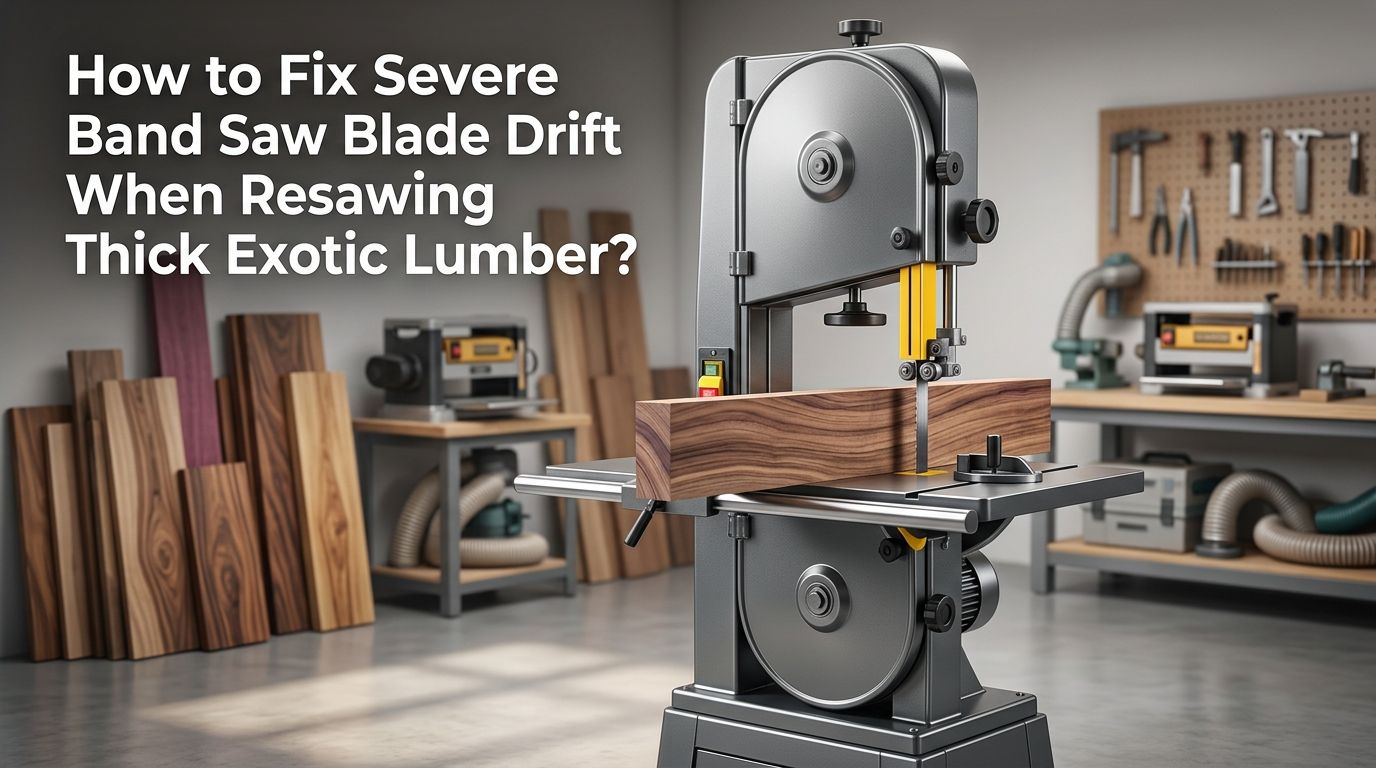
How to Fix Severe Band Saw Blade Drift When Resawing Thick Exotic Lumber?
Band Saw Blade: You just loaded a beautiful piece of 8/4 bubinga onto your band saw table. You start the cut, and within two inches, the blade wanders off your line like it has a mind of its own. The result?
Wasted wood, uneven slabs, and pure frustration. Blade drift during resawing is one of the most common problems woodworkers face, and it gets dramatically worse with thick, dense exotic species.
Exotic hardwoods like purpleheart, ipe, and cocobolo present unique challenges. Their extreme density, interlocked grain, and high resin content push standard band saw setups past their limits.
Key Takeaways
- Blade choice is the single biggest factor in eliminating drift during resawing. A wide blade (1/2 inch to 3/4 inch) with 2 to 4 teeth per inch provides the beam strength and chip clearance needed for thick exotic stock. Narrow blades with fine teeth will always struggle with deep cuts in dense wood.
- Proper blade tension prevents deflection under load. Most built in tension gauges read low for resawing. You should tension your blade until it deflects only about 1/4 inch under firm finger pressure midway between the wheels. Under tensioned blades are the second most common cause of drift.
- Wheel alignment and coplanarity matter more than most woodworkers realize. If your upper and lower wheels are not in the same plane, the blade will always want to pull to one side. Checking coplanarity with a straightedge takes five minutes and can eliminate drift entirely.
- Your fence must match the blade’s natural lead angle. Every blade has a slight tendency to cut at an angle. Setting your fence parallel to the miter slot may actually cause drift. Instead, find the blade’s lead angle with a test cut and set your fence to match it.
- Feed rate and blade cleanliness directly affect cut quality. Pushing too fast through dense exotics overloads the teeth and causes the blade to bow. Resin buildup on the blade dulls the teeth unevenly and creates one sided cutting pressure. Clean your blade often and feed at a moderate, steady pace.
- Guide bearings above and below the table must be set precisely. Loose or misaligned guides allow the blade to twist under cutting pressure. This is especially critical with exotic wood because the higher cutting resistance amplifies any weakness in your setup.
What Causes Band Saw Blade Drift in the First Place
Blade drift happens when the saw blade does not cut in a straight line parallel to the fence. The cut veers to the left or right, producing tapered or curved slabs. Several factors work together to cause this problem.
The most common cause is uneven tooth sharpness. If the teeth on one side of the blade are sharper or have more set than the other side, the blade will pull in that direction. This happens naturally as a blade wears, especially in abrasive exotic woods that dull teeth quickly.
Insufficient blade tension is the second major cause. A loose blade deflects sideways under cutting pressure. The deeper the cut and the harder the wood, the more lateral force acts on the blade. Exotic lumber pushes back harder than domestic species, so tension that works for pine will fail for ipe.
Misaligned wheels also contribute to drift. If the upper and lower wheels are not coplanar, the blade enters the cut at a slight angle. Poor guide bearing setup compounds this problem by allowing the blade to twist freely under load. Understanding these root causes is essential before you can apply the right fix.
Choose the Right Blade Width and Tooth Count
Blade selection is your most powerful tool against drift. A blade that is too narrow or has the wrong tooth count will drift no matter how well you tune your saw.
For resawing thick exotic lumber, use the widest blade your saw accepts. On a 14 inch band saw, this is usually 3/4 inch. On smaller saws, a 1/2 inch blade is the practical maximum. Wide blades have greater beam strength, which means they resist sideways deflection much better than narrow blades.
Tooth count matters just as much. Choose a blade with 2 to 4 teeth per inch (TPI) for resawing. These coarser teeth have large gullets that clear sawdust efficiently. Dense exotic woods produce fine, heavy dust that packs gullets quickly. If the gullets fill up, the blade stalls, overheats, and drifts.
Variable tooth pitch blades (such as 2/3 TPI or 3/4 TPI) reduce vibration and produce smoother cuts in hardwoods. They also lower noise during long resaw sessions.
Pros of wide, coarse blades: Better beam strength, efficient chip removal, less drift, and cooler running.
Cons of wide, coarse blades: Wider kerf wastes slightly more wood, rougher surface that requires planing, and they need more motor power to drive.
Set Blade Tension Correctly for Deep Cuts
Most band saw drift problems trace back to low blade tension. Factory tension gauges on band saws are often inaccurate, and the settings marked for each blade width are usually too low for serious resawing.
Here is how to set tension properly. First, install your blade and back off all guide bearings so they do not contact the blade. With the saw unplugged, add tension while pressing the blade sideways with your finger midway between the wheels. You want the blade to deflect about 1/4 inch on saws with 6 inch resaw capacity and about 3/8 inch on saws with 12 inch capacity.
The blade should feel firm and springy. It should resist your push and snap back quickly. A properly tensioned blade will produce a higher pitched ping when you pluck it, while an under tensioned blade will give a low, dull thud.
Pros of higher tension: Straighter cuts, less drift, reduced blade flutter, and cleaner surfaces.
Cons of higher tension: Faster tire wear, increased stress on the saw frame, and potential for blade fatigue if left tensioned overnight. Always release tension when the saw is not in use.
Check Wheel Coplanarity and Alignment
Wheel alignment is an often overlooked cause of severe drift. If your upper and lower wheels are not in the same plane (coplanar), the blade will always track at an angle. This creates a built in drift that no amount of fence adjustment can fully correct.
To check coplanarity, remove the blade and hold a long straightedge across both wheels at the rim. The straightedge should contact both wheels evenly. If you see a gap at one wheel, that wheel is offset. On many saws, you can fix this by adding thin shims behind the wheel or adjusting the upper wheel’s tilt mechanism.
Check the wheel tires at the same time. Worn, cracked, or uneven tires cause tracking problems. A tire with a flat spot or hardened rubber will make the blade wander. Replace tires that show visible wear.
Also verify that the upper wheel tilts smoothly and holds its position. A loose tilt adjustment lets the wheel shift during operation, causing intermittent drift. Tighten any loose bolts or replace worn adjustment mechanisms.
Pros of coplanarity correction: Eliminates a root cause of drift, improves blade life, and makes all other adjustments more effective.
Cons of coplanarity correction: Can be time consuming on older saws and may require aftermarket shims or parts.
Adjust Guide Bearings Above and Below the Table
Guide bearings keep the blade stable during the cut. They prevent the blade from twisting sideways and from being pushed backward. If they are set incorrectly, the blade can flex under the heavy load of resawing exotic wood.
Start with the side guide bearings. These should sit just behind the blade gullets, not on the teeth. Position them so a thin piece of paper barely fits between each guide and the blade body. The blade should spin freely without touching the guides, but the guides should engage immediately when cutting pressure is applied.
Next, set the thrust bearings (rear bearings). Position each thrust bearing about 1/64 inch behind the back edge of the blade. The blade should not ride on the thrust bearing during free running. It should only contact the bearing when you push wood into the blade.
Repeat this setup for both the upper and lower guide assemblies. Many woodworkers forget the lower guides, but they are equally important. If you have traditional steel block guides, consider upgrading to roller bearing guides or graphite impregnated guide blocks. These reduce friction and heat, which helps the blade run cooler and last longer in dense exotics.
Pros of precise guide setup: Eliminates blade twist, improves cut accuracy, and extends blade life.
Cons of precise guide setup: Requires patience and must be repeated each time you change blades.
Find and Set the Blade’s Lead Angle
Every band saw blade has a natural lead angle. This is the direction the blade wants to cut, and it is rarely perfectly parallel to your miter slot. Fighting this natural tendency causes drift. Working with it eliminates drift.
To find the lead angle, take a flat piece of scrap hardwood about 2 to 3 feet long with one jointed edge. Draw a straight line parallel to that edge. With the saw running, freehand cut along the line without using a fence. Adjust your feed direction until the blade tracks exactly on the line. Once you are cutting straight along the line for 4 to 5 inches, stop and hold the wood still. Turn off the saw.
Now mark a pencil line on the saw table along the jointed edge of the scrap piece. This line represents your blade’s lead angle. Set your rip fence parallel to this pencil line. This alignment lets the blade cut the way it wants to cut, producing straight results.
Some woodworkers prefer a point block fence instead of a flat fence. A point block is a rounded fence face that allows small steering corrections during the cut. This works well for occasional resawing but lacks the repeatability of a properly aligned flat fence.
Pros of lead angle alignment: Produces very straight cuts, repeatable results, and minimal waste.
Cons of lead angle alignment: Must be recalibrated each time you install a new blade, and the angle may shift as the blade wears.
Control Your Feed Rate for Exotic Hardwoods
Feed rate is the speed at which you push wood into the blade. Too fast and the blade bows under pressure. Too slow and the teeth rub instead of cutting, generating heat and accelerating dulling. Exotic hardwoods demand a careful balance.
The general rule for resawing dense exotics is to push with one finger. If your finger gets sore, you are pushing too hard. Let the blade do the work. The cut should produce a steady stream of sawdust, not packed chips or smoke.
Watch the surface of the cut as it emerges. Pronounced diagonal tooth marks mean you are feeding too fast. A burnished, glassy surface means you are feeding too slowly and the blade is rubbing. A good feed rate produces a lightly textured surface with small, even tooth marks.
Dense species like ipe, lignum vitae, and ebony require significantly slower feed rates than domestic hardwoods. Expect resawing to take two to three times longer than cutting the same thickness of soft maple. Patience here saves wood and blades.
Pros of controlled feed rate: Straighter cuts, smoother surfaces, longer blade life, and less heat buildup.
Cons of controlled feed rate: Slower production speed, which can be frustrating on large projects.
Keep Your Blade Clean During Resaw Sessions
Many exotic woods contain high levels of natural resins, oils, and extractives. Cocobolo, rosewood, and teak are especially bad. These substances bake onto the blade body and teeth during cutting, forming a hard crust that changes the blade’s cutting behavior.
Resin buildup does two things. First, it effectively dulls the teeth by coating them with gummy material. Second, it can build up unevenly, creating more friction on one side of the blade than the other. This uneven friction pulls the blade sideways and causes drift.
Clean your blade before every resawing session and again during long sessions. A Scotch Brite pad soaked in mineral spirits removes light buildup. For heavier deposits, use a commercial blade and bit cleaner spray. Remove the blade from the saw, spray it down, wait a few minutes, and wipe clean.
Applying a dry lubricant or blade coating product before cutting resinous species helps prevent buildup from forming in the first place. This small step makes a big difference in cut quality and blade longevity.
Use the Right Blade Material for Exotic Species
Standard carbon steel blades work fine for domestic softwoods and mild hardwoods. Exotic species present a tougher challenge. Their extreme density, abrasive silica content, and interlocked grain wear down carbon steel teeth quickly.
Bi metal blades use a high speed steel tooth edge welded to a flexible carbon steel body. They hold their sharpness three to five times longer than carbon steel in dense exotics. The longer edge life means more consistent tooth geometry, which directly reduces drift over time.
Carbide tipped blades represent the top tier for exotic lumber resawing. They use C4 tungsten carbide teeth that can cut for months in the hardest species. Carbide blades produce extremely smooth surfaces and maintain their lead angle far longer than any other blade type.
Pros of bi metal blades: Longer life than carbon steel, moderate cost, widely available, and good performance in most exotics.
Cons of bi metal blades: More expensive than carbon steel and cannot be resharpened at home.
Pros of carbide tipped blades: Exceptional longevity, very smooth cuts, and minimal drift over long use.
Cons of carbide tipped blades: High initial cost, require professional resharpening, and can damage guides if improperly set up.
Reduce Heat Buildup in Dense Cuts
Heat is the hidden enemy of straight resawing. As the blade cuts through thick exotic wood, friction generates significant heat in the kerf. This heat can soften the blade’s temper, dull the teeth prematurely, and cause the blade body to expand unevenly. All of these effects increase drift.
Several strategies reduce heat buildup. First, make sure your blade teeth have adequate set for the species. Set is the amount each tooth is bent outward, and it creates clearance between the blade body and the wood. Too little set means the blade body rubs against the cut walls, generating friction heat.
Second, use a blade lubricant stick or wax block. Press the lubricant against the blade while the saw is running (away from the teeth). This reduces friction between the blade body and the wood.
Third, consider making relief cuts for very thick stock. Cut halfway from each side rather than making a single full depth pass. This gives the blade a break and allows heat to dissipate.
Fourth, let the blade cool between cuts on long sessions. Running a dense exotic through a 12 inch deep cut generates tremendous heat. A brief pause protects your blade and produces better results.
Prepare Your Lumber Before Resawing
Proper stock preparation prevents many drift problems before they start. Exotic lumber often arrives with rough, uneven surfaces and edges that make consistent feeding impossible.
Joint one face and one edge before resawing. The jointed face rides against your fence, and the jointed edge sits flat on the table. Without these reference surfaces, the stock can rock or shift during the cut, pushing the blade off course.
Check the wood for internal stresses by making a shallow rip cut on a table saw and watching if the kerf opens or closes. Stressed wood will move during resawing and cause drift that has nothing to do with your saw setup. If the wood is stressed, let it rest after each cut to equalize before making the next pass.
Also inspect the wood for hidden defects like knots, voids, or changes in grain direction. Interlocked and wavy grain, common in species like sapele and African mahogany, can deflect the blade mid cut. Slow your feed rate in these areas and let the blade find its path.
Troubleshoot Persistent Drift Problems
Sometimes you do everything right and the blade still drifts. Here is a systematic troubleshooting approach.
Step 1: Install a brand new blade. A worn blade is the most common cause of persistent drift. Even if your current blade looks fine, the teeth may be unevenly worn from previous cuts in abrasive exotic wood.
Step 2: Recheck tension with the new blade installed. New blades often need different tension settings than worn blades.
Step 3: Verify wheel coplanarity again. Temperature changes in the shop can cause slight shifts in wheel alignment on some saws.
Step 4: Inspect the table for flatness. A warped table tilts the workpiece and creates an angled cut that mimics drift. Use a reliable straightedge across the table surface in multiple directions.
Step 5: Confirm the table is square to the blade. Use a small square against the blade body (between the teeth) and the table surface. Even a half degree of tilt creates significant taper in a deep resaw cut.
If drift persists after all these checks, the problem may be your saw’s frame flexing under load. Smaller 14 inch saws sometimes lack the frame rigidity for deep resawing in exotic hardwoods. In this case, reducing the depth of cut or upgrading to a larger saw may be the only solutions.
Build a Resaw Sled for Maximum Control
A resaw sled gives you superior control over thick, heavy pieces of exotic lumber. It holds the workpiece firmly and feeds it past the blade at a consistent angle and speed.
Build the sled from a flat piece of 3/4 inch plywood that rides in your miter slot. Attach a tall, straight fence to one side. The fence should be high enough to fully support your workpiece. Add a clamp or toggle mechanism to hold the wood firmly against the fence face.
The sled eliminates several sources of drift at once. It prevents the workpiece from rocking on the table. It ensures a consistent feed angle. And it keeps your hands safely away from the blade during the entire cut.
For repeatable thickness cuts, attach an adjustable stop to the sled that positions the wood at a fixed distance from the blade. This lets you slice multiple pieces of identical thickness without measuring each time.
Pros of a resaw sled: Superior control, consistent results, increased safety, and repeatable thickness.
Cons of a resaw sled: Takes time to build, may not fit all band saw configurations, and adds setup time for each session.
Frequently Asked Questions
Why does my band saw blade drift only with certain species of wood?
Different wood species have different densities, grain structures, and resin content. Dense exotics push back against the blade with more force than softer woods. Interlocked grain can deflect the blade mid cut. Resinous species coat the teeth and create uneven cutting pressure. A blade that cuts perfectly in poplar may drift badly in purpleheart because the cutting demands are completely different. You need more tension, a sharper blade, and a slower feed rate for harder species.
How often should I replace my band saw blade for exotic lumber resawing?
This depends on the blade material and the wood species. A carbon steel blade may last only a few hours in abrasive exotics like teak or ipe. Bi metal blades typically last three to five times longer. Carbide tipped blades can run for weeks or months under the same conditions. Replace or sharpen the blade as soon as you notice increased drift, slower cutting, or burn marks on the wood surface.
Can I eliminate drift entirely or is some drift always normal?
A properly tuned band saw with a sharp, well tensioned blade can cut with virtually zero drift. Drift is not an inherent feature of band saws. It is a symptom of a setup, blade, or alignment problem. If you follow the steps in this guide, you should be able to achieve cuts that need only one pass through a thickness planer to produce flat, consistent slabs.
Does blade speed affect drift during resawing?
Yes. Most band saws designed for woodworking run at blade speeds between 2500 and 3000 surface feet per minute. Some saws offer variable speed control. For very dense exotics, a slightly lower blade speed can reduce heat buildup and improve cut quality. However, blade speed alone rarely causes drift. Focus on tension, blade selection, and guide setup first.
Should I use a single point fence or a flat fence for resawing exotics?
Both work, but they serve different purposes. A single point (curved) fence lets you steer the cut in real time, which is useful for occasional resawing or working with highly figured wood. A flat fence set to the blade’s lead angle produces more consistent, repeatable results and is better for production resawing. If you resaw exotics regularly, invest the time in setting a flat fence to the correct lead angle.

Hi, I’m Leah Ray — the voice behind CraftBench Vault. I’m a passionate woodworking enthusiast dedicated to reviewing the best wood cutting tools and woodworking products. Through honest research and hands-on experience, I help fellow crafters make smarter buying decisions. Welcome to my workshop!